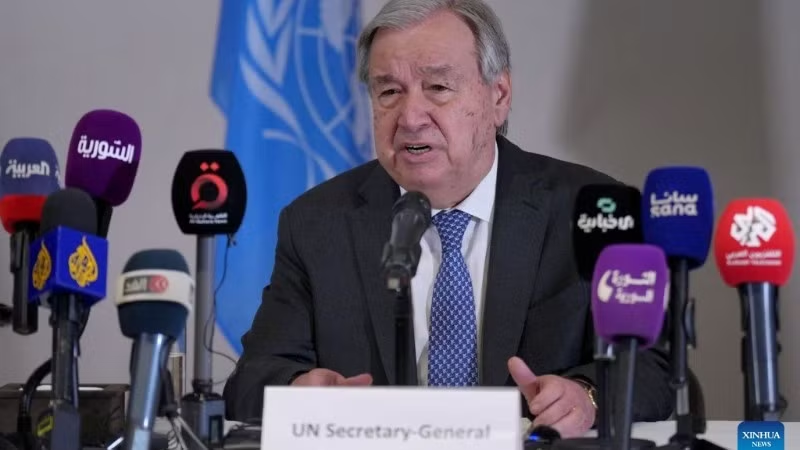
The official visit to the Middle Eastern country by the head of the world's largest multilateral organisation was intended to demonstrate the international community's support for the Syrian people's determination to rise from the ashes of war.
It was also the first visit to Syria by the UN's highest-ranking official since former UN Secretary-General Ban Ki Moon visited the country 17 years ago, in 2009.
The visit attracted widespread international attention as Syria has recently shown several positive developments. Its reform efforts have been highly appreciated, its determination to rebuild the country after the devastation of civil war has been welcomed, and its position and international cooperative relations have gradually been restored.
The three-day visit by Secretary-General Guterres reflects the international community's support for the efforts of the Syrian authorities and people to rebuild their country.
During talks with Syria's Interim President Ahmed al-Sharaa in the capital of Damascus, Guterres expressed his support through warm handshakes and friendly, approachable gestures.
The two leaders discussed Syria's transitional period, the country's reconstruction efforts, and the UN's supporting role in the recovery of the Middle Eastern nation following years of conflict.
Secretary-General Guterres once again reaffirmed the UN's commitment to standing alongside the Syrian people and supporting the political transition process, while stressing the importance of safeguarding the country's sovereignty, unity, and territorial integrity.
Guterres emphasised that the visit reflected international solidarity and reaffirmed the UN’s determination to "leave no one in Syria behind" at this critical turning point.
The visit became even more significant when the UN Secretary-General delivered an important address to the Syrian Parliament, as the legislative body had just convened its first session after many years of interruption.
He urged the removal of all remaining sanctions imposed on Syria and strongly called on the international community to support investment in infrastructure, education, healthcare, and creating livelihoods for its people.
The UN chief also called for greater efforts to enable Syrian refugees to return home safely. His visit came shortly after the Syrian authorities announced plans to implement the "Syria without refugee camps" initiative.
The initiative aims to end the need for people to live in temporary refugee camps by 2027 through economic reconstruction, infrastructure development, and support for the voluntary return of displaced people.
Towards this goal, Syria's Ministry of Emergency and Disaster Management stated that the country aims to eliminate the need for displaced people to live in temporary tent camps during 2026, creating sustainable livelihoods that will encourage them to return to their hometowns with confidence.
Syria is also accelerating the development of a national database on displaced people while working closely with the Office of the UN High Commissioner for Refugees (UNHCR), the World Bank (WB), and the Food and Agriculture Organisation of the UN (FAO) to promote community reintegration.
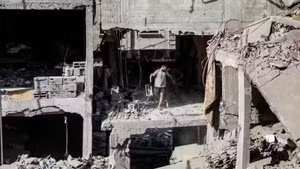
Rebuilding a country devastated by war is undoubtedly an enormous challenge and cannot be accomplished overnight. The determination of the Syrian authorities is justified and urgently needs the support of the international community.
Such international support is especially meaningful given that the Middle Eastern nation endured a 13-year conflict that claimed the lives of more than 500,000 people and forced millions from their homes.
The more than a decade of turmoil has resulted in one of the world's worst humanitarian crises.
It is hoped that the combined efforts of the Syrian authorities and the support of the international community will soon help erase the painful memories endured by the Syrian people.