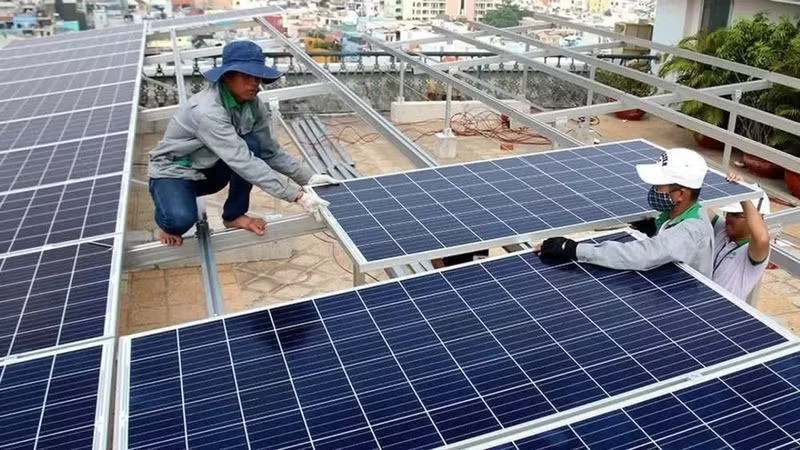
Solar energy was the fastest-growing renewable energy source over the past year, accounting for around 75% of the 692 GW of renewable energy capacity added worldwide. This marks a significant shift, positioning solar power as the most important source of new electricity generation capacity globally.
Most future growth potential lies in emerging and developing economies, where electricity demand is rising rapidly and solar power can be deployed much faster than conventional power systems.
Solar power is becoming a development tool for emerging economies. While fossil fuels have historically given an advantage to countries with large deposits, sunlight is widely available across the globe and is serving as a critical catalyst in the clean energy transition.
Power on the global energy map is shifting away from “who owns resources beneath the ground” towards “who can mobilise capital, land, power grids, and technology the fastest.”
As solar power becomes significantly cheaper than thermal power generation, it is forging a new development model. In Asia, economies such as India and Pakistan are witnessing a remarkable surge in solar power’s share of electricity generation, outpacing many wealthy countries.
India’s Cabinet recently approved Phase III of the Green Energy Corridor scheme, worth nearly 19.5 billion USD, to build transmission infrastructure for 135 GW of renewable energy capacity and deploy battery storage systems with a capacity of 50 GWh. The country is accelerating investment in grid infrastructure to seamlessly integrate these new capacities. The International Energy Agency (IEA) forecasts that solar power will meet around half of India’s additional electricity demand, positioning the South Asian nation as the world’s second-largest market for renewable energy growth.
Similarly, across sub-Saharan Africa, which boasts some of the world’s highest levels of solar irradiation, many countries are accelerating investment to achieve energy self-sufficiency. In Latin America, Brazil, which historically relied on hydropower, is rapidly developing solar power into the second pillar of its electricity system.
Meanwhile, countries that once built their geopolitical influence on oil and gas are pivoting into major solar investors. The IEA has upgraded its forecast for renewable energy growth in the Middle East and North Africa over the 2025–2030 period to around 23%, with Saudi Arabia spearheading the charge.
Experts predict that the global manufacturing landscape will be redrawn in the coming decades as industrial corporations increasingly seek out regions offering abundant, low-cost clean electricity.
Although current forecasts suggest that the world is unlikely to meet its target of tripling renewable energy capacity by 2030, the geopolitical significance of solar power extends far beyond capacity figures. This energy source could fuel a new power struggle, as industrial power shifts toward nations that master the technologies, supply chains, and capital needed to turn sunlight into electricity.