When solar power still waits for policy
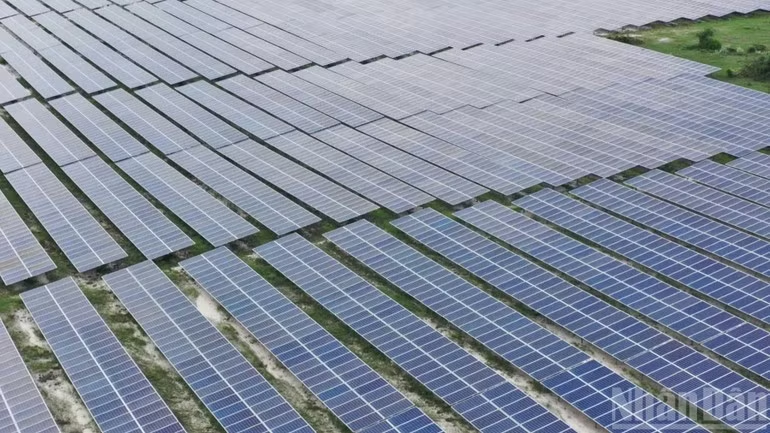
Solar power projects, once the star performers between 2019 and 2021, are now falling into a state of “freeze” due to unstable pricing frameworks and power purchase mechanisms. To date, investors and businesses still lack specific information on the pricing framework for rooftop solar power if implemented under the Direct Power Purchase Agreement (DPPA) mechanism. In practice, many parties continue to use the current retail electricity price as a basis for negotiation, but the legality of this approach has not yet been affirmed in any official legal document.
Nguyen Viet Dung, Vice Chairman of the Board of Directors of Halcom Viet Nam, shared: “Large power projects, from 100 to 500MW, require around five years of preparation. But the pricing framework is only effective for one to two years. When the validity period ends and the project is not completed in time, the opportunity is lost. Such short-term policies make it difficult for investors to take the initiative and prevent them from calculating long-term financial efficiency.”
According to many businesses, the current power purchase mechanism still has significant shortcomings, lacking clear regulations on grid connection, technical standards and procedures for selling electricity to the national grid. Although there are incentives for rooftop solar, they are not sufficiently attractive to encourage households and businesses to invest.
Dr Ha Huy Ngoc of the Viet Nam Institute of Economics provided a practical example: “At present, even when households or businesses install rooftop solar systems, they still struggle to sell excess electricity to the national grid due to requirements for registration, metering, invoicing… and the process remains complicated. As a result, many systems operate only internally, wasting the potential of providing green energy.”
When wind cannot yet be turned into electricity
While solar power projects face difficulties due to unstable purchase mechanisms and pricing frameworks, wind power projects are facing major obstacles in transmission. In the vast flatlands of the Mekong Delta—where giant wind turbines rise against the skies of Ben Tre, Tra Vinh and Vinh Long—renewable energy is expected to become a spearhead of green economic development.
Calculations by Power Construction Consulting Joint Stock Company No. 4 show that this region alone could harness nearly 3.9GW of wind power by 2030, helping transform the Mekong Delta into a renewable energy hub for the entire country. The region currently operates the Duyen Hai Power Centre with a capacity of over 4.5GW, along with nearly 700MW from 13 wind power plants and two solar power plants.
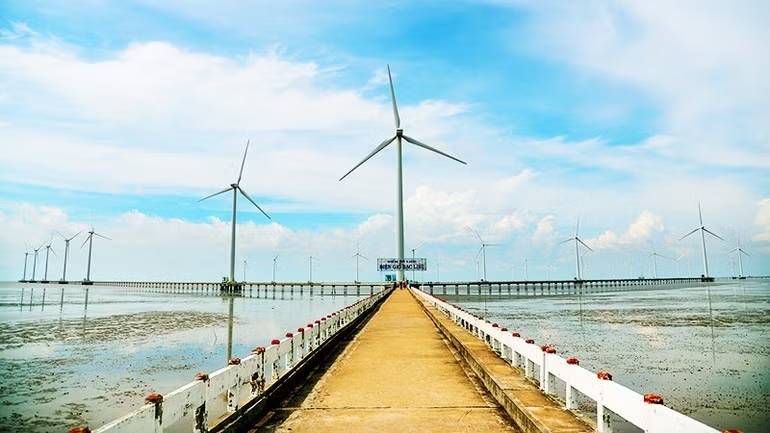
However, behind these promising figures lies a worrying reality. Many substations, particularly the 500kV Duyen Hai substation, are facing the risk of overloading by up to 150% when new projects come into operation between 2026 and 2030.
A representative of REE Corporation stated frankly: “We do not lack capital, nor do we lack operational capacity. But transmission projects face obstacles right from the legal stage, land clearance and decentralisation of authority. The time required to complete procedures is sometimes longer than the construction period itself.”
A special mechanism needed for transmission infrastructure
In light of this situation, many experts believe that Viet Nam needs a special mechanism for major electricity transmission projects, similar to the specialised mechanisms applied in transport and urban infrastructure.
Tran Viet Ngai, Chairman of the Viet Nam Energy Association, emphasised: “If transmission investment is not accelerated, renewable energy projects will continue to face output congestion. Transmission grids should be considered essential infrastructure, equivalent to transport, so that they receive appropriate preferential policies.”
Experts also believe that to promote sustainable rooftop solar development, the Government needs region-specific incentive policies. In the North, where the number of sunlight hours is lower—around 1,000 hours per year—additional support is needed to attract household investment. This would not only reduce dry-season power shortages but also help distribute energy supplies more evenly across the country. In addition, the State could apply green credit policies, allowing banks to earn Green Credit points when financing renewable energy projects.
This is both a financial incentive and a measure that spreads the spirit of sustainable development across the entire economic system. Renewable energy is not only an economic sector but also a symbol of Viet Nam’s commitment to green development, emission reduction and global responsibility. But for green electricity to truly reach every rooftop and factory, strong synchronisation between policy, infrastructure and development mindset is essential.
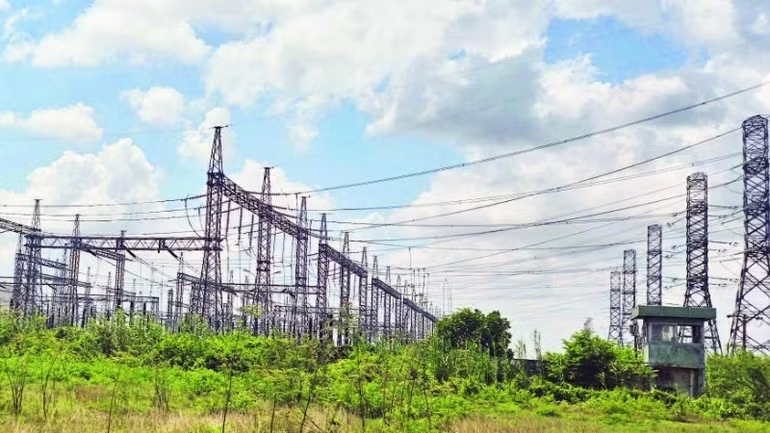
The solutions proposed by the Viet Nam Energy Association include:
• Assigning direct investment responsibilities to capable enterprises such as EVN and the National Power Transmission Corporation (NPT).
• Encouraging shared transmission infrastructure among investors to avoid each project building its own lines, which wastes land and resources.
• Prioritising investment in 220kV and 500kV transmission lines in regions with strong wind potential, especially the Mekong Delta.
• Developing large-scale Battery Energy Storage Systems (BESS) to reduce pressure on the grid during peak hours.
At the same time, experts recommend that the Government simplify investment procedures and implement a one-stop electronic system for renewable energy projects. In parallel, a separate Renewable Energy Law should be issued, independent from the Electricity Law, to create a clear, stable and long-term legal framework.






![[Infographic] GRDP growth scenarios for 34 provinces and cities in fourth quarter of 2026](https://en-cdn.nhandan.vn/images/nyM650OGFWrOVWc-xajqN-rTZ68Rlmc1fiGJOhBRYHFSa4DhrHNDxEFdnz313Vk5dNJuxdkHglPA3rLeaPeiaUheNuCI723k2lNssd-YLJuKR58epWq7s21lV5WjM-HR2-Qpbi4MwAzqt9wRjL4WjGkfEz7RO9qhcwg8o8LQFK8/grdp-growth-scenarios-for-34-provinces-and-cities-in-q42026-anh-dai-dien.jpg.avif)