Welcoming his Russian counterpart to the capital city of Maputo, Mozambique's foreign minister remarked that the country could almost be regarded as Lavrov's "second home", given the frequency of his visits. Mozambique is far from the only African nation receiving special attention from Russia. Moscow's growing diplomatic footprint across the continent is a clear demonstration of that commitment. In 2025 alone, Russia opened embassies in Niger, Sierra Leone, and South Sudan, with plans to establish further diplomatic missions in The Gambia, Liberia, Togo, and the Comoros.
In recent years, visits by senior Russian officials to Africa have become increasingly frequent. While each trip has its own specific objectives, they collectively reflect Moscow's determination to deepen a comprehensive partnership with African countries across key pillars including security, the economy, energy and diplomacy. Sergei Lavrov's latest tour was no exception. During meetings with leaders and officials in Ethiopia, Niger, Mozambique, and Burundi, the parties reached broad consensus on further strengthening ties between Russia and the four countries at both bilateral and multilateral levels.
Africa has in recent years attracted growing attention from major powers, including the US, India, Japan, and Germany. Russia is likewise positioning the continent as an important priority in its foreign policy. In a recent message marking Africa Day, Russian President Vladimir Putin said the continent had made remarkable progress in socio-economic development and was playing an increasingly prominent role in international affairs. Moscow, he stressed, attaches great importance to strengthening its long-standing friendships with African nations. Analysts believe this also aligns with Russia's broader strategy of expanding its network of partners to ease Western efforts to isolate the country, establish new supply chains, and maintain a balanced position in global affairs.
For Africa, Lavrov's visit and Moscow's continued support also carry considerable significance, particularly in the field of security. Speaking at the Russia–Alliance of Sahel States (AES) Ministerial Consultations, held during the tour, Lavrov reaffirmed that Moscow would continue assisting Sahel countries in enhancing the capabilities of their armed forces to counter the threat posed by extremist groups.
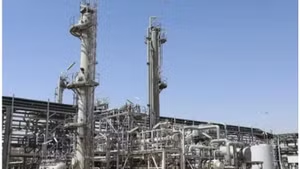
Russian cooperation is also evident across a wide range of African economic sectors, including energy, trade, mining, agriculture, and infrastructure. Russia's footprint in Africa's energy sector is reflected in numerous oil and gas projects, as well as a series of agreements to construct nuclear power plants. Moscow has supported Egypt in building the El Dabaa Nuclear Power Plant — the continent's first large-scale nuclear power project.
In terms of investment, Russia is not Africa's largest partner. However, analysts argue that what makes Moscow a welcome partner across the continent is its approach based on equality, mutual benefit, non-interference in internal affairs, and the absence of coercion or discrimination. African leaders have repeatedly stressed their desire to create added value within the continent, rather than simply exporting raw materials for processing elsewhere, where the bulk of the economic benefits are realised. Moscow has affirmed its readiness to support Africa in achieving that goal. Built on mutual respect, this foundation provides a solid basis for Russia and African countries to take their partnership to new heights in the years ahead.