The statement, made by Minister Budi Santoso on the sidelines of the BRICS Trade Ministers’ Meeting convened in Jaipur, India, on August 7, demonstrates a pragmatic approach amid profound shifts in the global geo-economic landscape towards greater South-South cooperation and market diversification.
Negotiations on a Comprehensive Economic Partnership Agreement (CEPA) between Indonesia and Mercosur had stalled due to internal differences among Mercosur member states, which currently comprise Brazil, Argentina, Paraguay, Uruguay, and Bolivia.
CEPA is a new-generation agreement requiring extensive commitments, ranging from substantial tariff cuts and the opening up of services and investment to non-tariff regulations, and labour and environmental standards.
Differences in the readiness of South American economies have complicated and prolonged efforts to reach consensus across the bloc. Therefore, the proposal to scale down the scope to a PTA underscores Indonesia’s flexible diplomatic approach.
Rather than remaining mired in comprehensive agreements that are unlikely to materialise in the short term, a PTA focuses on cutting tariffs on core strategic goods. This model allows the two sides to build trust and establish tangible trade flows before pursuing higher levels of economic integration.
Trade relations between Indonesia and Brazil, the largest economy in Mercosur, are expanding at an impressive pace. Bilateral trade reached 7 billion USD in 2025 and exceeded 3.53 billion USD in the first six months of 2026 alone.
However, considerable potential for cooperation remains due to their highly complementary trade structures. Indonesia exports vegetable oils, particularly palm oil, motor vehicle parts, electrical machinery, rubber products, and mineral fuels to Brazil.
Conversely, Brazil exports food-processing by-products, sugar, cotton, tobacco, metal ores, and agricultural inputs for the livestock sector to Indonesia. The PTA is designed to dismantle tariff barriers affecting these goods. Once tariff barriers are removed, supply-chain costs for both economies could fall significantly.
The prospects for an Indonesia–Mercosur PTA are substantial, but its practical implementation encounters formidable obstacles. The first is consensus within Mercosur. Brazil needs to persuade other member states, such as Argentina and Paraguay, to endorse the negotiating framework. Differences in domestic economic priorities among South American countries have always been Mercosur’s greatest challenge.
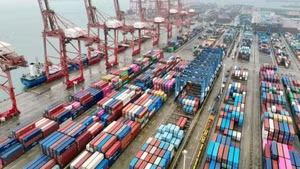
A further hurdle involves geographical distance and logistics costs. Shipping routes between Southeast Asia and South America are long and more expensive than routes within Asia or across the Pacific. If the PTA only delivers moderate tariff reductions, the resulting benefits could be offset by transport costs.
Finally, product competition remains an issue. Some agricultural and lightly processed goods from the two sides could create a degree of competitive pressure on sensitive domestic industries.
Indonesia’s proposal to establish a PTA with Mercosur through Brazil as a bridge is a practical, astute, and timely move.
It could help break the deadlock surrounding the complex CEPA negotiations and is expected not only to deliver direct economic benefits to Jakarta and Brasilia, but also to catalyse wider momentum and promote economic integration between ASEAN as a whole and Mercosur in the near future.