This is not only a race for the presidency, but also a fierce confrontation between two opposing political currents, reflecting deep divisions within the society of South America’s largest country.
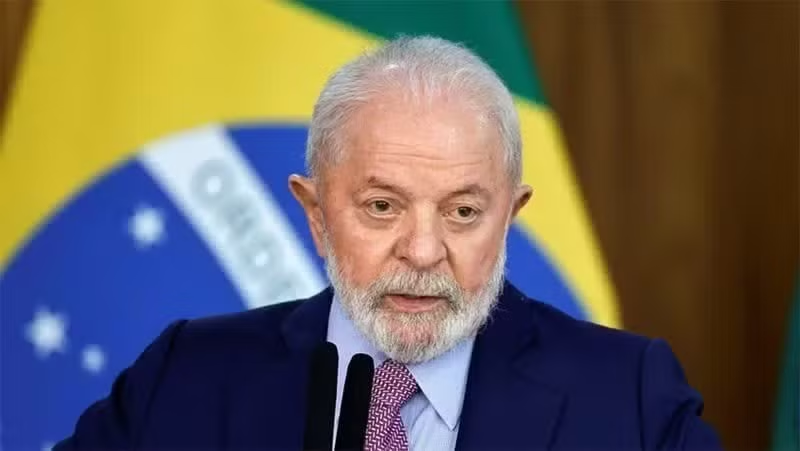
The campaign heralds Lula da Silva’s (Workers’ Party – PT) historic bid for a fourth presidential term.
At the age of 80, Lula da Silva positions himself as a seasoned politician representing the left, with policies focused on social reconstruction, protecting the Amazon rainforest, strengthening welfare, and combating poverty.
By contrast, former President Jair Bolsonaro’s ban from running for office and his legal penalties have paved the way for his 45-year-old son, Senator Flavio Bolsonaro (Liberal Party – PL), to assume the mantle of “Bolsonarism” — a conservative right-wing movement that advocates traditional family values, economic freedom and a tough stance on crime, while maintaining strong influence among agribusiness leaders and the Jewish and Evangelical communities.
Entering the race, President Lula da Silva’s advantage lies in his status as the incumbent, which grants him greater control over policymaking, as well as his international standing, which has recovered following sustained diplomatic efforts.
His primary challenges are his age, obstacles posed by slowing economic growth, and strong opposition from the middle class and the affluent Southern region.
Furthermore, maintaining a diverse coalition ranging from the left to the centre-right requires constant compromise, which could weaken the transformative nature of his policies.
For Senator Flavio Bolsonaro, his advantage lies in inheriting his father’s large and loyal voter base, along with strong financial and media support from agribusiness groups and conservative media outlets.
However, he also faces pressure to step out of his father’s shadow to win over centrist voters, who have grown weary of political deadlock and tensions. At the same time, he must contend with legal investigations and internal divisions within the right wing.
Voters in Latin America’s largest economy will go to the polls on October 4. The two leading candidates have both chosen their familiar political strongholds to hold the opening rallies of their campaigns.
In a speech to around 40,000 supporters in São Bernardo do Campo, São Paulo state, on August 16, President Lula da Silva placed particular emphasis on the role of women, who account for 53% of Brazil’s 158 million voters and were a key factor in his narrow victory in 2022.
The left-wing leader called for greater gender equality, arguing that men should be taught from an early age to respect equality with women.
Meanwhile, at Copacabana Beach in Rio de Janeiro, Senator Flavio Bolsonaro launched his campaign before around 9,000 attendees.
He pledged to rid Brazil of corruption and violence, tackle soaring food prices and rising public debt, protect women, and punish acts of abuse against women and children, in an effort to increase his support among female voters.
According to a recent poll conducted by the polling firm Quaest, Lula da Silva currently has the support of 43% of voters, while Flavio Bolsonaro stands at 40%.
The launch of the presidential campaigns shows that Brazil’s political landscape remains sharply polarised.
The country is deeply split between two ideological camps that are difficult to reconcile. The disappearance of traditional centrist forces has left the political atmosphere in a state of constant confrontation and tension.
The events of August 16 not only set the presidential race in motion ahead of election day but also represent a major test for Brazilian democracy.
The election result will determine whether Brazil continues along President Lula da Silva’s path of social integration and a stronger focus on social issues, or returns to the conservative populist current associated with the Bolsonaro family.