The UAE announced the suspension of all trade, business exchanges, and financial transactions with Iran after accusing Tehran of launching two ballistic missiles targeting shipping in the Gulf.
In response, Iran warned countries in the region not to support or facilitate the US military, stressing that any such action would be regarded as a hostile act against Tehran.
The UAE and Iran have longstanding economic and trade ties and, despite US sanctions on Iran, Abu Dhabi has remained one of Tehran’s vital trading partners.
However, since the conflict erupted in the Middle East, relations between the two countries have deteriorated significantly, as the UAE and many other Gulf countries host US military facilities.
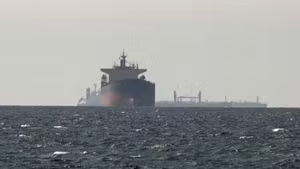
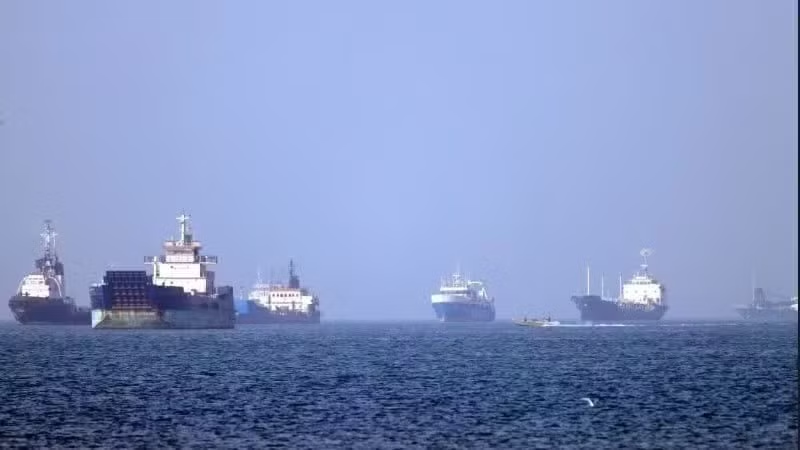
Tensions between Iran and the UAE recently escalated after Abu Dhabi accused Tehran of attacking two vessels belonging to the Abu Dhabi National Oil Company (ADNOC) as they transited the Strait of Hormuz.
The UAE Foreign Ministry condemned the “hostile attack by Iran” against the two ADNOC vessels, despite Tehran maintaining that the accusation was baseless. Iran said the UAE’s accusation ran counter to the principle of good-neighbourly relations, while undermining efforts to build trust and prevent escalating insecurity in the region.
The rift between Iran and the UAE in particular, and with other countries in the region more broadly, has deepened significantly over the issue of the Strait of Hormuz, a strategic shipping route through which a large proportion of the world’s oil and gas is transported.
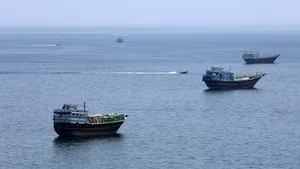
The situation in Hormuz has become increasingly tense as Iran has effectively imposed a blockade on the strait, with frequent attacks targeting commercial vessels.
Tehran also wants to impose fees on vessels passing through the shipping route, a move that has met with strong opposition from the US. Repeated attacks in the Strait of Hormuz have been one of the main factors behind the unravelling of the ceasefire agreement between the US and Iran.
Meanwhile, Gulf countries are also promoting cooperation mechanisms to strengthen maritime security. Fifteen countries have signed a declaration establishing a multinational maritime defence alliance, while 13 others have completed their national procedures, signed the alliance charter, and officially joined. The alliance aims to focus on protecting maritime and commercial activities in the Red Sea, the Gulf of Aden, and the Bab al-Mandab Strait.
Attacks on commercial vessels passing through the Strait of Hormuz have continued, while diplomatic efforts between the US and Iran to restore traffic along this vital shipping route have yet to bear fruit and tensions between Washington and Tehran continue to escalate.
Iran has set out a series of conditions for reopening the strait, including a demand to end the “war and acts of aggression” against Iran and its allies in Lebanon, Palestine, Yemen, and Iraq.
Tehran has also demanded that the US lift its naval blockade of Iran, end sanctions, release frozen assets, and provide compensation for war-related damage.
Meanwhile, US President Donald Trump said Washington had no plans to negotiate with Tehran. Trump has also repeatedly stated that the US is in control of the Strait of Hormuz and left open the possibility of officially designating the area into US territory.
Trump’s statement contrasts with Tehran’s position that the strait cannot be reopened unless Washington fulfils its commitments under the memorandum of understanding reached in June.
The agreement’s 60-day deadline expired without significant progress, while Iran and the US continued to accuse each other of causing its collapse.
Seeking to exert maximum pressure on Iran, US Treasury Secretary Scott Bessent warned that Tehran would face unprecedented economic isolation through new measures, including increased financial pressure and the continued imposition of restrictions on activities in the Strait of Hormuz.
As diplomatic efforts to resume US–Iran negotiations appear to have stalled, United Nations Secretary-General Antonio Guterres called on the two sides to work towards a long-term solution to the conflict in the Middle East, avoid military action, and lower inflammatory rhetoric.
However, in the face of moves by the US and its Gulf allies, Iran has continued to maintain a hardline position on the Strait of Hormuz.
Tehran warned that it could shift from a defensive posture to a “fully offensive” approach, while leaving open the possibility of taking military measures to break the US blockade.
Assessing the current negotiations as potentially nothing more than a lull before a larger conflict, Iran’s perception of the US as facing a calm before the storm reflects the profound lack of trust between the two sides.
The prospects for reaching a long-term agreement to end the conflict in the near future therefore remain fraught with difficulties and challenges.