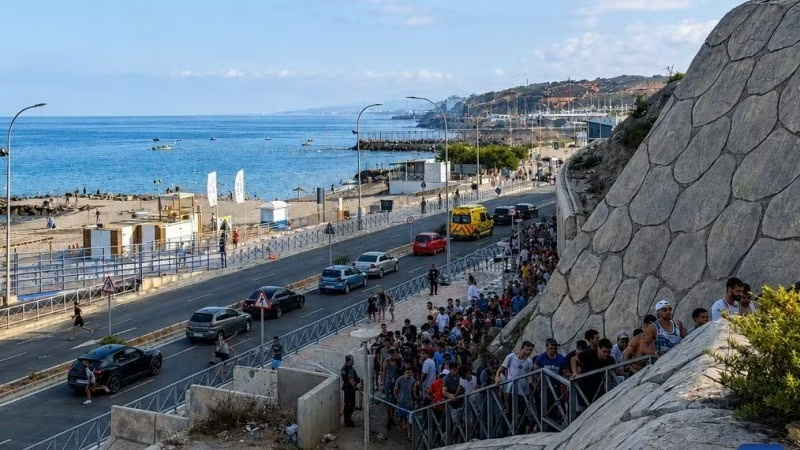
With around 60,000 people arriving in Ceuta from Morocco within just a few days, the influx has placed enormous pressure on Madrid while exposing deep divisions within the EU over immigration policy. The situation has prompted a series of hardline responses from several member states, threatening the bloc's unity in dealing with the crisis.
Covering an area of 18.5 square kilometres, Ceuta and neighbouring Melilla account for Spain's two territories on the North African coast bordering Morocco. They feature the only land borders between Europe and Africa. For decades, both cities have been regarded as key gateways for migrants from Africa seeking to reach Europe. However, the current crisis is considered the most severe since 2021, with approximately 60,000 people entering Ceuta in just a few days, turning the territory into the latest flashpoint in Europe's migration crisis.
The scale of the influx has far exceeded previous expectations, with the number of new arrivals equivalent to around 70% of Ceuta's population. Many migrants swam around the end of the border fence that extends into the Mediterranean Sea to reach the territory, with the perilous journey claiming the lives of at least 67 people. In response to the emergency, Spain deployed military personnel, police officers, and members of the Civil Guard to key locations across the territory to restore order.
Morocco also strengthened security along the border, using tear gas, water cannons, and warning shots to disperse crowds attempting to cross. An emergency agreement between the Moroccan and Spanish governments enabled around 53,000 people to be returned to Morocco, temporarily easing the pressure.
The cause of the sudden surge in migration has yet to be determined, but the situation has generated growing political concern across Europe. The crisis has reignited debate over migration policy, with the Italian Government suspending the application of the Schengen Agreement's free movement provisions in relation to Spain for one month and closing sea and air links between the two countries over security concerns. Rome's decision immediately drew a strong response from Madrid.
The Spanish Government summoned Italy's ambassador to lodge a formal protest, insisting that the influx into Ceuta was not the result of Spain's immigration policy. Instead, it argued that people-smuggling networks had exploited an earlier ruling by the Supreme Court concerning procedures for handling migrants intercepted at sea.
The crisis in Ceuta risks deepening divisions within the EU. Finland, the Netherlands, Denmark, the Czech Republic, and Sweden have all expressed support for Italy's tougher stance. Germany has stressed that protecting the EU's external borders must remain the top priority in efforts to combat illegal immigration.
By contrast, expressing solidarity with Spain in its efforts to manage the migrant influx, the European Commission (EC) and President of the European Council Antonio Costa have emphasised that the special provisions of the Schengen Agreement governing Ceuta and Melilla remain fully in force.
Criticising the hardline response adopted by some EU member states, Spanish Prime Minister Pedro Sanchez maintains that the integrity of the Schengen area remains secure and that the migration surge in Ceuta has not affected freedom of movement within the bloc. According to the Spanish authorities, Ceuta and Melilla operate under special arrangements, including separate border control procedures for anyone travelling by air or sea to mainland European territory.
As the only EU territories sharing land borders with Africa, Ceuta and Melilla have long been favoured entry points for migrants seeking to continue onwards to other EU member states. The latest crisis in Ceuta therefore represents a significant test of the EU's ability to forge consensus in responding to migration emergencies. Most member states have called for urgent discussions on the situation. In an open letter, the leaders of 22 of the EU's 27 member states urged the bloc's interior ministers to convene an emergency virtual meeting in an effort to reach agreement on rapid response measures to prevent further uncontrolled border crossings.
The Ceuta crisis is not solely Spain's concern. It also serves as a warning to the wider European Union of the need to find long-term and sustainable solutions to migration, an issue that has consistently challenged the bloc's cohesion and solidarity.