Global migration continues to post record figures, driven by the combined effects of prolong armed conflict and the increasingly visible impact of climate change. The total number of international migrants is estimated at more than 304 million, equivalent to around 3.7% of the world’s population, up steadily from 281 million in 2020.
Migrants are generally divided into two main groups according to their motivations: voluntary migrants, who move for economic reasons in search of better jobs or more modern living conditions; and forced migrants, including refugees, who flee armed conflict, political instability or natural disasters linked to climate change, often the most powerful yet least visible driver of displacement.
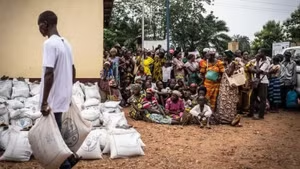
Migrant workers number about 168 million worldwide, helping to offset labour shortages in ageing economies. Around 239 million people across the globe are in urgent need of assistance after being displaced by conflicts in Sudan, Ukraine, Gaza and Afghanistan, as well as by sea-level rise and drought in the Pacific and North Africa.
The search for safety or a better life remains one of the world’s most dangerous journeys. According to IOM, 7,904 migrant deaths were recorded in 2025, down from the record 9,200 in 2024, the deadliest year since data collection began in 2014. Yet the figures still reflect a prolonged global failure to prevent avoidable deaths.
The slight decline from 2024 does not mean the journey has become any safer. Rather, migration flows are increasingly shifting to more “invisible” and harder-to-monitor routes. The real toll could be far higher, with hundreds of cases still unverified amid unprecedented aid cuts in 2025 and tighter restrictions on information about dangerous irregular migration routes.
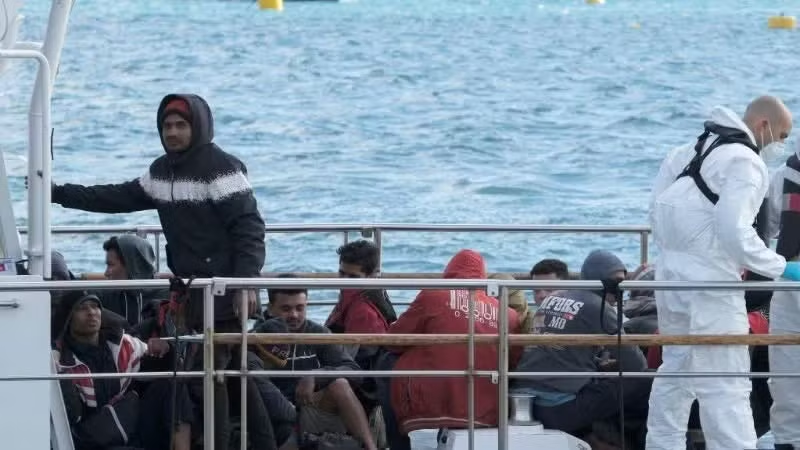
According to statistics, sea routes to Europe account for more than 40% of total migrant deaths worldwide. The Mediterranean is the deadliest route, with more than 2,180 deaths in 2025 and the toll already approaching 1,000 since the beginning of 2026. Around 1,200 people died on the West Africa/Atlantic route towards Spain’s Canary Islands while attempting longer and riskier sea crossings as border controls tightened in other regions. In Asia, 2025 recorded more than 3,000 migrant deaths, of which around 900 deaths and disappearances occurred on the Bay of Bengal and Andaman Sea route alone.
Migration routes are changing under the impact of conflict, climate pressure and tighter border control policies. One painful paradox is that the death rate continues to rise even as the number of arrivals falls. In Italy, the number of migrants reaching shore fell by 60%, yet the death rate rose by 150%.
As countries tighten border controls, migrants are being forced to choose longer and more remote routes, where humanitarian rescue teams are absent. Many boats have washed up on the coasts of Brazil, the Caribbean and Libya without any prior information about the accidents, indicating that many people have disappeared in silence. Countries are prioritising deterrence over rescue, prolonging response times when incidents occur at sea.
Since 2014, the IOM has recorded more than 82,000 deaths and disappearances during migration journeys worldwide. It is estimated that at least 340,000 family members around the world are living in anguish while waiting for news of missing migrants.
The agency has called for stronger political will to save more lives and expand safer migration routes. The IOM has also announced a record funding appeal to support around 41 million people affected by migration crises in 2026, with a focus on data-driven solutions and resilience in the face of climate change.
The global migration crisis urgently requires long-term solutions. The key challenge is how to manage migration flows in a humane and safe manner. Countries with effective integration policies, a strong focus on vocational training and sensible resource allocation can turn migrants into a valuable economic asset rather than a burden.