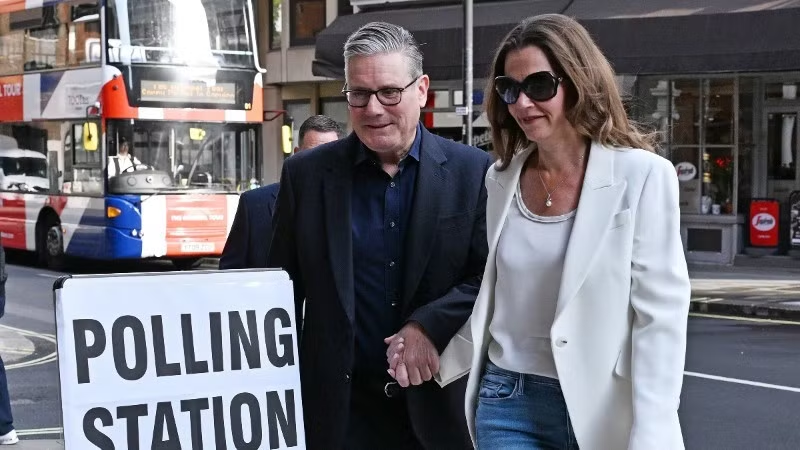
According to preliminary results, the ruling Labour Party lost more than 200 council seats in England and surrendered control of seven local councils to its rivals. Meanwhile, the right-wing populist Reform UK, led by politician Nigel Farage, emerged as one of the election’s biggest winners. Reform UK added more than 350 councillors to its ranks, while the left-wing Green Party and the centrist Liberal Democrats also made notable gains.
One of Reform UK’s most striking achievements in this election was winning control of local councils for the first time in working-class areas in northern UK, long regarded as traditional Labour strongholds. The election results also reflected increasingly clear political fragmentation in the UK, as major parties such as Labour and the Conservatives saw their influence decline, in contrast with the growing prominence of smaller parties including Reform UK, the Greens, and the Liberal Democrats.
Shortly after the disappointing results emerged, Prime Minister Starmer openly accepted responsibility for Labour’s relatively heavy losses in the local elections. However, the Prime Minister, who comes from a working-class background, stressed that the setback would only strengthen his determination to push ahead with his reform commitments.
Analysts said the elections reflected voter dissatisfaction with the ruling Labour Party’s reform measures, despite the fact that only two years ago voters had delivered the party a landslide victory in the general election. Professor John Curtice of University of Strathclyde observed that Britain was entering a new political era in which no party could dominate outright and voters were becoming increasingly fragmented.
Political commentators warned that if this trend continues, Labour could face mounting internal pressure over PM Starmer’s leadership ahead of the next general election, expected in 2028.
Against this backdrop, Deputy PM David Lammy called for stability at the top of government, warning that “changing horses midstream” would bring no benefits to the UK and could even push the government towards crisis. Defence Secretary John Healey affirmed that PM Starmer would continue pursuing his chosen path and dismissed speculation that the occupant of Number 10 Downing Street might resign. Healey argued that the election results should serve as a warning that the government must act more decisively and effectively to regain public support.
Since ending 14 years of Conservative rule in 2024, Starmer’s government has faced a series of challenges, ranging from sluggish economic growth to rising inflation, and persistent cost-of-living pressures. Nevertheless, the UK’s leader has received some positive assessments for his foreign policy, particularly his firm stance on the conflict involving Iran. Starmer’s unequivocal rejection of calls from US President Donald Trump for the UK to join the conflict in the Middle East was welcomed by the UK’s public opinion.
These difficulties have unfolded as the UK’s government seeks to improve post-Brexit relations with the European Union. The results of a poll published by the Daily Mirror revealed an interesting finding: around 59% of respondents supported rejoining the EU.
PM Starmer has also made no secret of his desire to move closer to the bloc with the blue flag, despite London having left the EU nearly six and a half years ago. He argued that strengthening ties with the EU would not only help guarantee security but also deliver economic benefits and create more jobs for British workers. However, observers noted that before dreaming of a reunion with the EU, the UK’s government must first stabilise domestic politics and restore public trust through measures aimed at boosting economic growth, curbing inflation, and creating jobs.