Turning commitments into action
Leaders of the 27 member states of the European Union have agreed on a plan to restructure the bloc’s economy under a stringent roadmap aimed at strengthening its global competitiveness.
#EU
Có 43 kết quả
Leaders of the 27 member states of the European Union have agreed on a plan to restructure the bloc’s economy under a stringent roadmap aimed at strengthening its global competitiveness.
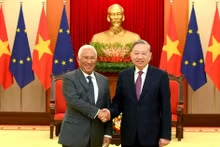
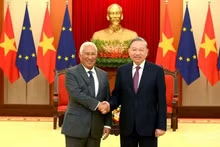
Viet Nam always regards the European Union (EU) and its member states as important partners in its process of integration and national development, National Assembly (NA) Chairman Tran Thanh Man told visiting European Council President António Costa in Ha Noi on January 29.
Prime Minister Pham Minh Chinh had a meeting in Ha Noi on January 29 with visiting President of the European Council (EC) António Costa, during which he expressed his hope for stronger cooperation between Viet Nam and the European Union (EU).
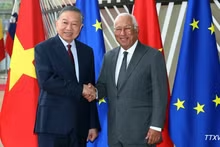
Vietnamese State President Luong Cuong and President of the European Council (EC) António Costa on January 29 officially announced the upgrading of Viet Nam–EU relations to a Comprehensive Strategic Partnership after 35 years of establishing diplomatic ties.
At the invitation of Vietnamese President Luong Cuong, President of the European Council Antonio Costa is paying an official visit to Viet Nam from January 28 to 29.
The upcoming official visit to Viet Nam by President of the European Council (EC) António Costa holds great significance for the Viet Nam – European Union relations, particularly as it follows the successful 14th National Congress of the Communist Party of Viet Nam (CPV), according to Vietnamese Ambassador to Belgium and Head of Viet Nam’s Mission to the EU Nguyen Van Thao.
After more than 25 years of arduous negotiations and several moments on the brink of collapse, the trade agreement between the European Union (EU) and the Southern Common Market (MERCOSUR) has finally been signed, laying the foundation for one of the world’s largest free trade areas.
The European Union (EU) enters 2026 facing numerous challenges stemming from the multi-layered crises of 2025: internal fractures, the burden of providing financial and military support to Ukraine, and security pressures, among others. With a number of major elections set to take place in 2026 — widely seen as shaping Europe’s geopolitical position — the bloc is placing greater emphasis on strengthening its internal resilience and strategic autonomy.
The European Union (EU) has recently announced that it will increase food safety and sanitary and phytosanitary (SPS) inspections on imports from non-EU countries by 50%, and step up audits at member states’ border control posts by 33%.
In 2025, strategic autonomy has become an urgent requirement for the European Union (EU) across multiple fields, from security and defence to economics, trade, and technology. Amid a world marked by volatility, the EU’s desire to reduce dependence, strengthen internal capacity, and enhance its standing is understandable. However, the path to autonomy is not an easy one, as a gap remains between ambition and actual capability.
In an effort to strengthen the European Union’s (EU) energy self-sufficiency, the European Parliament (EP) has just approved a plan to completely eliminate imports of Russian gas. However, this decision has met with opposition from some member states, who fear that “shutting off” the flow of gas from Russia could trigger a price surge in the energy market, harming the economy.
Bosnia and Herzegovina highly values Viet Nam’s dynamic development achievements and its increasingly prominent position in the region and the world, Chairman of the Presidency of Bosnia and Herzegovina Željko Komšić while receiving Vietnamese Ambassador Bui Le Thai, who presented his credentials on December 12 in the capital city of Sarajevo.
US Deputy Secretary of State Christopher Landau has warned that the European Union’s pursuit of a green agenda and its enforcement of regulations against American technology companies are undermining the transatlantic alliance.
The European Union (EU) has recently issued a Joint Communication on its strategic approach to enhancing the economic security of its 27 member states.
The “Pact for the Mediterranean: One Sea, One Pact, One Future” has just been officially launched, marking a historic step forward in the relationship between the European Union (EU) and the countries of the southern Mediterranean. The Pact is considered an important foundation for creating a cohesive, peaceful, and prosperous Mediterranean space.
Deputy Minister of Foreign Affairs Le Thi Thu Hang has authored an article on the overview and development prospects of the Viet Nam-European Union (EU) relations on the occasion of the 35th anniversary of diplomatic ties (November 28).
Minister of Public Security General Luong Tam Quang called for strengthened information exchange to support the prevention and combat of crime and legal violations, particularly in economic, trade and investment activities in Viet Nam, while meeting with Jens Rubbert, Chairman of the EU–ASEAN Business Council (EU–ABC), in Ha Noi on November 27.
European Central Bank (ECB) President Christine Lagarde has warned that Europe is becoming increasingly vulnerable to shocks such as US tariffs, and is falling behind in future growth drivers such as artificial intelligence (AI). She has proposed a series of bold reforms to help the European Union (EU) maintain its position as one of the world’s leading economic hubs.
Vietnamese Prime Minister Pham Minh Chinh met with Canadian PM Mark Carney and President of the European Commission (EC) Ursula von der Leyen on the sidelines of the G20 Summit in Johannesburg, South Africa, on November 22 afternoon (local time) to discuss directions for strengthening connectivity and promoting trade and investment cooperation between member countries of the Comprehensive and Progressive Agreement for Trans-Pacific Partnership (CPTPP) and the European Union (EU).
On November 13, in Ha Noi, the Ministry of Foreign Affairs held the workshop “Promoting the Export of Vietnamese Agricultural, Forestry and Fishery Products to the EU Market,” chaired by Deputy Minister of Foreign Affairs Le Thi Thu Hang.