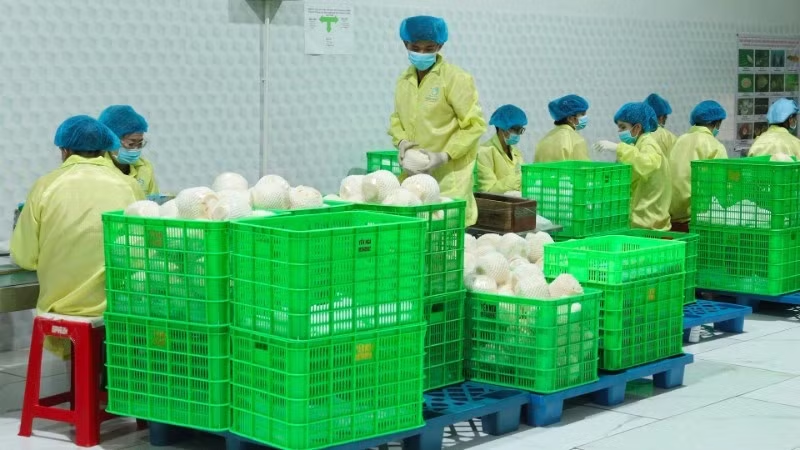
This move requires Vietnamese businesses to pay particular attention to product quality in order to meet export conditions.
According to Tran Ngoc Quan, Trade Counsellor at the Viet Nam Trade Office in Belgium and the EU, Viet Nam is currently the EU’s 17th largest trading partner.
Viet Nam’s share of total EU imports has grown slowly but steadily, from 1.8% in 2023 to 2.28% in 2024, with a significant proportion coming from agricultural, forestry and fisheries products.
From August this year, the EU–Viet Nam Free Trade Agreement (EVFTA) enters its fifth year of implementation.
Under the agreed roadmap, import tariffs on many Vietnamese products exported to the EU have been reduced to zero, creating additional price competitiveness for Vietnamese businesses.
In the first 11 months of 2025, Viet Nam’s coffee exports to most EU markets recorded positive growth compared with the same period in 2024, thanks to ample supply.
Specifically, exports to Germany exceeded 1 billion USD, up 97.5%, while exports to Italy reached 615.8 million USD, an increase of 52.9%.
For seafood products, the EU is currently Viet Nam’s fourth-largest export market.
However, the EU is now requiring exporters to comply with food safety, environmental and animal welfare standards that are already applied to farmers and businesses within the EU.
In addition to SPS inspections, the EU will review regulations on monitoring pesticide residues, particularly substances that have been banned in the EU but may still be present in imported agricultural products.
Moreover, certain active substances that have been reclassified by international organisations will also be incorporated into EU legislation.
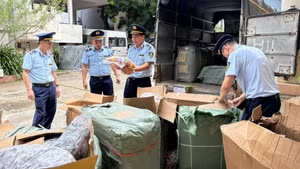
In addition, the EU is strengthening controls to combat trade fraud. Therefore, effective management solutions are needed for trade flows between Viet Nam, the EU, and third countries to prevent origin fraud that could undermine the benefits of the EVFTA, said Quan.
He added that in the coming period, Viet Nam should engage with the EU on measures to boost trade such as trade facilitation through self-certification of origin, the inclusion of ST rice in the tariff quota list, and efforts to seek EU approval for Viet Nam to export processed meat products.
As one of the major seafood exporters to the EU market, Sao Ta Foods Joint Stock Company (Fimex VN) has consistently invested in global certifications for responsible aquaculture to meet requirements on quality, hygiene and food safety.
According to Ho Quoc Luc, Chairman of Fimex VN, the company is currently expanding exports of processed shrimp to the EU, focusing on developing deeply processed products such as Nobashi shrimp, fresh battered shrimp and fried shrimp to increase added value and ease competitive pressure.
This is also a product segment in which Vietnamese enterprises have established a strong foothold in the EU market.
As the EU increasingly tightens traceability requirements and places greater emphasis on sustainable products, the company will continue to expand its shrimp farming areas certified to ASC standards in order to proactively increase raw material supplies for this market.
Under the EU’s new regulations, fruit and vegetables are also subject to heightened controls, particularly as the EU continues to issue warnings for certain Vietnamese products.
To avoid destruction or rejection of shipments, which would disrupt current trade flows, businesses need to pay close attention to cultivation areas and ensure SPS measures are applied from the production and processing stages.
Meanwhile, regarding green transition and sustainable development, although the EU has introduced more flexible adjustments, such as postponing the implementation of the EU Deforestation Regulation (EUDR), to give stakeholders more time to adjust systems, clarify technical requirements and reduce risks for businesses, Vietnamese enterprises should proactively adapt by regularly updating information and developing timely transition plans.
At the same time, businesses should also focus on renewing their market access strategies by not only seeking importers but also establishing a commercial presence in the EU.
This enables them to connect with and provide services to individual and institutional customers, while proactively managing their goods through bonded warehouses and logistics facilities, ensuring stable and flexible circulation of goods.