The consistent policy is to encourage the development of the private economy in most sectors and fields; to ensure property rights and freedom of business; and to build a transparent, equal, and healthy competitive investment environment.
The Sai Gon Ward Party Committee has thoroughly implemented and concretised the above policy, along with Resolution No.68-NQ/TW of the Politburo on the development of the private economy, through an action programme with clear objectives, priorities, and implementation roadmap.
As a special urban centre, converging symbolic spatial axes, distinctive architectural works, and cultural-historical values of international significance, Sai Gon Ward is shaping up to be a high-end financial, commercial, and service centre of Ho Chi Minh City. The private sector here is characterised by modern urban economic features such as: the digital economy, the sharing economy, the night-time economy, and 24/7 services linked to the process of international integration.
Based on this, the Ward Party Committee has developed a programme to lead the development of high-end trade and services, finance, and international tourism for the 2025–2030 period, proactively anticipating the formation of an International Financial Centre and implementing a special mechanism according to Resolution No. 260/2025/QH15 amending and supplementing some articles of Resolution No. 98/2023/QH15 piloting some special mechanisms and policies for the development of Ho Chi Minh City.
The noteworthy point is not simply the goal of increasing the number of businesses, but rather the orientation towards improving the quality of growth, technological content, productivity, and competitiveness of the private sector.
According to the leaders of Sai Gon Ward, the Ward Party Committee has directed the implementation of two key groups of solutions. These include solutions related to the economy, finance, and trade, which are being implemented synchronously in a modern, professional, and digital direction. Retail systems and shopping centres are encouraged to upgrade service quality, apply technology in management and payment, and gradually approach international standards.
The development orientation has focused on free trade models, duty-free shops or on-site tax refunds, and the business of high-end products serving international tourists, experts, and investors. This not only expands the consumption space but also gradually integrates urban services more deeply into the global value chain. This is a vivid concrete manifestation of the Party’s 14th Congress viewpoint on strongly developing high-quality service industries.
Along with this, administrative reform and digital transformation are identified as breakthrough solutions. The documents of the 14th Party Congress also emphasised building a development-oriented, honest, proactive, and people- and business-serving state; promoting decentralisation and delegation of power coupled with inspection and supervision; and shifting strongly from pre-inspection to post-inspection.
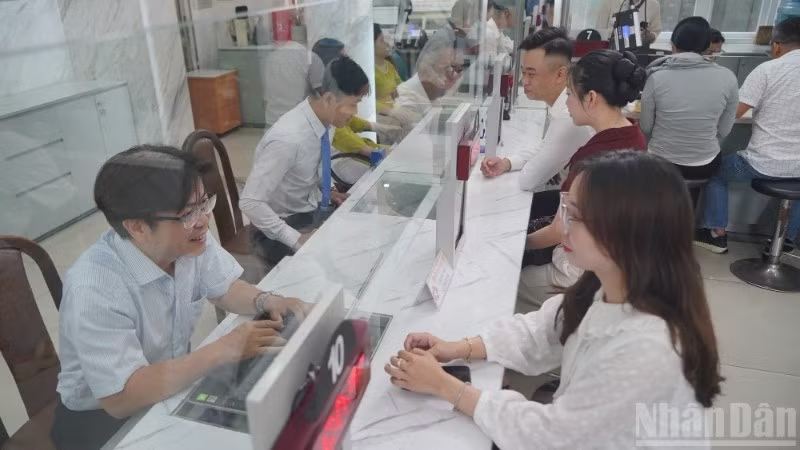
In line with this spirit, Sai Gon Ward has reviewed and streamlined procedures; shortened processing times; expanded online public services; and enhanced transparency and accountability. The overarching goal is to reduce compliance costs, create a favourable and stable business environment, and place citizens and businesses at the centre of service.
The initial results of implementing the Resolution of the 14th Party Congress and Resolution No. 68-NQ/TW have shown the correct direction. In the last six months, the number of businesses and business households in the ward reached 14,283 units (excluding foreign businesses), an increase of 966 units compared to July 1, 2025. State budget revenue by the end of 2025 reached 186.67%; in 2026, the budget revenue target was over 10.453 trillion VND, of which the private sector contributed over 6.75 trillion VND, equivalent to 64.57%.
These figures reflect the attractiveness of the central area and affirm the increasingly important role of the private sector in the revenue structure, creating resources for investment and development, and ensuring social security. This reality has shown that when the resolution is concretised with a clear action programme, linked to actual conditions and specific political responsibilities, the private sector can truly become a driving force for growth.