Building brands for OCOP products
Giang Tuan Vu, Director of Tuan Vu Foods JSC in Hoan Long Commune, said he had always been passionate about enhancing the brand and value of his hometown’s produce, which inspired him to use Dong Tao chicken to make sausage.
After numerous trials, he developed recipes for products made from Dong Tao chicken, such as chicken sausage and chicken cartilage sausage.
From a distinctive local product, Dong Tao chicken has gained added value through processing, brand building, and market expansion.
Vu said around 80% of the company’s output is now sold through online channels such as Facebook, Zalo, and TikTok.
“Online sales help us reach customers more quickly, expand the domestic market, and reduce intermediary costs,” he said.
Tan Hung Commune is one of the province’s major areas for growing speciality longan. The fruit that built the “Hung Yen longan” brand has also been upgraded through the OCOP programme.
Many concentrated longan-growing areas have adopted VietGAP standards. From fresh longan, local farmers have developed additional processed products meeting OCOP standards, such as dried longan and lotus-wrapped dried longan.
Tien Chau Pho Hien Cooperative now has four products recognised as three- to four-star OCOP products, including Huong Chi longan, Tien Chau longan, dried longan, and longan blossom honey.
Nguyen Quang Dien, Director of Tien Chau Pho Hien Cooperative, said OCOP recognition had helped dried longan products affirm their quality and brand while building consumer confidence. Greater attention has since been paid to labels, product information, and traceability, making the products easier to sell.
This year, Tien Chau Pho Hien Cooperative has harvested about 100 tonnes of fresh longan and produced around 27 tonnes of dried longan and lotus-wrapped dried longan. Moving forward, the cooperative will continue expanding its raw material-growing area and developing more OCOP products.
Vu Cong Binh, Head of the Rural Development Sub-Department of Hung Yen Province, said developing OCOP products is not simply about awarding star ratings.
He said that, more importantly, the OCOP programme is driving the reorganisation of production from developing raw material areas and applying scientific and technical advances to processing, packaging, brand building, and market development.
Hung Yen Province now has nearly 600 OCOP products from 323 producers, including 107 four-star products.
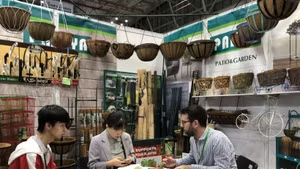
Many cooperatives and businesses have changed their approach to the market, stepped up promotion on digital platforms, and introduced their products into supermarket and retail chains both inside and outside the province.
Many producers are shifting from producing what they have to producing what the market needs, and from selling raw products to deep-processing them, building brands, and developing product stories. This is also the core value the OCOP programme seeks to promote.
Continuing to promote the OCOP programme
Under a decision by the Prime Minister, the national criteria set for new-style rural areas for the 2026–2030 period comprise 10 criteria. Among them, the criterion on rural economic development requires the effective development and implementation of plans for OCOP products linked to local characteristics and strengths.
This provides a basis for Hung Yen to continue improving the programme and linking OCOP more closely with rural economic development.
Under its plan, by 2030 Hung Yen Province aims to have around 700 OCOP products rated three stars or higher; ensure that 100% of OCOP products are sold through modern sales channels or available on e-commerce platforms; increase the number of OCOP product display and sales outlets to 40; and link OCOP products with rural tourism, with a view to expanding markets and gradually accessing export markets.
To achieve these targets, Le Trung Can, Deputy Director of the Hung Yen Department of Agriculture and Environment, said the province would step up communications, dissemination, professional training, and management training for OCOP producers.
The province will invest in and provide financial support for the construction, renovation, and upgrading of infrastructure in raw material areas and zones for products under OCOP development.
Hung Yen will also support trade promotion activities and connect supply with demand for OCOP products; provide consultancy for product development; develop dossiers and manage OCOP product data; digitalise product classification processes; digitalise products and establish traceability systems along OCOP value chains; design product models and packaging; support the development and registration of trademarks for OCOP products; and support packaging and label-printing costs.
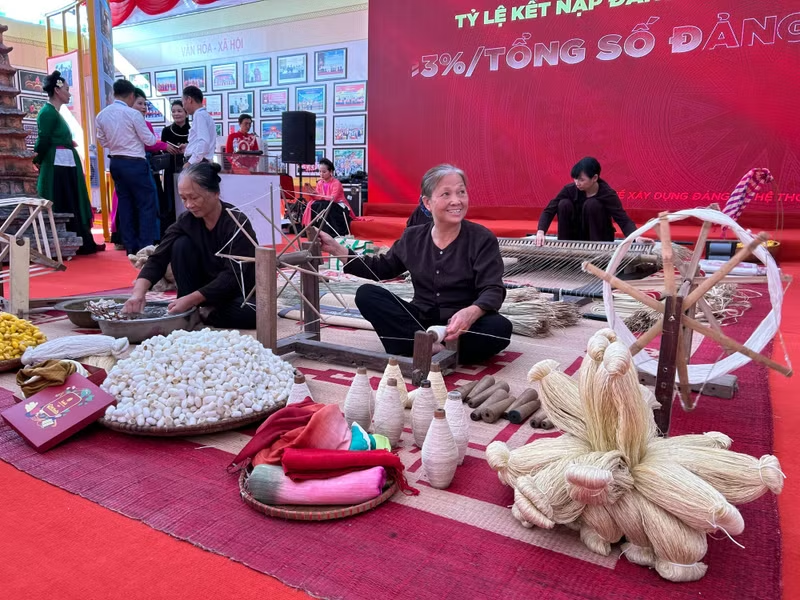
From Dong Tao chicken and Hung Yen longan to familiar products from rural communities, the added value created does not lie solely in the processed products, but also in the value of brands, consumer trust, and the value chains that are taking shape.
When each local speciality becomes a branded commercial product, OCOP raises the value of agricultural produce, contributing to improving local people’s livelihoods and laying the foundation for sustainable rural development.