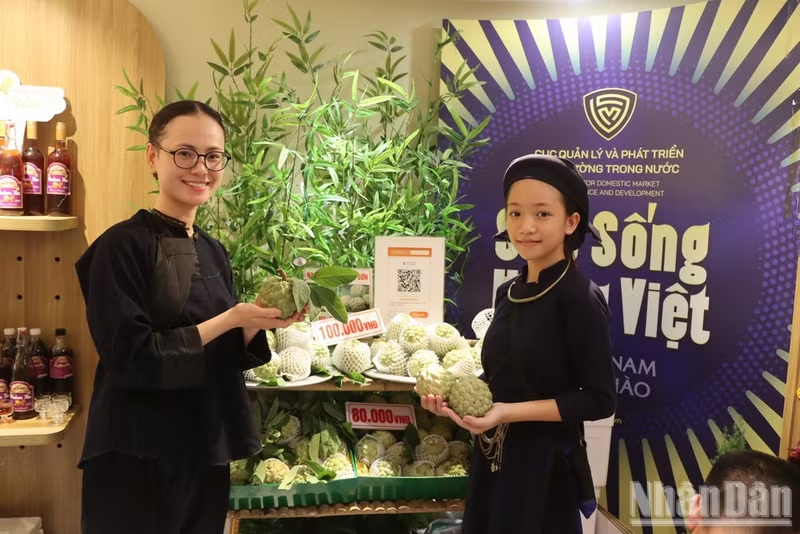
On April 5, 2026, the Government issued Resolution No. 88/NQ-CP on promoting the development of the domestic market, stimulating consumer demand and stepping up the “Vietnamese People Prioritise Vietnamese Goods” campaign. The resolution identifies the strong development of the domestic market and increased purchasing power among people and businesses as important drivers of growth, while considering domestic production a sustainable foundation for supplying goods to the domestic market.
For ethnic minority communities and people living in mountainous areas, this represents significant untapped potential. Many products are made from local raw materials, production knowledge, and the distinctive cultural values of communities. With consumers paying increasing attention to quality, provenance, natural characteristics, and the stories behind products, these factors can become competitive advantages.
Spaces where purchasing power should be tapped
At the seminar “Boosting Domestic Demand — Expanding Market Access for Products from Ethnic Minority and Mountainous Areas”, held by Cong Thuong (Industry and Trade) Magazine on September 3, Bui Nguyen Anh Tuan, Deputy Head of the Agency for Domestic Market Surveillance and Development under the Ministry of Industry and Trade, said that, from a market development perspective, five spaces could be prioritised for products from ethnic minority and mountainous areas.
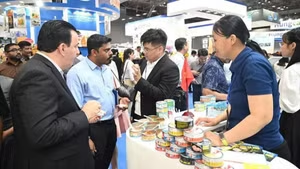
The first is modern distribution systems in urban areas and major consumption centres. However, this requires products to be standardised in terms of quality, packaging, data, and supply. E-commerce, social media, and multi-channel sales platforms are another avenue. These are considered opportunities for products from remote areas to reach buyers directly while conveying stories about their origins, identity and verified product data.
There are also markets linked to cultural and experiential tourism, ranging from community-based tourism sites, hotels, and restaurants to airports, railway stations, rest stops, museums, and cultural centres. Here, the value of a product lies not only in the goods themselves but also in the accompanying local experience and story. Other segments include gifts, healthcare, green consumption, and responsible consumption — areas in which buyers are simultaneously concerned with quality, the environment, community livelihoods, and cultural identity.

Finally, there are local markets and two-way trade in mountainous and border areas. Market development is not simply about bringing specialities from mountainous areas down to cities; it must also ensure that essential goods and quality Vietnamese products at reasonable prices reach people in mountainous and rural areas.
Notably, not every product needs to seek entry into supermarkets or be sold on a mass scale. According to Bui Nguyen Anh Tuan, what is more important is choosing the right segment, scale, and story for each product. This is also an approach suited to the specific characteristics of highland products. If a single distribution model is imposed on every product, local advantages may be diluted, while the production capacity of cooperatives and households may not necessarily meet the requirements of the mass market.
However, according to Dao Duc Huan, Head of the OCOP and Rural Tourism Management Division at the Central Office for Coordination of the National Target Programme, the major bottleneck lies not only in product quality or raw material areas but also in the organisational capacity and market mindset of cooperatives. To secure stable orders, cooperatives must strengthen their overall capacity, from member organisation, management, technology, and logistics to branding, packaging, communications, storage, and risk management. More importantly, they need to shift from the mindset of “producing and then waiting for buyers to come” to proactively engaging in the market.
This change cannot happen overnight. A cooperative that previously mainly sold to traders will face entirely different requirements when seeking to enter modern distribution systems; its responsibilities will then extend beyond production to organising members, consolidating supplies, managing risks, sharing profits and risks, building its brand, packaging products, and taking responsibility for consumers. This is a process of shifting from being a producer to becoming a market player.
In recent years, the OCOP Programme has also focused on this adaptation process, standardising everything from production processes, quality and safety to packaging and market access, while enhancing the management capacity of cooperatives, households, and businesses. For fresh products, the issue is also linked to science and technology, storage and extending shelf life, because unless these stages are addressed, geographical distance will continue to be a barrier to purchasing power.
Turning demand into a driver of production
Information from the seminar also shows that in Lam Dong, where supply-demand connection activities are organised regularly, producers have more opportunities to access purchasing businesses, distribution systems, and consumers outside the locality. Many businesses, cooperatives, and production households have paid greater attention to branding, quality, packaging, labelling, and traceability, while e-commerce and digital platforms have gradually helped production establishments become more proactive in introducing and selling their products.
Lam Dong Province has also organised trade promotion and business-matching activities, developed pilot models for goods trading points in mountainous, remote and isolated areas, and brought Vietnamese goods to rural and mountainous areas. These efforts have not only opened market outlets for local products but also helped establish two-way markets.
However, the requirement for the next period is to improve the quality of connection activities. According to the orientation of the Agency for Domestic Market Surveillance and Development, supply-demand connections need to be carried out through a process of selection, preparation, testing, and monitoring. Following connection programmes, trial orders, the potential for repeat orders, and difficulties related to delivery and quality need to be monitored, rather than simply participating in a trade fair and considering the process complete.
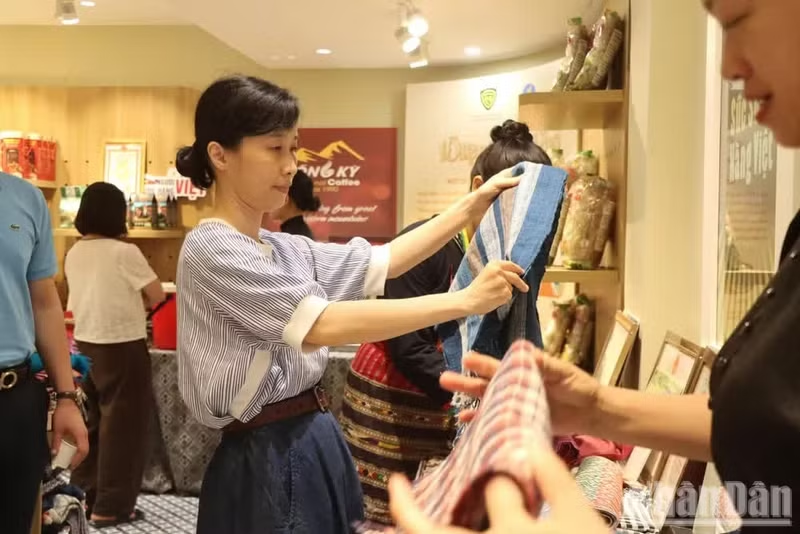
At the same time, distributors need to play their role earlier in the chain. Corporations, supermarkets, retail chains, tourism businesses, and digital platforms can provide requirements from the outset regarding specifications, prices, volumes, and delivery.
When market signals reach producers early, they have a stronger basis for making investment decisions. Digital transformation also needs to address the core of business operations rather than stopping at opening an online shop. Digital storefronts, digital content, livestreaming, and KOLs can only be truly effective when backed by sufficiently robust systems for inventory management, order processing, payment, and customer data to retain buyers.
In particular, logistics needs to be reorganised regionally, with appropriate collection, preliminary processing, and packaging points; suitable warehouses; shared transport schedules; and links with postal, logistics, and retail networks. The aim is not only to reduce costs per unit of goods but also to increase the share of value retained by producers.
Another important change concerns how policy effectiveness is assessed. Whereas success may previously have been measured by the number of products introduced, trade fairs held, or participating producers, the new approach places greater emphasis on more substantive outcomes: the proportion of products that remain on shelves, repeat orders, revenue growth, cost reductions, the number of jobs created, and additional income generated in communities.
These are also measures that accurately reflect the essence of harnessing domestic demand. A strong market is not created by purchasing power alone but also by the supply side’s ability to meet demand. When consumers have more quality choices, distributors have reliable supplies, cooperatives have a basis for investment, and producers have stable market outlets, then the market can form a virtuous cycle.
For products from ethnic minority and mountainous areas, this cycle carries significance beyond purely commercial value. It can help sustain livelihoods, create jobs, raise incomes, and contribute to preserving local values. To achieve this, fundamental shifts are needed: from producing according to capacity to organising production according to market demand; from competing mainly on price to increasing value based on quality, provenance, and identity; and from fragmented support to coordinated action across the entire value chain.
Boosting domestic demand, therefore, is not about “how many more products can be sold” at a particular point in time. The deeper goal is to establish stable trade flows so that market purchasing power becomes a signal for production, production generates reliable supplies for distribution, and distribution delivers products to the right consumers. This is when domestic demand truly becomes a foundation for domestic production and a driver of higher value for products from ethnic minority and mountainous areas.










![[Video] Eight-month public investment disbursement reaches 50% of yearly plan](https://en-cdn.nhandan.vn/images/nyM650OGFWrOVWc-xajqNz57td8idIAL_VG9puyG2UZSh9a-ip79SRwvbzBwNEcQ_SZtLGThwR4Kp7S4xd9nklBm2seVye4c367gN-6eKf4/giai-ngan-von-dau-tu-cong.jpg.avif)