Mounting pressure on the power system
A report by the state utility EVN shows that in June 2026, when electricity demand was high, total electricity generation and imports reached 32.6 billion kWh, up 14.25% year on year. In the first six months of the year, total electricity output reached 171.54 billion kWh, up 9.85%.
Along with output, electricity demand has continued to reach new highs. The highest daily electricity consumption (Amax) reached 1.215 billion kWh, up 9.8% year on year, while peak power capacity (Pmax) reached as high as 57,537 MW, up 12.91% year on year.
Notably, the northern region continued to record high demand growth, with Pmax reaching 30,248 MW. This development reflects mounting pressure on system operation and power supply security, particularly during periods of sudden spikes in demand.
This pressure will increase further as electricity demand is expected to grow strongly in the coming years. Under the revised Power Development Plan VIII (PDP8), nationwide peak demand is forecast to reach around 99,934 MW by 2030 and approximately 228,570 MW by 2050. Meanwhile, total planned power generation capacity is set to reach around 183,291 MW by 2030 and approximately 774,503 MW by 2050.
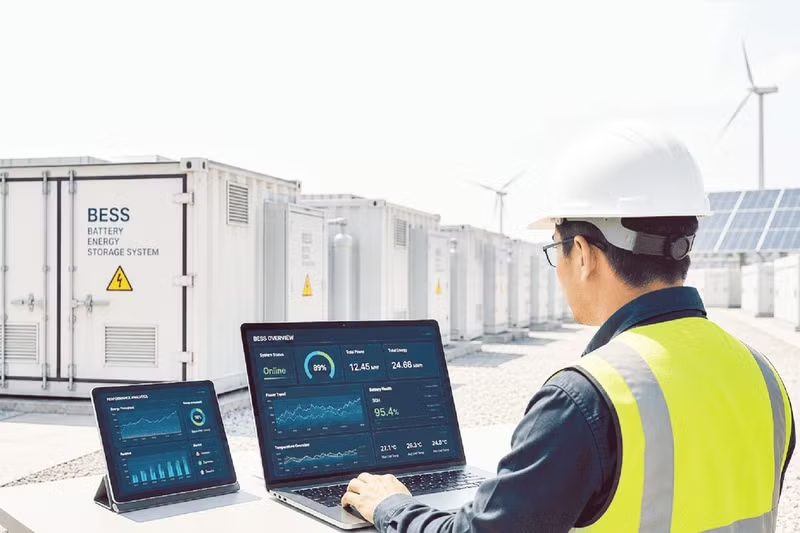
The large-scale development of power generation capacity, particularly renewable energy, also requires greater use of flexible resources to balance the system. Under the revised PDP8, BESS capacity is targeted at 10,000-16,300 MW by 2030 and is expected to rise to around 95,983-96,120 MW by 2050.
These figures show that energy storage is no longer merely a supplementary solution but is becoming an increasingly important component of the future power system.
Northern region to invest in 530 MW of BESS at 83 substations
In response to the growing need for flexible system operation, power utilities are gradually integrating BESS into the power grid.
The Northern Power Corporation (EVNNPC) is investing in BESS with a total capacity of 530 MW/1,060 MWh, which is expected to be installed across 83 substations in three phases.
Phase 1 has a capacity of 305 MW/610 MWh and is being implemented at 47 substations. To date, EVNNPC has completed BESS installation at nine substations and is accelerating work at the remaining sites.
Phase 2, with a capacity of 140 MW/280 MWh at 23 substations, is currently undergoing contractor selection, while Phase 3 is expected to add a further 85 MW/170 MWh at 13 substations.
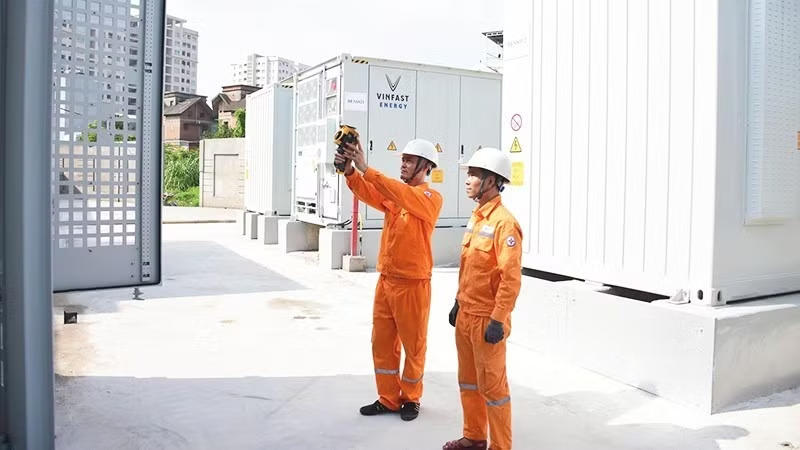
According to EVNNPC, BESS investment is primarily aimed at meeting capacity demand during periods of high load, helping reduce the risk of overloads and incidents on the regional grid and improving the reliability of electricity supply.
In the long term, energy storage will also create greater room for flexible grid operation, optimise the use of existing infrastructure, and enhance the system’s ability to adapt to increasingly significant fluctuations in demand.
It is also part of efforts to modernise and develop a smart grid and apply advanced storage technologies, contributing to the goal of ensuring national energy security.
However, demand for BESS is driven not only by the challenge of meeting rising electricity needs but also directly by the rapid growth of renewable energy.
A representative of Power Engineering Consulting Joint Stock Company 2 (PECC2) said that for solar power, surplus generation commonly occurs between 10 am and 3 pm — when solar radiation is high, but demand has yet to reach a high level. Conversely, between 6 pm and 8 pm, electricity demand rises sharply while solar power generation capacity is almost unavailable.
The gap between periods of abundant electricity supply and periods of high demand provides an opportunity for BESS to play a role.
With flexible charging and discharging capabilities, BESS can absorb excess electricity during the day and then discharge it in the evening when demand is high. This mechanism enables energy to be shifted over time, increasing the ability to utilise renewable energy sources and reducing pressure on conventional power sources.
In particular, when demand peaks, BESS can provide capacity for short periods, thereby helping reduce pressure on the transmission grid and increasing flexibility in power source dispatch.
Mechanisms needed to establish a market
According to Nguyen Huu Khoa, a lecturer at Ho Chi Minh City College of Electricity, when the share of electricity generated from renewable energy exceeds 15%, the need for flexible, adjustable resources, including BESS, will become increasingly apparent. Energy storage is therefore considered an important component in the transition towards a green power system.
However, Viet Nam’s BESS market remains at an early stage and faces numerous barriers. One issue of concern is the high dependence on imported equipment. According to Khoa, without domestic manufacturing capacity, the market could be affected by fluctuations in international supply, risk of supply-chain disruptions, and safety and cybersecurity issues.
Therefore, alongside attracting investment in BESS projects, Viet Nam needs to gradually develop a domestic energy-storage equipment manufacturing industry, thereby enhancing its technological, equipment, and supply-chain autonomy.
Another bottleneck lies in revenue mechanisms. BESS can provide many benefits to the power system, such as shifting demand, supplying capacity during peak hours and supporting ancillary services. However, these benefits need to be quantified, with appropriate payment mechanisms put in place.
Khoa said that a model combining capacity payments, electricity output payments, and payments for ancillary services could be studied to create more stable revenue streams for investors.
For solar power, BESS integration should also be promoted more strongly. Khoa proposed encouraging a storage capacity ratio of more than 20% in solar power projects, while considering a higher tariff for electricity charged into storage systems and discharged to the grid during evening peak hours.
This mechanism would incentivise investors to reduce the amount of solar power generated and fed into the grid during the middle of the day, instead storing some of the output and shifting it to the evening. This would not only improve the utilisation of renewable energy sources but also help reduce pressure on the system when demand is high.
According to Khoa, policies for BESS development should also be expanded from the power sector to the entire battery value chain.
The government could consider preferential policies to attract private-sector investment in the production of energy-storage batteries, charging stations, battery-swapping stations, and related infrastructure. Instruments such as tax breaks, green credit, or corporate income tax support could offer businesses additional incentives to participate.
Thus, for BESS to truly become a market rather than remain limited to individual projects, Viet Nam needs to address several issues simultaneously, including pricing and payment mechanisms, technical standards, financing, domestic manufacturing capacity, and supply chains.
Once these conditions are met, BESS will not only absorb surplus electricity from renewable energy sources but also become an important resource for making the power system more flexible, secure, and efficient.