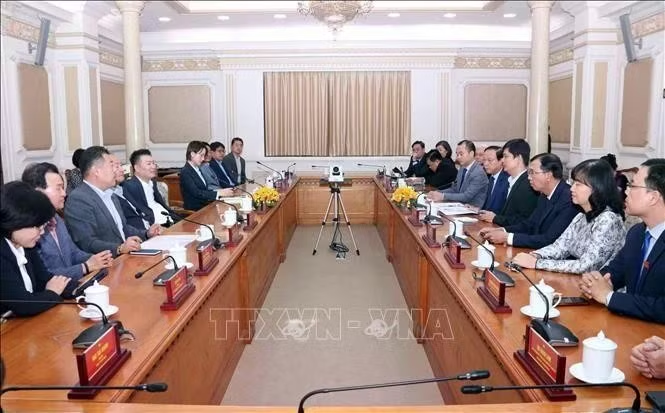
At a working session with Hwang Kyoung-ah, Vice-Chairman of the Daejeon Metropolitan City Council, and a delegation from the Korean city, Nguyen Van Tho, Standing Vice Chairman of the Ho Chi Minh City People’s Council, noted that the RoK is one of the city’s most important economic partners.
He said the RoK is currently the second-largest investor in Ho Chi Minh City, with more than 3,300 valid projects and total accumulated foreign direct investment (FDI) of 15.7 billion USD. Bilateral trade turnover between the two sides reached 6.4 billion USD in 2025. Ho Chi Minh City has established cooperative relations with 12 localities in the country, including Daejeon.
Tho affirmed that throughout its development process, Ho Chi Minh City hopes to continue receiving support and partnership from Korean localities and businesses, including those from Daejeon. The city stands ready to further expand cooperation with Daejeon in areas such as the economy, science and technology, culture, education and people-to-people exchanges.
He expressed appreciation for and agreement with proposals put forward by the Daejeon delegation, particularly those aimed at enhancing joint work among businesses, associations and social organisations for the practical benefit of residents in both cities.
For his part, Hwang said Daejeon has strengths in science and technology and wishes to share its experience while promoting cooperation with Ho Chi Minh City in areas where the former holds advantages and the latter has growing interest.
He added that the participation of leading enterprises from Daejeon in the delegation reflects the city’s desire to strengthen connectivity and cooperation with businesses in Ho Chi Minh City. The Daejeon Metropolitan City Council will make every effort to enhance coordination with the Ho Chi Minh City People’s Council in order to further consolidate and develop the strong relationship between the two cities.
During the meeting, representatives of the sides also shared experiences in ensuring social welfare for residents, discussed orientations for cooperation in social welfare programmes, and exchanged views on the operation of civic and business associations contributing to local development.