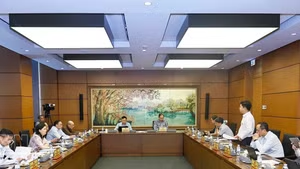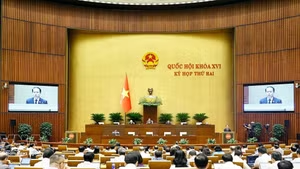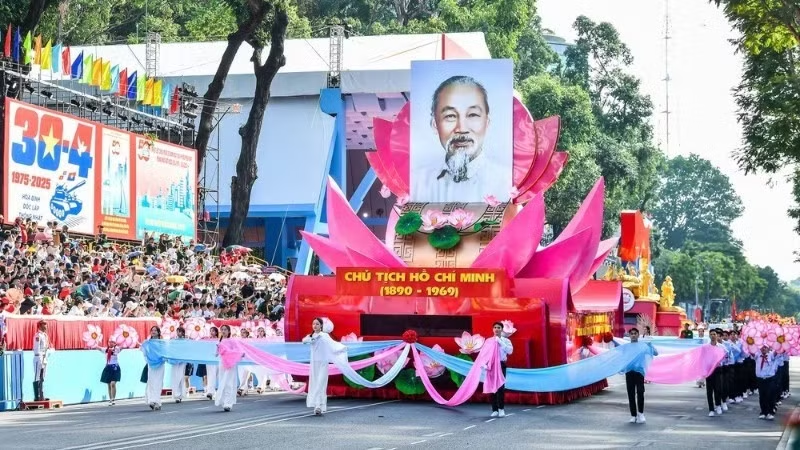
In the current phase of development, as the country faces the imperative of faster, more sustainable, and inclusive growth, the lesson of national unity must be more deeply internalised: to advance on the path to prosperity, the nation must continue to sustain and harness the strength that made the Spring of reunification possible.
The date of April 30 always evokes a special sentiment among Vietnamese people. It is a moment of deep emotion in remembrance of the immense sacrifices made by generations, and of pride in the stature of a nation that overcame formidable challenges to achieve reunification.
Yet April 30 is not merely a milestone for remembrance and gratitude. It is also a point of reflection on the country’s development path today. For the victory of 1975 was not simply the result of military strategy or historical opportunity; more profoundly, as General Secretary and President To Lam emphasised in his address marking the 50th anniversary of the Liberation of the South and National Reunification, it was a triumph of the will for independence, self-reliance, and resilience, of the aspiration for peace and unity, and above all, of the strength of national unity.
Therefore, the greatest value that the Day of Victory offers today lies not merely in heroic memory, but in its message for development. If, in wartime, national unity was the force that enabled the country to overcome bombs and bullets and secure independence and reunification, then in peacetime it must become the strength to overcome backwardness, escape the middle-income trap, and bridge disparities in development opportunities across regions and social groups, working together towards a strong, prosperous, and happy Viet Nam.
In other words, national reunification was the historic achievement of the 20th century, while transforming that unity into a driver of development is the historic task of the 21st century.
In recent statements, General Secretary and President To Lam has repeatedly underscored a core principle: development must not be detached from the people.
In his address on April 7, 2026, upon assuming the office of President, General Secretary To Lam affirmed that the foremost priority is to thoroughly internalise the principle that “the people are the root”, to strongly promote the people’s role as central actors, to mobilise the strength of the people and the great national unity bloc, and to ensure that the ultimate goal is for the people to benefit from the fruits of development.
This is not merely a political message, but also a clear definition of the quality of growth in the new era. Growth is meaningless if it does not translate into better living standards for the people. Development cannot be sustainable if people do not feel they are the central actors, partners, and beneficiaries of that process.

Viewed in the context of commemorating April 30, the depth of this historical lesson becomes even clearer. Those who sacrificed their lives for reunification did not do so merely for nominal peace. What they aspired to — and what the entire nation continues to strive for — is a truly strong and civilised Viet Nam, where all citizens enjoy prosperity, freedom, compassion, and opportunities for development.
Therefore, the most meaningful way to honour April 30 is not only through solemn commemorations, but by turning peace into development and fostering unity in belief, interests, and aspirations for the future.
It must be recognised that national unity is not merely a spiritual value or a political slogan. It is a tangible resource for development. When society is cohesive, when public trust is strengthened, and when people have confidence in the development path, businesses are more willing to invest, local authorities more determined to innovate, institutions more effective, and major reforms more likely to be implemented swiftly.
Conversely, for economic growth to reinforce national unity, it must itself be inclusive and people-centred. There can be no lasting unity if wide disparities persist between urban and rural areas, plains and mountainous regions, and core and remote areas.
Nor can long-term social consensus be sustained if the fruits of growth are concentrated in a few sectors, while parts of the population continue to struggle with livelihoods, education, healthcare, and opportunities for advancement. Thus, what April 30 offers today is not only a spirit of national solidarity, but also a clear political responsibility: to ensure that development reaches all people and all regions, so that everyone has a stake in the country’s future.
Notably, in remarks marking the Great National Unity Day in 2025, General Secretary and President To Lam affirmed that national unity is a tradition, an asset, and an invaluable heritage passed down through generations, and the source of all victories and achievements of the nation.
This perspective is highly instructive. To regard national unity as an “invaluable heritage” is to see it not merely as a memory to be preserved, but as a form of spiritual capital that must be safeguarded, nurtured, and translated into action at every stage of development.
A nation that preserves this heritage of unity will possess strong resilience in the face of change, robust internal strength amid international competition, and the capacity to mobilise diverse resources towards a common goal. This is the fundamental condition for rapid yet stable development, high growth alongside stability, and dynamic innovation while maintaining identity and social cohesion.
From this perspective, April 30 presents a dual imperative. On the one hand, it requires nurturing patriotism, national pride, and a sense of responsibility for the shared destiny. On the other, it demands translating these values into practical capacity for organising development.
This entails building stronger institutions, creating a more transparent business and investment environment, enhancing social welfare, and ensuring more balanced development in culture, education, and healthcare, so that national unity is felt in everyday life. When people perceive policies as closer, fairer, and more effective, and when genuine opportunities are created, national unity will cease to be an abstract concept and instead become a living foundation of the nation.
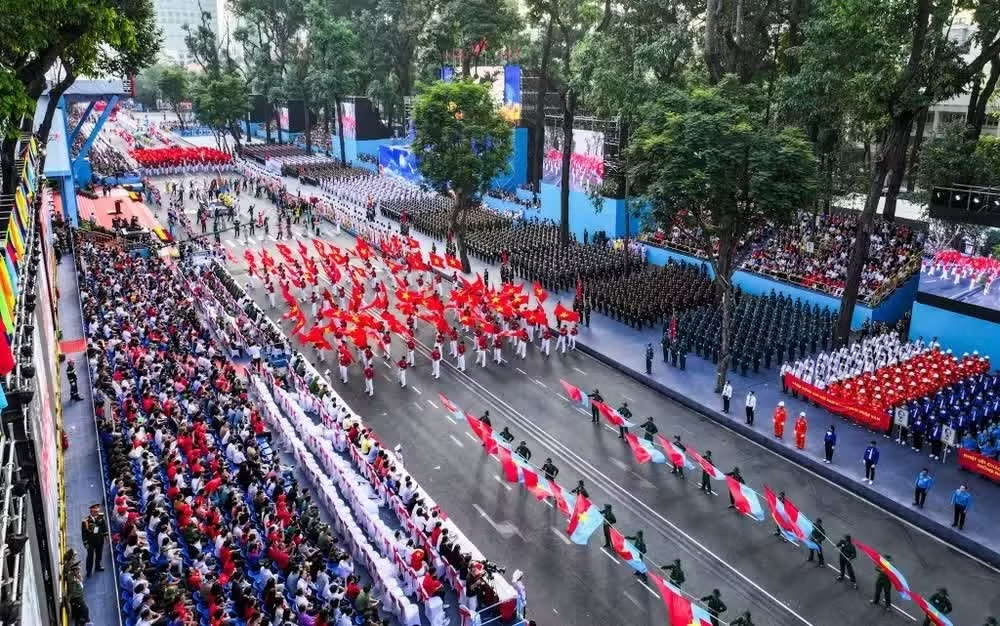
Half a century after reunification, what we can take pride in is not only the safeguarding of independence, sovereignty, and territorial integrity, but also the establishment of important foundations for a new phase of development. Yet much remains to be done. The world is changing rapidly, strategic competition is intensifying, and challenges relating to technology, climate change, non-traditional security, population ageing, and inequality of opportunity are all posing new questions.
In this context, no advantage is more enduring than national unity. No foundation is stronger than public trust. And no path is more sound than development centred on people, with the people as the driving force and national unity as its foundation.
As April returns, the red flag with a yellow star once again flies proudly across the country. In the national memory, April 30 will forever remain the Spring of reunification. But for today’s generation, it must also be the Spring of action — action to preserve what previous generations secured through sacrifice; action to turn peace into development, unity into prosperity, and solidarity into momentum for progress.
By doing so, we will not only prove worthy of the past, but also move confidently into the future, with the conviction that the strength which secured the great victory continues to carry the nation forward on its journey towards a strong, prosperous, civilised, and happy Viet Nam.