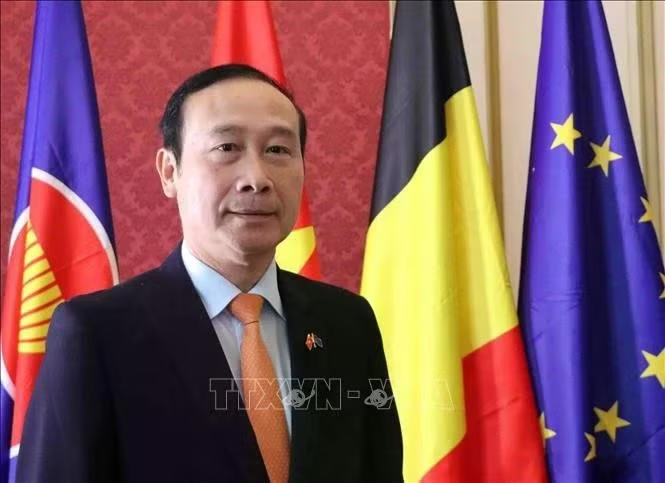
In an interview granted to the Viet Nam News Agency’s correspondents in Belgium, Thao noted that the visit reflects the EU’s recognition and appreciation of Viet Nam’s foreign policy of independence, self-reliance, multilateralisation and diversification of international relations, while affirming the country’s growing stature and credibility in the international arena, particularly as a key partner of EU in the Asia–Pacific region.
Costa has also shown strong personal interest in Viet Nam, reflected in his direct phone call with Party General Secretary To Lam on the 50th anniversary of the liberation of the South and national reunification (April 30, 1975 – 2025), as well as his congratulatory message to Vietnamese leaders on the 80th anniversary of National Day (September 2, 1945 – 2025), Thao noted.
According to the diplomat, the visit goes beyond protocol, providing an opportunity for leaders of the two sides to hold in-depth discussions on concrete and practical cooperation programmes, with a view to elevating Viet Nam–EU relations to higher levels, in line with the two sides’ potential and development demands amid mounting regional and global challenges.
Looking back on 35 years of diplomatic ties since 1990, Thao said that despite the relatively short timeframe, Viet Nam–EU relations have recorded substantial progress thanks to strong commitment from both sides. Cooperation has expanded across politics, economy, culture, society and people-to-people exchanges, underpinned by regular high-level engagements in both bilateral and multilateral settings.
Viet Nam–EU trade and investment cooperation has delivered strong results, with Viet Nam emerging as the EU’s largest trading partner in ASEAN. Viet Nam is also one of only four Asian economies—alongside Japan, the Republic of Korea and Singapore—to have concluded a free trade agreement with the EU, and stands out within ASEAN for having the most extensive and comprehensive cooperation mechanisms with the bloc.
Beyond trade and investment, Viet Nam and the EU have established key cooperation frameworks on climate change, notably the Just Energy Transition Partnership (JETP) with the G7 and the EU. The EU has also demonstrated strong commitment to supporting Viet Nam’s goal of achieving net-zero emissions by 2050, as pledged at COP26.
Cooperation in culture, society, and human resource development have also recorded practical outcomes, particularly in people-to-people exchanges, cultural collaboration, and education and training between Viet Nam and 27 EU member states. Many successful programmes have been carried out between Vietnamese universities and research institutes and their EU counterparts.
Thao noted that Viet Nam–EU cooperation holds significant potential, especially in key areas like trade and investment. With a GDP of nearly 20 trillion USD and a population of around 450 million, the EU offers strong demand for Viet Nam’s competitive products, while EU investment in Viet Nam still has room to grow, particularly in high-tech and innovation-driven sectors.
He highlighted science-technology and innovation as other pillars of the Viet Nam – EU cooperation, noting that the EU excels in both fundamental and applied research, and that strengthening collaboration in this field aligns with Viet Nam’s development demands while supporting the effective implementation of Resolution No. 57 of the Politburo on breakthroughs in science, technology, innovation, and digital transformation.
The diplomat expressed his belief that this visit, together with the agreements expected to be signed, will give new momentum to Viet Nam–EU cooperation in science, technology, and innovation.
In addition, Thao also spotlighted cooperation in environmental protection, water security, and cultural preservation as key pillars. He stressed that strengthening cultural exchanges and people-to-people connections not only builds a sustainable foundation for political and economic ties but also promotes tourism and mutual understanding between Viet Nam and the EU.