Amid a rising wave of protectionism that has put pressure on the global trading system, the agreement stands as a testament that multilateralism remains the cornerstone for global stability and shared development.
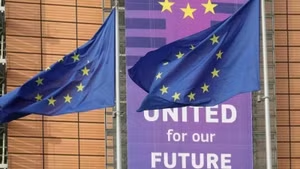
Although initially launched as early as 1999, the EU-MERCOSUR trade agreement took a quarter of a century to reach fruition. The main obstacles during the negotiations stemmed from strong opposition within certain EU member states. While major economies such as Germany and Spain were supportive, a bloc led by France resolutely opposed the deal over concerns related to environmental protection, agricultural competitiveness, and social impacts. Opposition was so widespread that anti-agreement protests persisted across the EU for many years.
However, through persistent efforts and concessions from both the EU and MERCOSUR, the deadlock was gradually resolved, enabling the two sides to reach this historic agreement. The signing ceremony in Paraguay recently concluded decades of challenging negotiations and marked the beginning of a new era of cooperation across the Atlantic.
European Commission (EC) President Ursula von der Leyen emphasised that the agreement will create one of the world’s largest free trade areas, encompassing more than 700 million people and accounting for approximately 20% of global GDP. Brazilian President Lula da Silva, from MERCOSUR’s leading nation, described the deal as a “win-win agreement.”
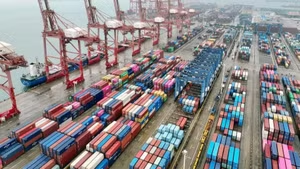
Economically, the agreement represents a strategic investment by the EU to diversify export markets, enhance competitiveness, and strengthen its influence as a reliable trade partner. Tariff barriers will be gradually removed, opening significant opportunities for key EU export sectors such as automobiles, machinery, and pharmaceuticals to access the vast South American market. The EC estimates that EU exports to MERCOSUR could grow by around 39% annually, creating additional employment opportunities for hundreds of thousands of Europeans.
Beyond goods trade, cooperation will also expand into strategic minerals, helping the EU secure supply chains necessary for digitalisation and the green transition. This is particularly significant given increasing global supply chain disruptions caused by geopolitical conflicts and unpredictable changes in trade policies.
For MERCOSUR, the agreement represents a “golden opportunity” for businesses to penetrate a market of around 450 million people, boost exports, and attract investment from the EU. Furthermore, the deal acts as a protective mechanism, enabling South American nations to respond more effectively to global economic volatility and rising protectionist trends.
Beyond pure economic benefits, the agreement is a resounding victory for multilateralism. In recent years, the international trading system has been shaken by tariff wars and waves of protectionism. Against an increasingly fragmented geopolitical backdrop, many experts have even expressed concerns about the decline of multilateralism.
In this context, the EU-MERCOSUR agreement serves as a vivid demonstration of the enduring strength of a rules-based international trade system, where cooperation is the key to unlocking development opportunities for all countries.
While considered a major step forward in interregional relations, the EU-MERCOSUR trade agreement will still face several challenges before full implementation, primarily due to France and some member states maintaining their opposition. Analysts expect that the agreement will soon overcome these hurdles, ushering in a new chapter in EU-MERCOSUR relations.