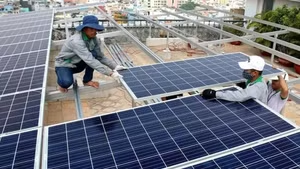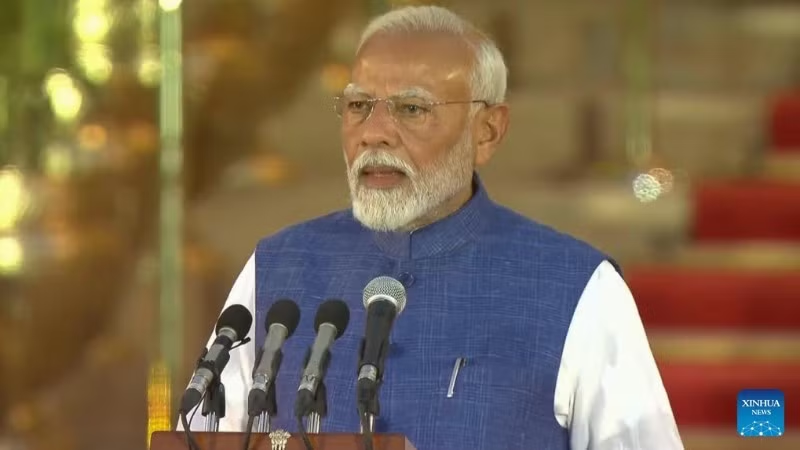
The success of the visit is demonstrated by the signing of 11 cooperation agreements, providing strong impetus to the India-Malaysia Comprehensive Strategic Partnership, which was established in August 2024. The documents signed this time reflect the expansion of cooperation in many key areas, beyond the framework of traditional trade, including defence and security, energy, semiconductors, and cross-border digital payments. Speaking with his Malaysian counterpart Anwar Ibrahim, Prime Minister Modi proudly affirmed that the results achieved during the visit bring “new speed and depth” to India-Malaysia relations in particular and India-ASEAN cooperation in general.
The Indian Prime Minister's visit demonstrates New Delhi's new vision and approach to expanding and diversifying relations with traditional and non-traditional partners. This is evident in New Delhi's efforts to promote cooperation with a range of countries across continents, even with the pressure from the high reciprocal tariffs 50% from the US having eased after the effective phone call between Prime Minister Modi and US President Donald Trump, along with positive negotiations, goodwill, and concessions from both sides.
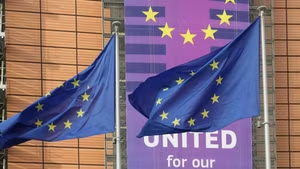
India has also made significant progress in its cooperation with European partners. In early 2026, India and the European Union (EU), within the framework of the India-EU Summit held in New Delhi, announced the completion of negotiations for a bilateral Free Trade Agreement (FTA), which is expected to be signed soon this year. This is considered a significant step forward because the FTA negotiations between New Delhi and the EU were not a smooth road, but faced many difficulties, including an eight-year interruption that seemed insurmountable, and were only resumed in 2022.
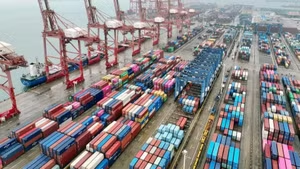
Previously, Modi made his fourth visit to the UK since assuming the position of prime minister in 2014. During this trip, the two sides successfully signed a bilateral trade agreement, which is widely considered as a new impetus for the world's fourth and sixth largest economies. Under the agreement, over 90% of UK exports to India will see phased tariff reductions over 10 years, with cosmetics, clothing, food, and beverages benefiting from the largest cuts. New Delhi's average tariff on London products will fall from 15% to 3%, with immediate tariff reductions for salmon, lamb, and machinery, and gradual trade liberalisation for chocolate, cosmetics, and automotive parts. Whisky and gin are the biggest beneficiaries, with tariffs halved to 75% immediately, and set to be further reduced to 40% in the tenth year.
This trade agreement is estimated to bring the UK economy around 4.8 billion GBP (over 6.4 billion USD) each year, boosting London's exports to New Delhi to increase by 60%, equivalent to 15.7 GBP billion by 2040, while creating thousands of jobs, opening new opportunities for businesses, and boosting growth in the UK. Not only are European countries benefiting, but India is also reaping significant rewards from the elimination of tariffs on 50% of its exports to the UK, including key products such as textiles, footwear, and agricultural products.
The Prime Minister of India's visit to Malaysia is seen as a brushstroke in the ongoing picture of cooperation that New Delhi has been actively and proactively expanded over the past time. The South Asian nation's economy, which has experienced very high growth rates for many years and recently risen to fourth place in the world rankings, has a significant contribution of these diverse cooperations.