The administration of US President Donald Trump is adopting a more proactive approach in its counter-terrorism strategy by stepping up direct coordination with partners in the region in order to safeguard US interests against potential threats.
General Anderson’s warning comes as extremist armed groups intensify pressure in a number of strategic areas, directly threatening the security of capitals across West African countries and expanding their operations into neighbouring states. The region is facing severe challenges, including security instability in the Sahel and coastal countries, terrorism, political instability, illegal arms trafficking and transnational organised crime.
The so-called “tri-border area” between Niger, Burkina Faso and Mali is frequently the scene of violence carried out by groups linked to al-Qaeda and IS, making it a hotspot for jihadist activity.
According to the Armed Conflict Location & Event Data (ACLED), Tillaberi was the deadliest area in the central Sahel region in 2025, with more than 1,200 fatalities, most of them civilians. In 2025 alone, violence perpetrated by jihadist groups claimed nearly 2,000 lives across Niger. Niger, Burkina Faso and Mali have established the Alliance of Sahel States (AES) to build a joint military force of around 5,000 troops to coordinate efforts against jihadist groups.
The international community has voiced deep concern over the surge in terrorist attacks in West Africa and the Sahel, with many observers arguing that the epicentre of global terrorism has shifted from the Middle East to this region, which now accounts for at least 47–59% of all terrorist incidents worldwide.
Recent statistics show that West Africa and the Sahel record an average of 44 deaths per day as a result of terrorist attacks. Terrorist violence has increased nearly 12.7-fold over the past 15 years, while the number of fatalities has risen 28.6 times.
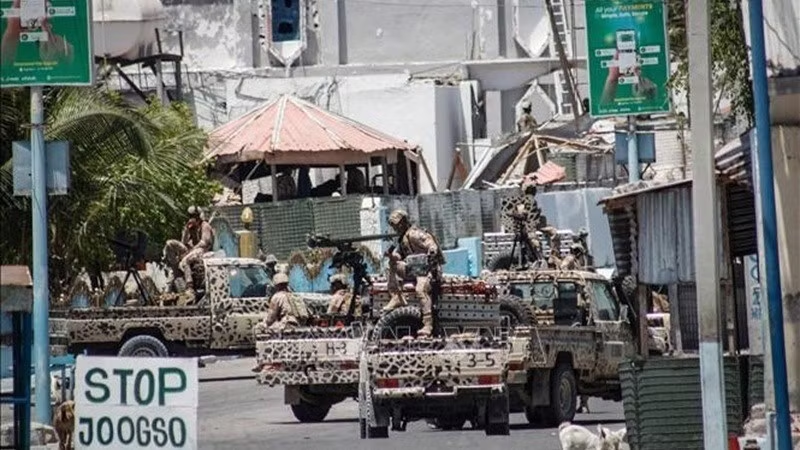
Alongside terrorism, piracy in the Gulf of Guinea and human trafficking have further weakened community resilience. Current threats are no longer limited to armed attacks, but also include arms smuggling and support for terrorist groups such as Al-Shabaab, undermining security along key maritime routes in the Gulf of Aden and the Red Sea.
One of the reasons West Africa has become “fertile ground” for extremist organisations to expand their activities lies in political instability, disputes and conflicts in certain countries, which have created “security vacuums”. Over the past decade, nearly half of the original member states of the Economic Community of West African States (ECOWAS) have experienced coups or attempted coups, heightening tensions among neighbouring countries.
Extremist groups are exploiting fractured relations between states in the region to expand their influence across the Sahel and the Lake Chad basin. Divisions, mistrust and limitations in information-sharing have undermined the region’s collective ability to address pressing challenges together.
Faced with the risk of widening security instability in West Africa, the US is seeking to strengthen cooperation with regional partners to enhance surveillance capabilities, border protection and maritime security. AFRICOM has said it will continue to work with willing and capable countries to counter shared threats, noting that the combination of national capabilities and US support has delivered positive results in recent years.
As part of Washington’s strategy to expand cooperation with military forces in Africa to counter armed groups linked to IS, the US military has increased the provision of military equipment and intelligence-sharing with Nigeria. The US has also eased certain restrictions on the supply of military hardware and capabilities, helping partner countries improve operational effectiveness on the ground. Notably, beyond security considerations, AFRICOM also views economic cooperation and investment potential as factors that directly contribute to strengthening stability and security in Africa.
Terrorism and violent extremism are not only persisting but are expanding in scale and sophistication at an alarming rate. As the security situation continues to deteriorate, the region’s overall risk level has now reached a high-risk threshold. ECOWAS has called on countries in the region to coordinate closely and respond swiftly to counter terrorist threats and cross-border crime.
Meanwhile, although the US is not increasing the deployment of direct combat forces, its new counter-terrorism approach — centred on deeper coordination with partners — underscores that Africa occupies an important place on the US “security map”, and that the region’s security remains closely linked to American interests.