The path towards realising the aspiration for peace for all humankind is fraught with immense challenges. Although peace and co-operation remain the dominant trends in international relations, the world has in recent times continued to grapple with growing, widespread and increasingly complex instability.
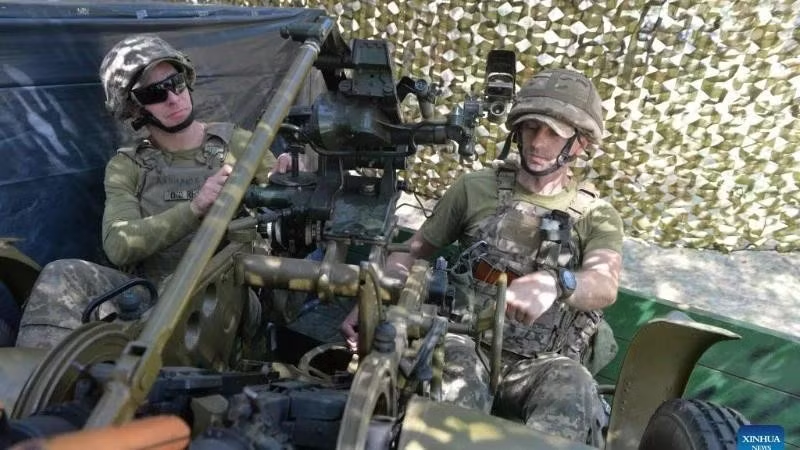
The conflict in Ukraine has officially entered its fifth year, violence persists across many African countries, while peace in the Middle East remains but a “narrow window of opportunity”. Adding to this sombre picture are swiftly escalating tensions in parts of Asia, the Americas and other regions.
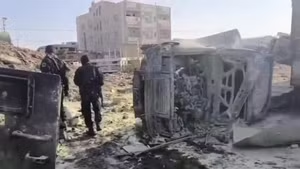
According to statistics from the Armed Conflict Location & Event Data Project (ACLED), a global conflict monitoring organisation, the number of violent incidents worldwide has doubled over the past five years. The Global Peace Index has declined for several consecutive years. Civilians are caught in the vortex of violence and bear the heaviest toll.
Research by the Geneva Academy of International Humanitarian Law and Human Rights in Switzerland indicates that more than 100,000 civilians have been killed in armed conflicts worldwide over the past 18 months. Millions have been forced into a “great migration” to flee conflict, with no certainty of return.
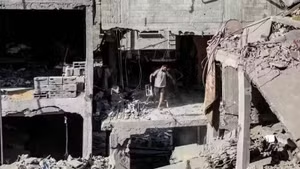
In places such as the Gaza Strip, hostilities have not only caused devastating loss of life and infrastructure but have also destroyed the future, as an entire generation of children have either perished or carry physical and psychological trauma that may never heal.
Global military expenditure has reached a record high of 2.7 trillion USD, many times greater than total official development assistance and equivalent to the entire GDP of Africa.
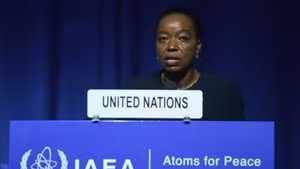
United Nations Secretary-General Antonio Guterres has pointed to the harsh reality: “The world is spending far more on waging war than in building peace.”
According to United Nations estimates, ending world hunger before 2030 would require only 4% of the vast sums currently spent on the military. Redirecting even a small fraction of military expenditure could have profound significance, helping to fill many critical gaps.
These include eradicating child malnutrition, supporting developing countries in adapting to climate change, investing in education in low- and lower-middle-income nations, and bringing the international community closer to achieving the Sustainable Development Goals (SDGs).
Despite facing numerous challenges, the aspiration and efforts to build a peaceful world for all continue unabated. More than 60,000 peacekeepers from 115 United Nations member states are currently deployed worldwide with the mission of protecting civilians, mediating conflicts and preventing escalation.
In addition, several countries, such as Oman, Qatar, Saudi Arabia and the United Arab Emirates, have emerged as “messengers of peace”. With foreign policies grounded in mutual respect, non-interference, mutual benefit and the ability to maintain the trust of all parties, these nations have acted as constructive bridges, contributing significantly to easing tensions in the Middle East and beyond.
Regarding Ukraine, although the prospects for peace remain fragile, a series of recent trilateral negotiations have marked a new development. Meanwhile, efforts to establish sustainable peace in Gaza have recorded a notable milestone with the establishment of the Gaza Peace Council.
With the participation of heads of state and leaders from more than 50 countries, including founding members and observers, the council opens up opportunities for countries and the United Nations to co-ordinate humanitarian assistance, reconstruction and stabilisation efforts in Gaza.
These mediation efforts demonstrate that building a world free from war, conflict and violence where all peoples can live in safety and freedom. Notably, sustainable development remains humanity’s foremost objective.
It is a burning aspiration, yet also a formidable challenge that no single nation can resolve alone.