Both sides reaffirmed their strong ties and their commitment to fostering a climate of cooperation, security and stability across the Eurasian continent.
Russia is Kazakhstan’s largest foreign investor, and economic cooperation between the two nations continues to grow through new joint projects, with Russia accounting for approximately 19% of Kazakhstan’s total international trade.
The two sides have settled most transactions in their national currencies, helping to shield bilateral trade from external pressures. Cooperation has also focused on the energy sector, particularly the expansion of transit routes for Russian oil through Kazakhstan, as well as infrastructure development.
This marked President Putin’s second official visit to Kazakhstan during his current term in office. Although diplomatic protocol generally limits state visits to one per term, the leaders of both countries agreed to waive this convention to underscore the strategic nature of cooperation between their countries.
Accompanying President Putin was a delegation of 30 people, including senior officials and representatives of major Russian companies. The delegation participated in a series of EAEU-related meetings and events in Astana alongside delegations from various countries totalling some 400 representatives.
President Putin also delivered an address at the 5th Eurasian Economic Forum, which centred on digital transformation and artificial intelligence.
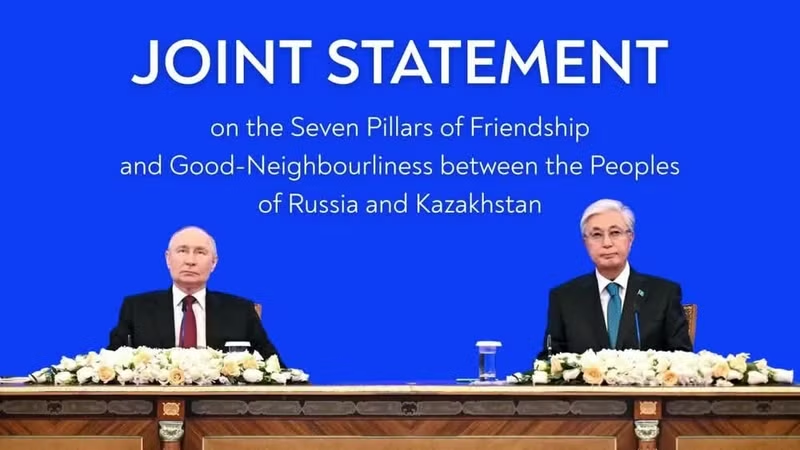
Talks between President Putin and his Kazakh counterpart, Kassym-Jomart Tokayev, concluded with a joint statement underscoring the visit’s significance for the development of their strategic partnership.
The statement on seven pillars of cooperation made deepening bilateral ties across all areas a central priority. The two countries also pledged to intensify efforts to advance Eurasian integration, with the goal of establishing a regional framework for cooperation, security and dialogue.
The cooperation framework envisions transforming the shared border into a zone of good neighbourliness, while recognising the two countries’ economic partnership and shared linguistic and cultural heritage as part of a common heritage.
Among the key agreements signed during the visit were a 16.4 billion USD deal to build Kazakhstan’s first nuclear power plant and an intergovernmental agreement to expand cooperation in the oil and gas sector.
President Putin described Russia-Kazakhstan relations as growing dynamically on the basis of equality and mutual respect. He also highlighted effective cooperation in areas such as the development of international transport corridors, digitalisation and the adoption of artificial intelligence across economic sectors.
For his part, President Tokayev praised the results of bilateral economic cooperation and reaffirmed the target of increasing bilateral trade to 30 billion USD. He noted that the two countries are currently implementing 177 joint projects with a combined value of nearly 53 billion USD. The Kazakh leader also stressed that no major international issue can be resolved without Russia’s direct involvement.
During his visit, President Putin attended a meeting of the Supreme Eurasian Economic Council in Astana, where the 5th Eurasian Economic Forum was also officially opened, launching a series of high-level regional economic events. The forum gave priority to shaping the technological future and advancing a shared vision of an AI-driven digital economy.
Speaking at the plenary session, President Putin stated that Russia holds a competitive edge in the race for AI leadership and is prepared to deploy related technologies. He also emphasised the benefits of deeper integration within the EAEU.
The Kazakh leader, meanwhile, emphasised that the transition to a digital economy and the advancement of AI are essential if the country is to avoid stagnation as traditional growth drivers, such as natural resources and cheap labour, gradually lose their impetus. To that end, Kazakhstan has designated 2026 as the national “Year of AI and Digital Development” and used the forum to present its pioneering strategic initiatives in this field across Central Asia.
The 5th Eurasian Economic Forum was expected to reinforce the EAEU’s role in the global economy at a time of intensifying geopolitical competition and rapidly shifting opportunities and challenges demanding closer international cooperation.
Against this backdrop, the deepening partnership between Russia and Kazakhstan stands to benefit not only the two countries but also contributes to advancing a broader space of cooperation, development and stability across the Eurasian continent.