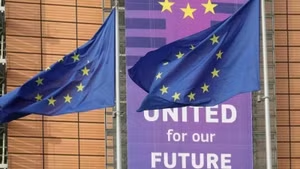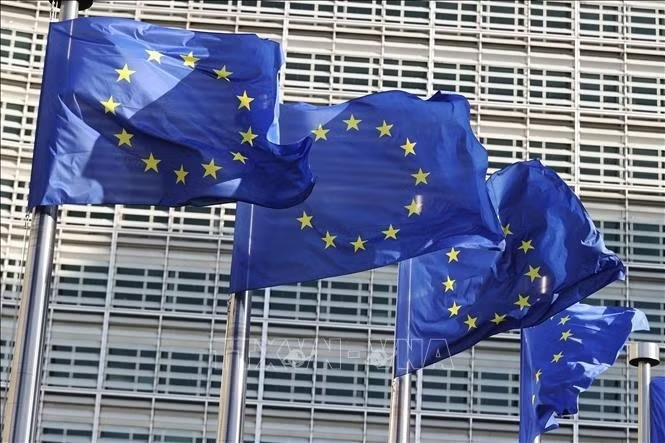
To end decades of dependence on Russian energy sources, the EU announced that it will stop importing liquefied natural gas (LNG) from Russia by the end of 2026 and pipeline gas by the end of September 2027. European Commission President Ursula von der Leyen considered this a historic turning point, marking the moment the European Union officially enters an era of energy independence from Russia, and opening up opportunities for sustainable energy development.
However, the EU’s decision immediately met with opposition from several member states such as Hungary and Slovakia, which are heavily dependent on supplies from Moscow.
According to Hungarian officials, LNG terminals must be located near deep-water ports to serve large LNG tankers. The Baltic and Nordic countries, with their coastal advantages, could quickly diversify their supply sources by establishing LNG import facilities from the US, and Norway.
Meanwhile, due to its unique landlocked geographical location, building infrastructure for importing, storing, and distributing LNG has become an “impossible task” for Hungary.
Therefore, the flow of natural gas from Moscow plays a crucial role in Budapest’s energy security. This explains why Hungary has consistently opposed the ban on Russian gas imports for many years.
In a similar reaction, Slovak Prime Minister Robert Fico also expressed concern that replacing the cheap and stable supply from Russia would drive up energy prices, erode the competitiveness of businesses, and harm the economy as a whole.
The two Central European countries even warned they were considering appealing the EU’s decision to the European Court of Justice. This situation poses a challenge for the EU, because without coordinated efforts from all members, the goal of completely cutting off the flow of natural gas from Moscow is unlikely to be achieved.
Along with differing viewpoints among member states, the EU also faces many difficulties in achieving its stated goal. A key issue is the requirement to diversify supply sources.
According to the agreement reached, EU member states will submit their supply diversification plans to the EC before March 2026. Clearly, the EU’s cessation of imports will cause Russia to lose a significant source of revenue, but this plan could also create difficulties for the EU itself.
Without quickly finding stable and affordable alternative sources, the EU risks falling into a new cycle of rising energy prices, leading to economic instability.
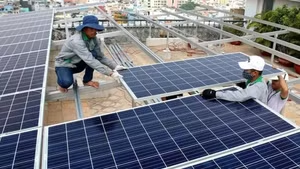
Undeniably, the EU has made persistent efforts in realising its goal of ensuring energy security. After a challenging period, the EU has made significant progress in developing numerous renewable energy projects and expanding its network of partners.
A recently published EC report shows that natural gas from Russia currently accounts for only about 13% of the EU’s total imports, a sharp decrease from the 45% recorded in 2021.
However, to replenish reserves, the EU has been forced to import LNG at a much higher cost than from Russia. New suppliers have also not been able to quickly fill the gap left by Russia’s cheap and stable supply.
This reality not only drives up energy prices but also threatens to undermine the competitiveness of EU businesses in the global market.
Alongside optimistic views on the prospects of the EU energy sector soon becoming self-sufficient, some experts express concern that with the harsh winter approaching and gas prices escalating, the EU may face a new energy crisis.
This open question presents the EU with the challenge of balancing political goals with the needs of economic development.