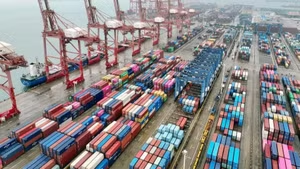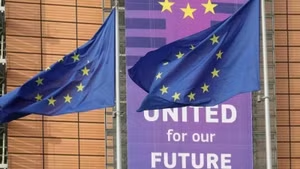
The FTA, signed in January 2026 between the EU and the four founding MERCOSUR members — Argentina, Brazil, Paraguay, and Uruguay — establishes one of the world’s largest free trade areas, covering more than 700 million people. It will gradually eliminate tariffs on over 90% of trade flows between the two blocs, which together account for around 30% of global GDP.
MERCOSUR primarily exports agricultural and mineral products to the EU, while increasing exports of machinery, chemicals, and pharmaceuticals from Europe to South America. Under the agreement, MERCOSUR will remove 91% of tariffs on European goods, while the EU will lift 92% of tariffs on imports from South American countries. The deal is expected to help EU businesses save approximately 4 billion EUR in duties annually and facilitate investment in key supply chains, including strategic raw materials.
The EU views the agreement with MERCOSUR as part of a broader strategy to diversify partnerships, reinforce autonomy, strengthen multilateralism, and uphold a rules-based international order. The deal is also expected to allow small and medium-sized enterprises to access larger markets. Germany and Spain have welcomed the EC’s decision, arguing that the FTA with South American countries will create additional growth opportunities, expand markets, and enhance the EU’s resilience to global trade fluctuations.
Although the agreement has yet to receive formal approval from the European Parliament (EP), the EC’s decision came after Argentina and Uruguay ratified the deal. According to EU trade spokesperson Olof Gill, provisional implementation will begin on the first day of the second month following the exchange of diplomatic notes between the EU and Uruguay — the first MERCOSUR country to complete ratification. The agreement will apply to ratifying countries, while Brazil and Paraguay are expected to finalise their procedures in the near future.
Despite being backed by a majority of EU member states, the agreement with MERCOSUR faces strong opposition from France, Poland, and farmers’ associations. France has taken the lead among dissenting countries, citing concerns that low-cost agricultural imports from Brazil and other South American nations could place competitive pressure on its domestic farming sector.
Agricultural organisations argue that the deal would exert significant strain on European agriculture due to competition from cheaper products that may not fully comply with the EU’s stringent standards. French President Emmanuel Macron described the EC’s recent decision as “a bad surprise”, saying it did not fully respect the role of the EP, as the agreement has yet to be approved by the EP.
Opposition from several EU member states has created significant legal hurdles for the agreement with the South American countries. The EP has voted to refer the deal to the Court of Justice of the European Union (CJEU), and lawmakers have adopted a request asking the court to determine whether the agreement is compatible with EU policies, a move that could delay its implementation.
Amid divergent views, the EU faces the challenge of striking a balance between advancing trade liberalisation and safeguarding farmers’ interests, while maintaining social stability within the bloc.