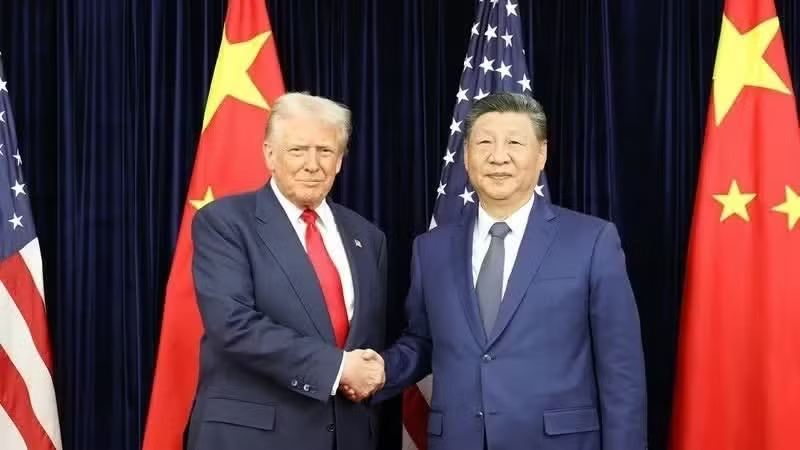
President Donald Trump has begun the first visit by a US President to China in nearly a decade. Occurring at a crucial juncture in US-China relations, the visit to Beijing by the occupant of the White House presents an opportunity for the two sides to reduce differences and expand cooperation in numerous sectors between the world’s two largest economies.
This marks President Donald Trump’s first visit to China since winning re-election for a second term. Trump previously paid a State visit to China in 2017 during his first term in office.
This US-China summit has attracted significant international attention as the leaders of the world’s two largest economies meet face to face. Notably, accompanying President Trump are several prominent US business leaders, including Tesla Chief Executive Elon Musk and Apple Chief Executive Tim Cook, alongside representatives from Qualcomm, ExxonMobil and Boeing.
In recent years, head-of-state diplomacy has been regarded as an “anchor” for China-US relations, playing an important role in maintaining stability amid global turbulence. Since the start of his second term, President Trump and Chinese President Xi Jinping have held five telephone conversations to maintain communication and discuss bilateral relations as well as pressing global issues.
During their most recent talks in Busan, the Republic of Korea, in October 2025, the two leaders sought ways to steer China-US relations through uncertainties. At that meeting, President Xi Jinping likened himself and his US counterpart to two captains guiding the “giant ship” of bilateral relations steadily through rough seas.
Although China-US relations have experienced considerable ups and downs, including disputes over tariffs, Beijing has consistently maintained open channels of dialogue with Washington. China has dispatched economic and trade delegations for six rounds of negotiations with the US side, seeking to narrow differences while expanding common ground.
By focusing on the long-term benefits of cooperation rather than falling into a spiral of retaliation, trade relations between the two countries have remained relatively stable. The two sides currently maintain a one-year “tariff truce” reached during high-level talks in the Republic of Korea last year.
During this visit, the two leaders are expected to discuss a wide range of important topics, including the possibility of establishing a “US-China Trade Council” and a bilateral “Investment Council” to promote cooperation in sectors such as aerospace, agriculture and energy. US Trade Representative Jamieson Greer stated that the new mechanisms could facilitate trade worth tens of billions of USD between the world’s two largest economies and would involve only non-sensitive goods.
Another closely watched issue is the possibility of extending the “trade truce” agreement. Under this arrangement, China agreed to approve exports of strategic minerals and delay the implementation of certain new export control measures, while the US temporarily suspended trade restrictions and export controls related to China.
Iran and security in the Strait of Hormuz are also expected to feature prominently in discussions between the two leaders. Observers believe Washington wants Beijing to encourage Tehran to reach an agreement with the US, given that China is currently the largest buyer of Iranian crude oil. Ahead of the US-China summit, diplomatic and security activities related to Iran and the Strait of Hormuz have intensified, as both Washington and Beijing seek to maintain regional stability and ensure security along this strategic maritime route.
In addition, strategic competition over artificial intelligence (AI) is expected to be another key topic of discussion, as both sides share concerns over risks such as AI being exploited to develop biological weapons, launch cyber attacks or sabotage critical infrastructure.
Leaders in both the US and China recognise that maintaining stable bilateral relations not only helps remove obstacles to each country’s development, but also carries profound significance for global stability and prosperity. According to experts, while major breakthroughs from the White House leader’s visit to Beijing may be difficult to expect, if the two sides can temporarily set aside disputes and establish cooperation mechanisms based on clear principles, this would represent a notable step forward in further opening the door to cooperation between the world’s two largest economies.