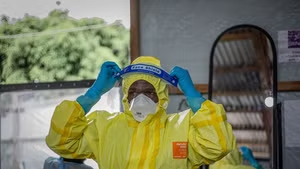
A series of countries have activated strict disease-control procedures to prevent the spread of the rodent-borne Hanta virus.
Such caution and concern are understandable as the “ghost” of Covid-19 continues to haunt billions of people worldwide, while fatalities linked to the Hanta virus have already been recorded. The MV Hondius is scheduled to dock at a port in Spain’s Canary Islands on May 11 with nearly 150 passengers on board.
However, a group of passengers had earlier disembarked on Saint Helena Island in the Atlantic Ocean, complicating contact-tracing efforts. In addition, the exact number of people who left the ship has yet to be determined.
While the vessel’s operator, Oceanwide Expeditions, stated that only 29 people had disembarked, the Dutch Ministry of Foreign Affairs said the number was as high as 40 people of various nationalities.
The three confirmed fatalities from the Hanta virus included a Dutch couple and a German man. The two men died on board the vessel, while the woman died after arriving in South Africa. The Dutch Ministry of Health announced that a flight attendant was undergoing Hanta virus testing after developing mild symptoms and being hospitalised in Amsterdam.
The flight attendant was traced as having been in contact with the wife of a Dutch worker who died in South Africa from the Hanta virus. The woman had travelled on a KLM flight from Johannesburg to Amsterdam.
Dutch health authorities are urgently contacting passengers who were on the flight for screening and quarantine measures. A man in Switzerland tested positive for the Hanta virus after disembarking from the ship and returning home by air.
To date, eight Hanta virus infections and three related deaths linked to the MV Hondius cruise ship have been recorded.
What concerns health authorities most are the unanswered questions surrounding whether passengers who left the vessel were carrying the virus and whom they may have come into contact with. There are also fears over whether new Hanta virus clusters could emerge from these passengers.
Amid the complicated developments of the Hanta outbreak, health agencies in South Africa and Europe are conducting large-scale tracing efforts to identify people who had contact with passengers leaving the vessel.
The UK Health Security Agency (UKHSA) said two British passengers were self-isolating at home, while another British citizen had been evacuated from the vessel and transferred to the Netherlands for treatment.
The US Centers for Disease Control and Prevention (CDC) is closely monitoring the health conditions of US citizens who travelled on the MV Hondius. The US Department of State has ordered a coordinated inter-agency response, including direct contact with passengers and cooperation with international partners.
However, US citizens have expressed relief after US authorities affirmed that the current risk of disease transmission to the public remains very low. The MV Hondius stopped in Argentina and departed on April 1 before calling at Chile and Uruguay.
Argentine authorities are investigating the possibility of infections within the country, given that all three people who died from the Hanta virus had visited South American countries.
The Hanta virus spreads through rats and other rodents via contact with their waste or bodily fluids. The Andes strain identified on board the MV Hondius has limited human-to-human transmission capability, though close contact is required.
Symptoms may appear up to eight weeks after exposure and include fever, body aches, internal bleeding, respiratory failure, and kidney failure.
Medical experts said the current situation is not as severe as the early stages of the Covid-19 pandemic because the Hanta virus is less transmissible. Carrying nearly 150 people, the MV Hondius is currently anchored off Cape Verde awaiting medical assistance.
Observers believe that the hard-earned lessons from the Covid-19 pandemic will help health authorities successfully contain, trace, and handle the Hanta virus outbreak, preventing it from escalating into a global pandemic.