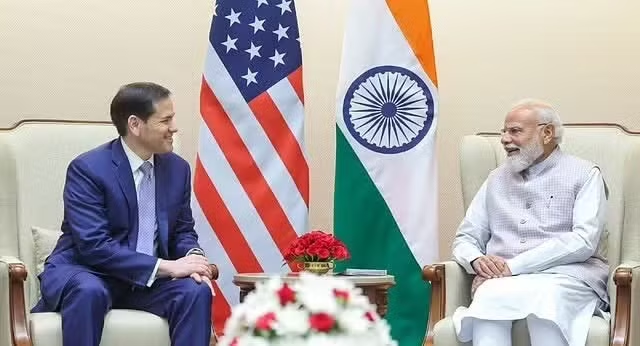
The head of US diplomacy affirmed the commitment to maintaining the strategic partnership with India, aiming to secure a closer “handshake” with the world’s most populous country in strategic areas such as defence, energy and advanced technology.
US Secretary of State Marco Rubio’s four-day visit to India takes place at a time when bilateral relations have faced turbulence following a number of disagreements over tariffs and changes in the US approach towards Pakistan. Washington’s closer engagement with Pakistan, especially Islamabad’s role in efforts to resolve the Iran crisis, is believed to have hurted US-India relations.
The shift in US foreign policy priorities has raised concerns in New Delhi, while trade tensions have cast a shadow over bilateral ties. Recent moves by President Donald Trump’s administration have unsettled more than two decades of US policy, which had consistently sought to strengthen relations with India and regarded the country as an important partner.
During the visit, Rubio and Indian Prime Minister Narendra Modi discussed progress in bilateral cooperation across various fields. The two sides exchanged measures to enhance the comprehensive global strategic partnership, while agreeing to strengthen trade and defence cooperation and accelerate collaboration in critical and emerging technologies.
With the “Mission 500” goal set by the leaders of the two countries to double bilateral trade by 2030, the visit also offered an opportunity for both sides to push for the early conclusion of a mutually beneficial trade agreement, considering it an important pillar of economic relations.
Showing readiness to bring US-India relations back to a stable trajectory, the Indian Prime Minister said the two sides had discussed steady progress in the partnership, as well as issues related to regional and global peace and security. He affirmed that New Delhi and Washington would continue to coordinate closely for shared interests.
For his part, Rubio described the US and India as “a strategic alliance” and said the trade partnership was the foundation of bilateral relations. Seeking to ease tensions caused by the Trump administration’s tariffs on imports from India, which reached up to 50% last summer, Rubio explained that the measures did not target India but were part of a global effort to create a better trade balance for the US.
Amid the conflict in the Middle East, which has seriously affected the global energy market and weighed on India’s economy, the US sought to reaffirm its commitment to ensuring energy market stability in order to ease dissatisfaction on the Indian side stemming from bilateral disagreements.
Rubio stressed that Washington would not allow the Middle East conflict to affect the global energy market, while saying US energy supplies could help India diversify its imports. Describing India as an extremely important partner of the US, Rubio said the two sides were preparing several important announcements in the coming months to further strengthen bilateral relations.
Notably, the visit also came ahead of the meeting of foreign ministers of the Quad, comprising the US, India, Japan and Australia, in India. Rubio held talks with his host counterpart S. Jaishankar and attended the Quad Foreign Ministers’ Meeting. This was an opportunity for the group’s members to advance their vision of a free and open Indo-Pacific, affirming the Quad’s role as an important pillar in shaping stability and security in the region. The US Department of State has described India as a cornerstone of the US approach to the Indo-Pacific.
US Secretary of State Marco Rubio’s visit has helped generate important momentum to reactivate ties with one of Washington’s most important partners. Despite outstanding issues in bilateral relations, both sides have underlined their shared interests in maintaining strategic cooperation.