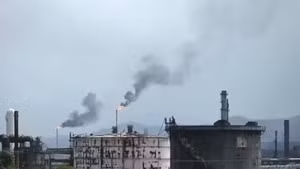
Europe is reeling from extreme heatwaves. The average temperature in Western Europe between June and July 2026 was 21.62°C, breaking the record set during the same period in 2022.
Carlo Buontempo, Director of Copernicus—the European Union’s (EU) global warming monitoring agency—stated that the past 11 years have been the hottest in recorded history. However, record-breaking temperatures are not the only issue associated with Europe’s heatwaves.
Pressures on the economy, as well as on water, health, and food security, have also been laid bare.
Severe droughts and plummeting river water levels are disrupting inland waterway transport, power generation, and the agricultural sector.
By early August 2026, Germany had recorded approximately 12,500 heat-related deaths for the year. This situation places immense strain on the healthcare system, particularly regarding the care of children and the elderly.
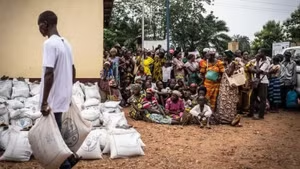
According to the World Food Programme (WFP), the El Niño phenomenon could push nearly 50 million people into acute hunger by 2027. These severe impacts are compelling governments to shift their perspective on climate change, recognising it as a global geopolitical challenge. Years ago, scientists predicted that climate change would heighten the risk of future conflict and violence between nations.
While poor governance and underdevelopment are often cited as the primary drivers of conflict and violence, climate change is also a root cause.
Climate change is also a key driver behind waves of illegal migration. The flow of refugees across international borders not only reflects a humanitarian crisis but also fuels xenophobia, leading to division and instability in many regions.
The world is not lacking in warnings about the severe impacts of climate change; what is missing is action taken at a commensurate pace and scale.
In 2024, wealthy nations contributed 136.7 billion USD in climate finance—a figure that remains a drop in the ocean compared to the estimated 1.3 trillion USD annually that developing countries require to adapt to climate change.
The agreement reached at the 30th UN Climate Change Conference (COP30) in Brazil in late 2025 leaves significant gaps regarding finance and the phase-out of fossil fuels.
Nations mired in conflict and warfare—such as Yemen and Somalia—are frequently among those hardest hits by climate-related disasters.
The “vicious cycle” linking climate change and national security is placing strain on countries' prospects for sustainable development.
Climate change directly impacts food and water security, triggering socio-economic instability; consequently, the capacity to respond to climate change is further undermined.
Current realities demonstrate that climate factors must be prioritized in security and development planning—such as by enhancing the resilience of urban areas and healthcare systems, and accelerating the adoption of new technologies for early warning and disaster risk management.