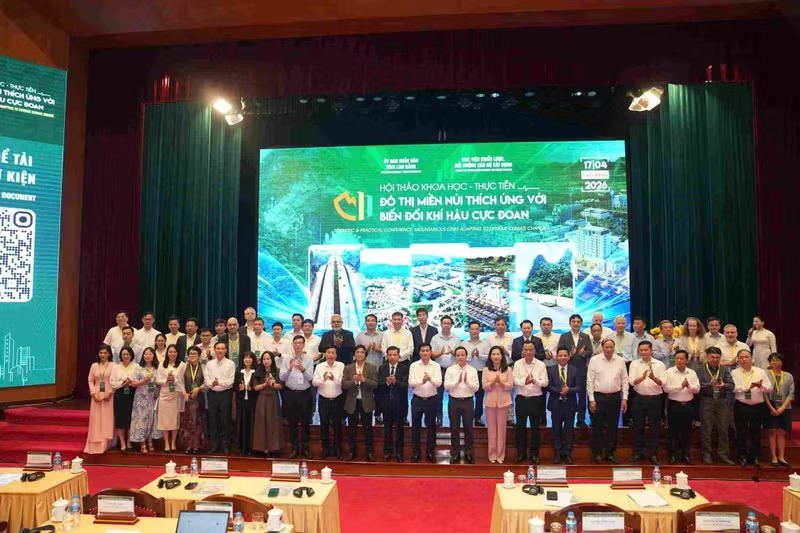
Rather than reacting passively, local Party committees are proactively focusing on infrastructure suited to the terrain and natural conditions, designed to adapt to climate change and manage risks early and from a distance.
Cao Bang prioritises resilient infrastructure and digital transformation
In 2024 and 2025, storms caused severe losses of life and property in Cao Bang Province, with damages estimated at more than 4.2 trillion VND. In the first quarter of 2026 alone, the province endured four episodes of thunderstorms with hail and lightning, inflicting major damage on housing, agriculture and infrastructure, directly affecting livelihoods. Losses were estimated at around 44.35 billion VND.
Faced with increasingly extreme and unpredictable weather, the Standing Committee of Cao Bang Provincial Party Committee affirmed that developing safe, climate‑adapted mountain towns is a solid foundation for achieving the socio‑economic, defence and security goals set out in the 20th Provincial Party Congress Resolution for the 2025–2030 term.
The Standing Committee of Cao Bang Provincial Party Committee affirmed that developing safe, climate‑adapted mountain towns is a solid foundation for achieving the socio‑economic, defence and security goals s
In early 2026, the Provincial Party Committee began preparing the general urban plan for Cao Bang for 2026–2035, emphasising the development of smart urban areas and the creation of a province‑wide urban development database.
The Provincial Department of Construction reports that Cao Bang is completing an integrated urban planning system linking development with disaster prevention, environmental protection and climate‑change adaptation. Investment is being prioritised in resilient technical infrastructure, particularly drainage systems, river and stream regulation, and erosion control.
Cao Bang has already built drainage systems and domestic wastewater treatment facilities for the provincial centre and invested in technical infrastructure for 56 communes and wards.
At the same time, the province is accelerating digital transformation in urban management, focusing on an integrated urban database, digitising planning records and applying geographic information systems (GIS) to collect, store, analyse and visualise spatial data.
Ninh Binh strengthens environmental protection and climate resilience
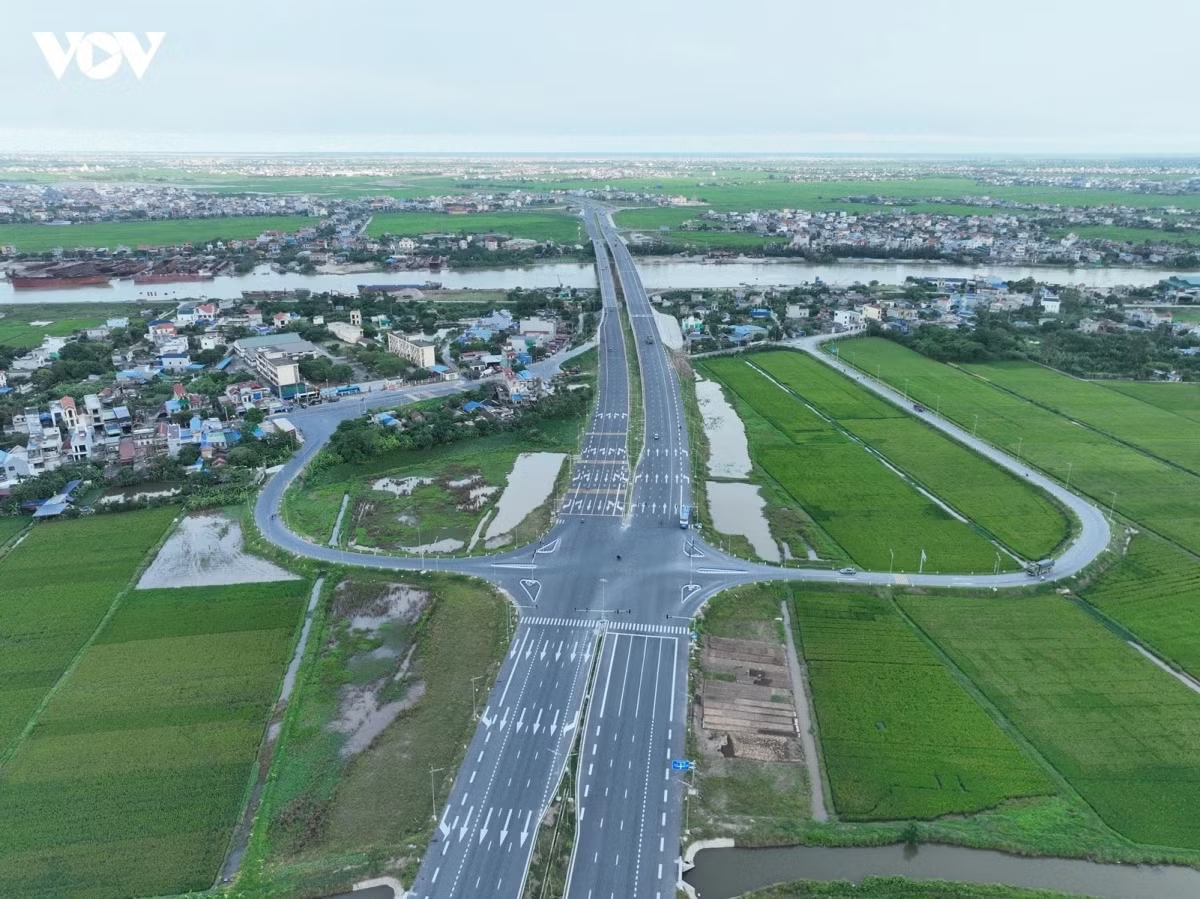
The Standing Committee of Ninh Binh Provincial Party Committee issued Directive No. 08‑CT/TU to address climate change and environmental incidents, assigning the Provincial People’s Committee and Party Committee to implement tasks on environmental protection, biodiversity conservation and climate adaptation in the provincial planning for 2021–2030 with a vision to 2050.
Meanwhile, the Ninh Binh People’s Committee has accelerated efforts to complete systems for collecting and treating urban and residential wastewater, improved solid‑waste management, and relocated polluting facilities away from residential and urban areas.
Provincial authorities also restrict land allocation and leasing in areas with valuable ecosystems, natural scenic beauty and beaches to projects that do not directly serve the community, thereby ensuring resilience to climate change and sea‑level rise.
Ninh Binh provincial authorities restrict land allocation and leasing in areas with valuable ecosystems, natural scenic beauty and beaches to projects that do not directly serve the community, thereby ensuring resilience to climate change and sea‑level rise.
This approach aims to preserve and enhance the natural landscape, ecology, coastal areas and shoreline environment.
Following Directive No. 08‑CT/TU, wards and communes across Ninh Binh promptly developed plans suited to local realities. In Ha Nam Ward, the Party Committee and People’s Committee have focused on investing in and upgrading urban transport systems to gradually increase the proportion of green, environmentally friendly transport.
Local authorities have also intensified efforts to review, classify, remediate and rehabilitate land contaminated by persistent pesticide residues, while strengthening protection of severely waterlogged areas. In addition, the ward has implemented coordinated measures to reduce water pollution and improve water quality in the Nhue–Day–Chau Giang river basins.