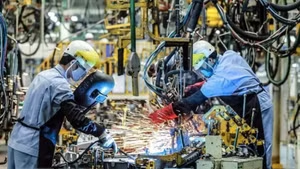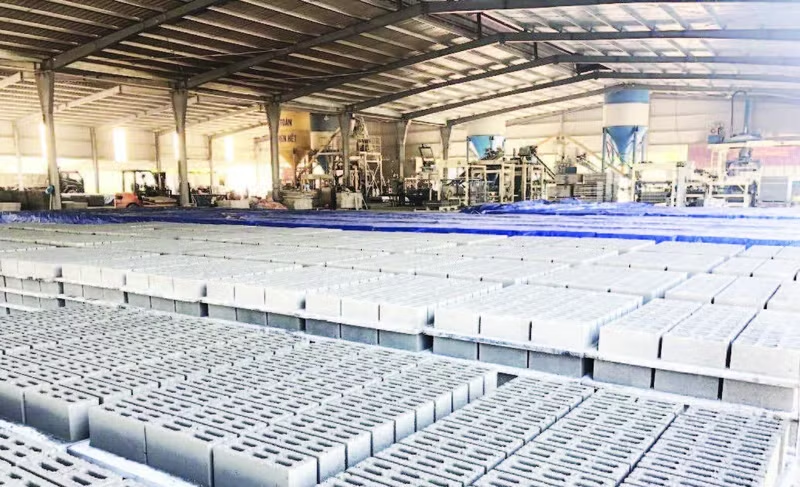
According to the Department of Science, Technology, Environment and Building Materials under the Ministry of Construction, building materials typically account for between 55% and 65% of the total value of construction projects. Viet Nam has now developed a large-scale building materials industry with one of the region's leading production capacities.
Each year, the country produces around 125 million tonnes of cement, 150 million cubic metres of concrete, 11.7 million tonnes of construction steel, 6.1 million tonnes of coated steel sheets, 2.5 million tonnes of welded steel pipes, 840 million square metres of ceramic tiles, 350 million square metres of construction glass, more than 40 billion standard bricks, 26 million sanitary ceramic products, 26 million square metres of natural stone cladding, and 25 million tonnes of asphalt concrete, together with hundreds of millions of cubic metres of construction sand, stone, and a wide range of other building materials.
These figures highlight the building materials industry's vital contribution to Viet Nam's socio-economic development. In addition to meeting domestic construction demand, many Vietnamese building materials have entered export markets, thereby supporting industrial growth and creating employment for millions of workers.
Despite these achievements, however, significant challenges remain. The traditional growth model continues to rely heavily on natural resource extraction, intensive energy consumption and high carbon emissions, making it increasingly difficult to meet stricter environmental requirements.
The use of alternative raw materials, alternative fuels, and green building materials remains well below its potential. This underscores the need for the industry to shift from a conventional growth model towards one driven by technological innovation, improved governance, resource efficiency, effective energy use, circular economy principles, and higher value-added production.
The building materials industry is currently governed by the Viet Nam Building Materials Development Strategy for 2021–2030, with a vision to 2050; the 2025 Construction Law (Law No. 135/2025/QH15); Decree No. 09/2021/ND-CP on the management of building materials; and Circular No. 10/2024/TT-BXD. However, in light of new development requirements, a number of existing regulations have revealed their limitations. In particular, the classification and catalogue of building materials remain insufficiently defined, while policy mechanisms to encourage the development of new materials, smart materials, low-emission materials, and materials suited to coastal and island environments are still incomplete. In addition, the development of an integrated, shared, and interoperable database for the building materials sector has yet to meet management requirements in the era of digital transformation.
Furthermore, regulations governing product quality management and the use of waste materials as production inputs require further review and refinement. Some provisions have yet to be fully aligned with the new Law on Product and Goods Quality, creating practical difficulties during implementation.
According to industry experts, the regulatory framework for the building materials sector should be further improved to ensure greater consistency, transparency, stability, and environmental sustainability. The overarching objective is to accelerate the green transition, promote the circular economy, and reduce emissions across the industry.
To this end, greater use should be made of alternative raw materials and fuels, while fly ash, bottom ash, gypsum, blast furnace slag, and other qualifying waste materials should be utilised as production inputs. This would not only reduce pressure on mineral resources but also contribute to industrial waste treatment, environmental protection, and more efficient resource utilisation.
The industry should also intensify efforts to develop non-fired bricks, lightweight materials, recycled materials, green building materials, energy-efficient materials, and climate-resilient construction materials. At the same time, outdated production lines that consume excessive resources and generate high emissions should be progressively phased out. This is regarded as an essential move to enable the building materials industry to meet Viet Nam's greenhouse gas reduction commitments and contribute to the country's goal of achieving net-zero emissions by 2050.
Another key priority is to strengthen the effectiveness of product quality management. This should be pursued through a more robust, data-driven approach, supported by digital technologies, product traceability systems, and enhanced information sharing among regulatory authorities.
The sector must also accelerate the adoption of science and technology, innovation, and digital transformation throughout the production value chain. Businesses should invest in upgrading production lines, mastering advanced technologies, and developing new materials, functional materials, smart materials, and specialised products for green buildings, coastal and island infrastructure, and other high-tech engineering projects.
To support this transition, the rapid development of an industry-wide data platform and the digitalisation of production management, quality control, product traceability, logistics, and environmental monitoring systems will be essential.
According to Deputy Minister of Construction Nguyen Van Sinh, improving the legal and policy framework for green building materials is an urgent priority for Viet Nam's construction sector. Future market development should focus on strengthening the competitiveness of domestic enterprises, maintaining a balanced supply-demand structure, and enhancing international competitiveness. Export activities should be guided by a selective and sustainable approach, avoiding excessive reliance on products that consume large amounts of natural resources while generating limited added value.
At the same time, stronger collaboration among businesses, research institutes, and educational institutions is needed to gradually establish an innovation ecosystem for the building materials industry. This should be complemented by the development of a comprehensive sectoral database and an information coordination mechanism to support state management, business operations, and the transparent, sustainable development of the building materials market in the years ahead.