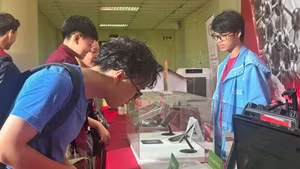
This marks Viet Nam's gradual transition from mastering a single product to mastering semiconductor chip design capabilities.
An important milestone in Viet Nam's journey towards mastering semiconductor technology was reached on November 3, with the official launch of the VGC v1.0 security chip, designed entirely by Vietnamese engineers.
One mission, two solutions
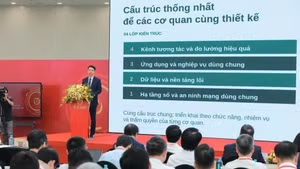
Starting from the security chip development task assigned by the Ministry of National Defence, Viettel, and the Viet Nam Government Information Security Commission have set their sights on a longer-term goal: building a technology platform that can be used not only to produce the VGC v1.0 but also to develop multiple subsequent generations of security chips.
This goal stems from practical realities. Each security product requires its own chip. However, these chips all share the same basic building blocks: processors, encryption modules, key generation modules, and secure boot mechanisms. If each chip is developed separately, engineering teams must rebuild everything from the ground up every time. Viettel and the Viet Nam Government Information Security Commission therefore decided to build a solid foundation once, enabling subsequent chips to be designed on that basis.
The automotive industry has long followed this approach. A car manufacturer can use the same chassis for different vehicle models. Each model has its own design, but the underlying structure has already been tested and refined.
The secure semiconductor platform operates in much the same way. It comprises a master design, a repository of reusable security functional blocks, and a standardised testing process. Chip design protection has also become an established step in this process.
VGC v1.0 is the first product developed using this platform. According to the development team, subsequent generations of chips will not have to start from scratch, potentially reducing development time. This vision is consistent with established practices in the chip design industry.
Professor Don Bouldin of the University of Tennessee in the US once estimated that preparing a component for reuse requires approximately 50% additional initial effort but can reduce the effort required for subsequent designs by around 70%. In other words, the investment in the platform can be recouped from the second chip onwards.
Lieutenant General Tao Duc Thang, Member of the Party Central Committee and President and General Director of Viettel Group, acknowledged: “Researching, designing, and developing security semiconductor chips is an extremely challenging field, requiring the long-term accumulation of knowledge, technology, and high-quality human resources.”
“However, we believe that starting later does not mean accepting dependence. With the right strategy, focused resources, and persistent pursuit of our goals, we can gradually narrow the gap and move towards mastering the country's strategic technologies,” Lieutenant General Tao Duc Thang affirmed.
Open architecture – The key to mastering design
For long-term development, the platform must be built on an architecture that Viet Nam has full rights to use and modify. This is why the engineering team chose RISC-V, a processor design standard developed at the University of California, Berkeley, in 2010.
RISC-V can be likened to a shared set of grammatical rules. Everyone can use it, but what story they write is up to them.
Building on this set of rules, Viettel engineers designed their own processor to meet specific requirements and integrated the Viet Nam Government Information Security Commission's cryptographic algorithms directly into the chip. This is particularly important for a security product, as chip developers can understand every internal detail, verify its operation, and make modifications whenever necessary.
Experience in Europe clearly demonstrates the importance of technology platforms in the semiconductor industry, where the ability to develop platforms is just as significant as chip manufacturing. Since 2013, the Swiss Federal Institute of Technology Zurich (ETH Zurich) and the University of Bologna in Italy have jointly developed the PULP platform based on RISC-V. Since then, the research team has completed more than 70 chip fabrication runs, moving from 65nm to 7nm technology and using reusable design blocks and templates. This is precisely the logic of “develop once, use many times.”
This approach has now become widespread. The 240-million-EUR DARE project, coordinated by the Barcelona Supercomputing Centre and bringing together 38 partners from 13 countries, is also being implemented using RISC-V, as with VGC v1.0. The project aims to reduce Europe's dependence on foreign hardware and software technologies, particularly proprietary processors from the US and Asia, by developing European-designed processors.
Major corporations such as Bosch, Infineon, NXP, and STMicroelectronics have also invested in a joint venture pursuing this approach. The common thread running through these projects is the goal of technological self-reliance. Open design enables the internal workings of chips to be inspected and reduces dependence on suppliers.
A challenge extending beyond a single chip
The VGC v1.0 chip measures just 10 × 10mm in its package but contains up to 300 million transistors and is manufactured using 28nm CMOS technology. According to test results, its encryption and decryption speeds are approximately 15 times faster than those of a purely software-based solution performing the same tasks.
In the first quarter of 2026, the first batch of chips passed technical testing and was granted certification for use in socio-economic activities. This demonstrates that the platform is operational. More importantly, however, are the plans the two parties are making for the next stage.

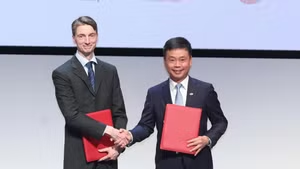
At the launch ceremony, the Viet Nam Government Information Security Commission and Viettel signed a cooperation agreement covering, among other things, the mass production of VGC v1.0 and the development of a multi-core security integrated circuit platform. This means integrating multiple processors working together on a single chip, along with dedicated cryptographic components, to serve large-scale applications.
Looking further ahead, potential applications include supporting the national digital signature authentication system, which has more than 2 million digital certificates in circulation; protecting records, contracts, and customer data in the finance and banking sectors; securing connected devices such as surveillance cameras, environmental sensors, and monitoring stations; and protecting information systems serving critical infrastructure, including electricity, water, oil and gas, and telecommunications. Each application presents a distinct challenge, but all can start from the same foundation.
Emphasising the determination to master core technologies, General Phan Van Giang, Politburo member, Deputy Prime Minister and Minister of National Defence, affirmed: “This represents motivation, determination, and the spirit of daring to tackle difficult challenges and venture into areas where nothing has yet been achieved in terms of thinking and awareness. We may have started later, but we will not move slowly; we are moving forward to overtake others.”
This is the difference between producing a single product and mastering an entire capability. Engineers and experts from the two organisations have established a master design, a repository of functional blocks, and a process that all subsequent chips can build upon.
Most importantly, these technological assets are entirely under Viet Nam's control. The VGC v1.0 chip demonstrates that the design foundation for the semiconductor security industry has been established, and the real measure of its success will be the chips developed on that foundation.