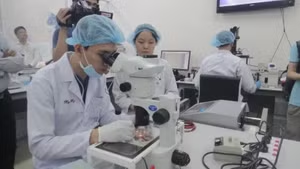
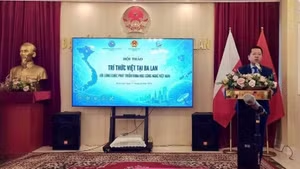
However, the industry still faces significant challenges in research and development (R&D), product development, the scale of domestic enterprises and participation in high-value-added activities. These bottlenecks must be fully identified and addressed in a timely manner.
According to experts, making appropriate strategic choices for developing the semiconductor industry requires an objective assessment of existing capabilities, along with a clear understanding of Viet Nam’s strengths, technological gaps and opportunities within the global value chain.
Mastering the manufacturing process
Deputy Minister of Science and Technology Le Xuan Dinh stressed that semiconductors are the “physical core” and fundamental foundation determining the success or failure of national strategic technologies, ranging from artificial intelligence (AI), cloud computing and the Internet of Things (IoT) to quantum technology, photonic chips and cybersecurity. Without proactively developing its semiconductor industry, Viet Nam risks becoming entirely dependent on imported hardware when deploying strategic infrastructure.
Although Vietnamese engineers have independently designed and developed several types of chips, manufacturing still has to be outsourced overseas due to the lack of domestic fabrication facilities. This poses risks that are difficult to control. Only by fully mastering the entire process, from chip design to domestic manufacturing, can Viet Nam truly ensure its national technological safety and security.
Associate Professor Dr Nguyen Tran Thuat, Director of the Institute of Semiconductors and Advanced Materials under Viet Nam National University, Ha Noi, said that policy measures such as Resolution No. 57-NQ/TW, Decision No. 1018/QD-TTg and Decision No. 1017/QD-TTg have helped Vietnamese enterprises make tangible progress in mastering semiconductor technology.
A growing number of domestic digital technology enterprises have entered the integrated circuit design sector, developing notable products such as the VGC version 01 security chip, jointly developed by Viettel and the Government Cipher Committee. Manufactured using a 28-nanometre CMOS process, the chip contains 300 million transistors and can perform encryption and decryption approximately 15 times faster than purely software-based solutions for the same tasks.
Nevertheless, R&D activities continue to face three major bottlenecks. First, the costs of building cleanrooms and acquiring testing, measurement and prototype fabrication equipment exceed the financial capacity of individual research institutes, universities and startups, requiring the State to provide financial support to help turn academic simulations into practical applications.
Second, Viet Nam also faces a severe shortage of chief engineers and senior engineers with extensive hands-on experience at international corporations who can lead complex chip design projects.
Third, regulations on financial management, procurement of specialised equipment and research project evaluation need to allow room for "controlled risk-taking", given the high failure rate of experiments in the chip commercialisation process.
Capitalising on existing strengths
To address these bottlenecks and achieve a qualitative breakthrough, enabling Viet Nam to move beyond processing and assembly towards mastering semiconductor technologies in higher-value segments, Deputy Minister Le Xuan Dinh said the Ministry of Science and Technology had identified three key strategic directions.
First, rather than competing directly in the general-purpose chip segment, which requires tens of billions of USD in investment, Viet Nam will focus its resources on R&D for specialised chips, such as edge AI chips, IoT chips and chips for 5G/6G devices. These areas allow the country to capitalise on its strengths in algorithm optimisation, intelligent design architecture and customisation to meet specific domestic needs.
Second, the country will make a decisive shift from direct funding allocations towards commissioning scientific research based on practical business needs, with the aim of developing commercially viable products. This will be accompanied by promoting co-financing from science funds and venture capital funds, introducing output-based funding mechanisms and accepting calculated risks.
Third, human resource training will be closely linked to practical experience in real-world production processes, while mechanisms will be introduced to attract chief architects and overseas Vietnamese experts to lead domestic R&D teams.
Drawing on decades of experience leading and developing semiconductor ecosystems, supply chains and intellectual property management at major corporations, Dr Richard L. Thurston, Chairman and CEO of Great Lakes Semiconductor, recommended that Viet Nam develop a unified national semiconductor industrial strategy.
Such a strategy should connect ministries, government agencies, research institutes, universities, domestic enterprises, foreign investors and supply chain partners through a systematic and consistent industrial policy, with shared priorities and measurable milestones. This would help prevent laboratories from operating in isolation, disconnected incentive schemes and overlapping or fragmented projects.
Viet Nam should not rush to build large-scale semiconductor fabrication plants (fabs) at this stage, as they could become a financial burden. Instead, the country should leverage its existing strengths in electronics assembly, packaging and testing, its pool of talented engineers, industrial clusters and international trade networks as a springboard towards higher-value activities such as chip design, materials, specialised components and commercialisation.
At the same time, Viet Nam should establish complementary partnerships with countries with advanced semiconductor industries, including the US, Japan, Germany and Ireland, as well as other partners in equipment and design. Such cooperation would provide access to manufacturing capabilities, materials testing and certification, training, investment and customer networks.
Importantly, these partnerships should be built on the principle of mutual benefit, rather than serving as a substitute for Viet Nam’s own capabilities.