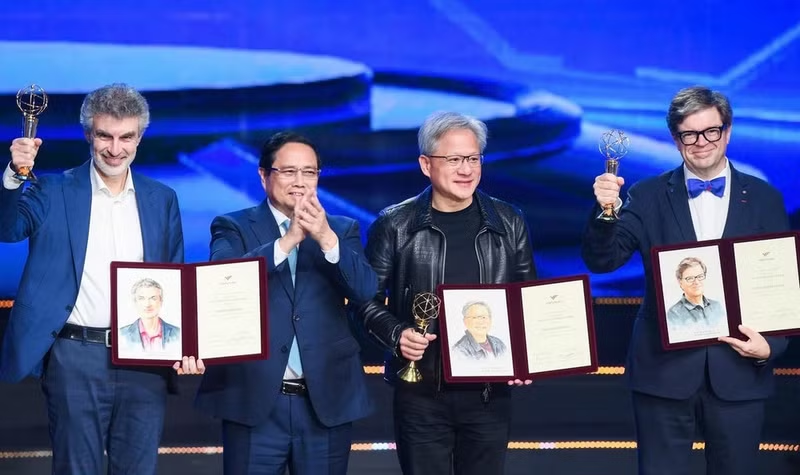
This is the fourth year that TIME has published its annual list honouring the 100 individuals with the most profound influence on the future of AI worldwide. Notably, all three VinFuture scientists featured this year are pursuing breakthrough research directions aimed at helping AI expand its ability to understand and interact with the physical world – from “world models” and “spatial intelligence” to “embodied intelligence”.
Professor Yann LeCun: Seeking to break the limits of large language models
According to TIME, while much of the technology industry continues to scale up large language models (LLMs), Professor LeCun believes that this direction will not enable AI to advance towards human-level intelligence.
At AMI Labs, a company co-founded by Professor LeCun after he left Meta, his team is pursuing a different approach, aimed at helping AI develop an intuitive understanding of the fundamental laws of the physical world. The focus is on “world models”, which enable AI to build an internal model of how the world operates and predict the consequences of different actions, thereby supporting its ability to choose appropriate courses of action.
According to TIME, this approach has the potential to make AI more powerful in fields such as robotics, autonomous vehicles and medicine. This explains why, in March 2026, AMI Labs set a record by raising more than US$1 billion in a seed funding round.
Professor Fei-Fei Li: Opening up the field of “spatial intelligence”
For Professor Li, one prominent focus of her recent research is “spatial intelligence”, aimed at helping AI move beyond image recognition towards understanding three-dimensional structures and the physical world. This line of research stems from the view that learning solely from text and 2D images is not sufficient for AI to truly understand and interact with the physical world. Just as reading every book about basketball does not mean knowing how to throw a ball, AI needs to be able to understand space, objects and how they operate in the 3D world.
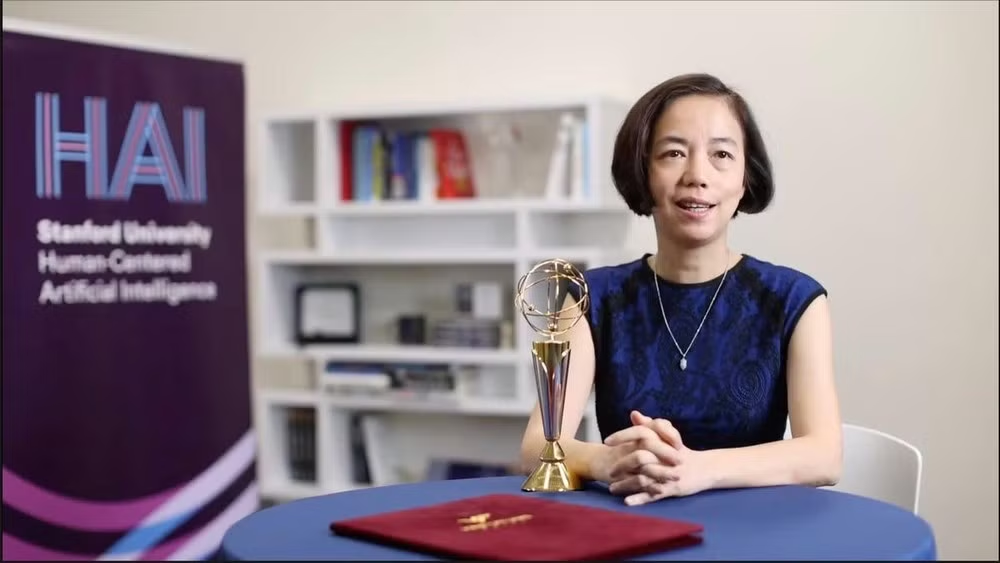
This is the challenge that Professor Li and her colleagues are seeking to address at World Labs, a company she co-founded in 2024. Its first product, Marble, allows users to create and explore 3D worlds from text, images or videos, while recreating depth and spatial layouts. One important application of this technology is to create simulated environments for training and evaluating robots before they operate in the real world.
Professor Daniela Rus: Bringing artificial intelligence into the real world
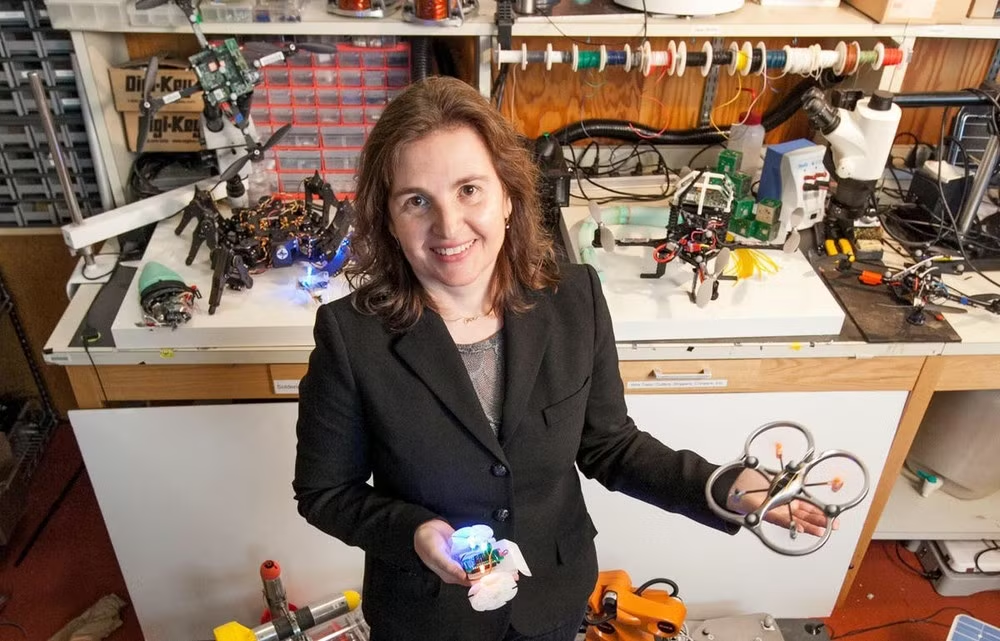
According to TIME, one of the highlights of Professor Rus’s research is the development of nature-inspired AI architectures capable of operating effectively at a significantly smaller scale than neural networks commonly trained for the same tasks.
In 2020, Professor Rus and her colleagues at the Massachusetts Institute of Technology (MIT) developed a tiny neural network inspired by the nervous system of a worm that was nevertheless capable of controlling a car to stay in its lane. This line of research subsequently became one of the foundations for Liquid AI, a company founded by Professor Rus and her colleagues three years later to develop highly capable AI systems that are more efficient in terms of computing and resource requirements.
TIME highlights Professor Rus’s more than three-decade career in robotics, with the goal of developing “embodied intelligence”, namely bringing AI into robots and physical devices so that they can perceive their surroundings, make decisions and take actions in the real world. Her research is being applied in automobiles, logistics and automation.
From the foundations of modern AI to expanding the frontiers of future technology
In 2024, VinFuture awarded the US$3 million Grand Prize to Professor Yann LeCun, Professor Fei-Fei Li, Professor Yoshua Bengio, Professor Geoffrey Hinton and Mr Jen-Hsun Huang for their breakthrough contributions that advanced deep learning. The Prize comprehensively recognised the foundational contributions that created the modern AI revolution: from neural networks and deep-learning algorithms and large-scale data to accelerated computing platforms.
Two years later, TIME100 AI 2026’s continued recognition of Professor LeCun and Professor Li carries particular significance in terms of continuity: from the foundational contributions that drove the deep-learning revolution to efforts to expand the current frontiers of AI, towards systems capable of better understanding and interacting with space and the physical world. This imprint is further strengthened by the inclusion of Professor Daniela Rus – a Member of the VinFuture Prize Council who is also leading pioneering research in both AI and robotics.
The inclusion of all three scientists in TIME100 AI 2026 further affirms the international stature of the VinFuture scientific network. Going beyond the framework of a prize, VinFuture is connecting an outstanding scientific community of humanity, where influential achievements are honoured, pioneering ideas are shared, and breakthroughs with the potential to shape the future are identified and promoted.
After nearly six years, the VinFuture Prize has established its position and prestige on the global science and technology map. Many VinFuture Prize Laureates have continued to receive recognition through the world’s leading prestigious scientific awards, including the Nobel Prize, the Queen Elizabeth Prize for Engineering and the Breakthrough Prize, thereby demonstrating VinFuture’s ability to identify at an early stage works of foundational value to the future of humanity.
Notable examples include Professor Omar Yaghi (2021 VinFuture Special Prize, 2025 Nobel Prize in Chemistry); Dr Katalin Karikó and Professor Drew Weissman (2021 VinFuture Grand Prize, 2023 Nobel Prize in Physiology or Medicine); Dr Demis Hassabis and Dr John Jumper (2022 VinFuture Special Prize, 2024 Nobel Prize in Chemistry); and Professor Geoffrey Hinton (2024 VinFuture Grand Prize, 2024 Nobel Prize in Physics).