The President To Lam also stressed that a strong scientific foundation must first and foremost be built upon a highly capable community of scientists, supported by an ecosystem that identifies, nurtures, develops, values, and protects scientific talent.
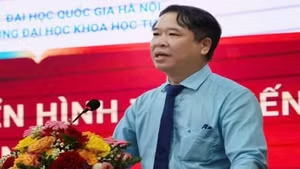
Nguyen Quang Huan, Vice Chairman of the Advisory Council on Science, Technology and Digital Transformation under the Central Committee of the Viet Nam Fatherland Front and Chairman of the Board of Directors of Halcom Viet Nam JSC, said the general secretary and state president's remarks accurately identified the core bottleneck in the country's current science and technology ecosystem, namely the long-standing underestimation of basic science, which has resulted in an insufficient foundation for generating new knowledge in a sustainable manner.
He noted that the President To Lam's guidance is of great significance to the country's strategy for achieving rapid and sustainable development in the new era, as it restores basic science to its rightful place as the cornerstone of the nation's knowledge base. This is both an immediate requirement and a long-term strategic priority for enhancing national competitiveness amid the accelerating Fourth Industrial Revolution and global digital transformation.
The President To Lam pointed out that the fields shaping the future of the world today — including artificial intelligence, semiconductors, quantum technology, biotechnology, advanced materials, and data technology — all originate from basic research that has been consistently supported over many decades. For Viet Nam, science and technology are increasingly becoming direct drivers of economic growth and higher labour productivity.
He also observed that the country currently lacks sufficient leading experts across many disciplines, faces a shortage of the next generation of scientists, provides limited long-term development opportunities for young researchers, and continues to experience brain drain.
Affirming that the general secretary and state president had made a thorough assessment of these challenges, Nguyen Quang Huan noted that Viet Nam had for many years failed to invest adequately in basic science, resulting in a shortage of highly qualified scientists and a lack of original theories bearing a distinct Vietnamese contribution. He argued that building a strong scientific base requires highly skilled scientists across every level of the scientific ecosystem — from basic and applied research to technological development and innovation.
International experience shows that countries with advanced scientific capabilities are those that possess world-class intellectual talent, robust research ecosystems, and effective mechanisms for attracting, developing, and retaining outstanding researchers.
Having identified the shortcomings in basic scientific research, President To Lam proposed the establishment of a National Programme for Basic Science Talent. The programme should encompass the entire talent development pipeline, from early identification and elite education to doctoral and postdoctoral scholarships, support for young research team leaders, leading experts, and Vietnamese intellectuals around the world.
According to Nguyen Quang Huan, this is a comprehensive yet highly practical directive that addresses key constraints on the development of science and technology. It is fully aligned with Politburo Resolution No. 57-NQ/TW, issued on December 22, 2024, on breakthroughs in science, technology, innovation, and national digital transformation. The resolution identifies the development and effective utilisation of high-quality human resources, talented individuals, experts, and scientists as one of its central tasks, while placing science and technology at the heart of the country's development strategy. This demonstrates that building a highly qualified scientific workforce is not merely the responsibility of research institutes or universities but of the entire political system, all levels of government, every sector, and society as a whole.
To achieve this objective, education and training are of decisive importance. If science and technology are the engines of development, education provides the foundation upon which those engines are built. Reflecting this vision, Politburo Resolution No. 71-NQ/TW, issued on August 22, 2025, on breakthroughs in education and training, identifies higher education as the core driver of high-quality human resource development, talent cultivation, and the advancement of science, technology, and innovation. It also sets out the task of modernising and elevating higher education to achieve breakthroughs in developing highly skilled professionals and talented individuals capable of leading research and innovation.
Universities must serve not only as centres for educating future generations but also as hubs for research, innovation, and technology transfer. This will provide the essential conditions for cultivating a high-calibre scientific workforce capable of meeting the country's development needs in the new era.