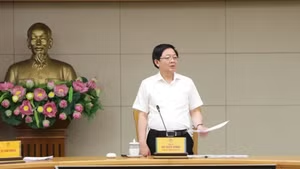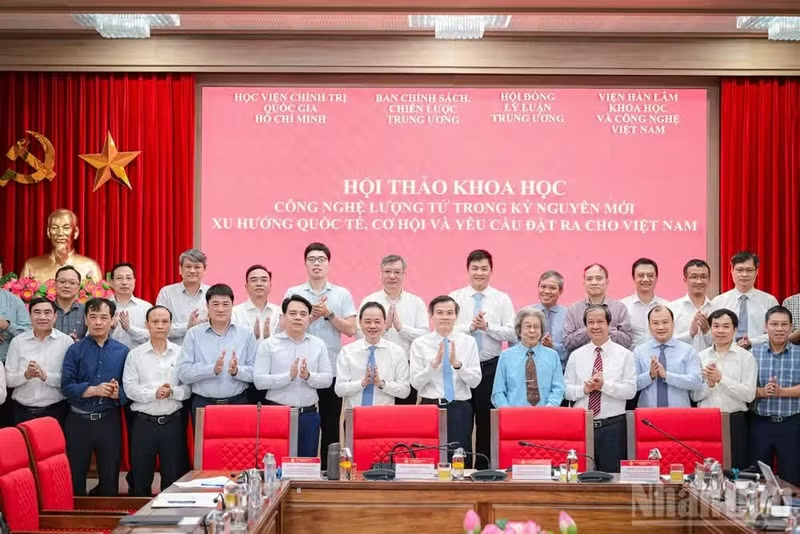
Delivering the opening remarks, Doan Minh Huan, Politburo Member and Director of the Ho Chi Minh National Academy of Politics, stated that research into quantum technology is a pioneering field capable of generating breakthrough technological advances that can profoundly transform human understanding and reshape the world. It is therefore an area that must be recognised early and prioritised.
Huan emphasised that the conference reflected an urgent need to closely connect theoretical thinking, cadre training, and strategic policy advisory work with modern scientific and technological knowledge. He noted that quantum technology could have far-reaching impacts on development models, competitiveness, human resource quality, national self-reliance, and the country’s international standing.
In his introductory remarks, Tran Hong Thai, Deputy Head of the Party Central Committee's Commission for Policies and Strategies and President of the Viet Nam Academy of Science and Technology, stressed that quantum technology could create new capabilities in measurement, sensing, simulation, computation, and materials science.
These capabilities could serve fundamental scientific research while also finding applications in defence, security, telecommunications, finance, healthcare, energy, natural resources, environmental management, and high-tech industries.
According to Thai, the workforce required for quantum technology is inherently interdisciplinary, encompassing physics, mathematics, computer science, cryptography, photonics, materials science, electronics, control systems, measurement science, software, and data science, as well as many other disciplines, including the social sciences, humanities, and religious studies.
He noted that developing such a workforce requires early preparation, including establishing research groups and laboratories, and engaging both domestic and international experts.
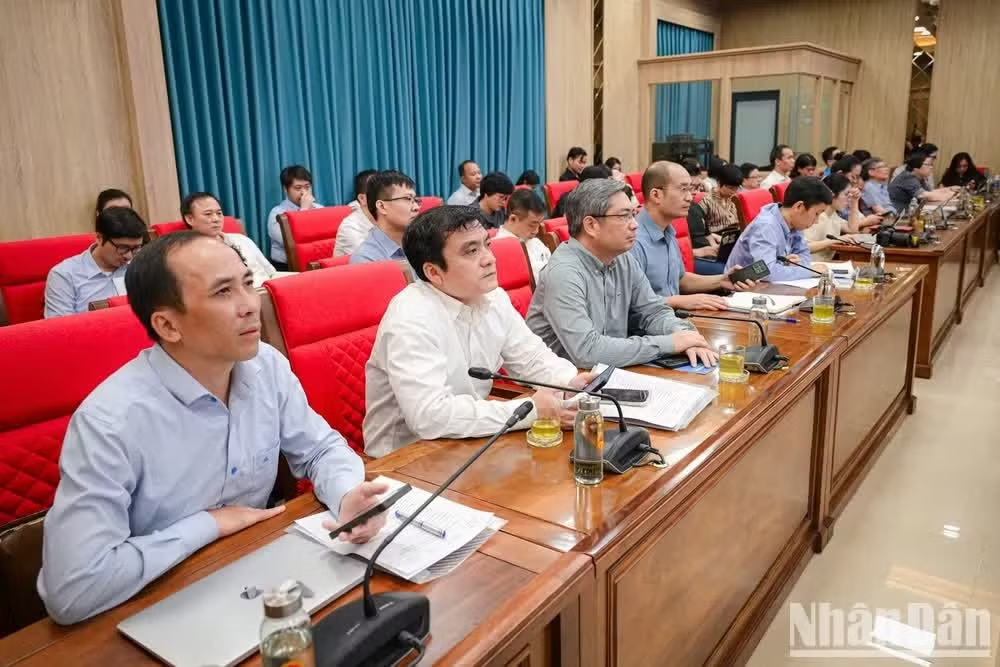
The conference featured three presentations on the following themes: quantum technology in the new era – vision and international experience; current situation, bottlenecks and requirements for Viet Nam in developing quantum technology; and objectives, tasks, solutions, and priorities for implementation in the coming period.
At the conference, participants focused on clarifying the foundations already available in Viet Nam, the existing capability gaps, and the issues that must be addressed proactively to support the development of this strategic technology.
The conference identified approaches suited to Viet Nam’s practical conditions and proposed a range of solutions regarding priority areas within quantum technology, resource mobilisation, and human resource development, as well as financial mechanisms to support the substantive, long-term, and effective development of quantum technologies.
Participants also proposed solutions for governing the development of quantum technology, accelerating its application, and ensuring security, safety, and strategic autonomy while safeguarding the highest national interests.
Concluding the conference, Tran Hong Thai stated that Viet Nam should prioritise several areas aligned with current national conditions, particularly post-quantum cryptography and data security; sensing and measurement technologies; photonics, materials and components; simulation, algorithms, and software; AI for scientific research; and interdisciplinary workforce development.
He also stressed the importance of expanding international cooperation, leveraging trusted partners, international experts, and overseas Vietnamese experts, while linking these efforts with workforce training, knowledge transfer, access to infrastructure and technical standards, and the development of domestic self-reliance capabilities.