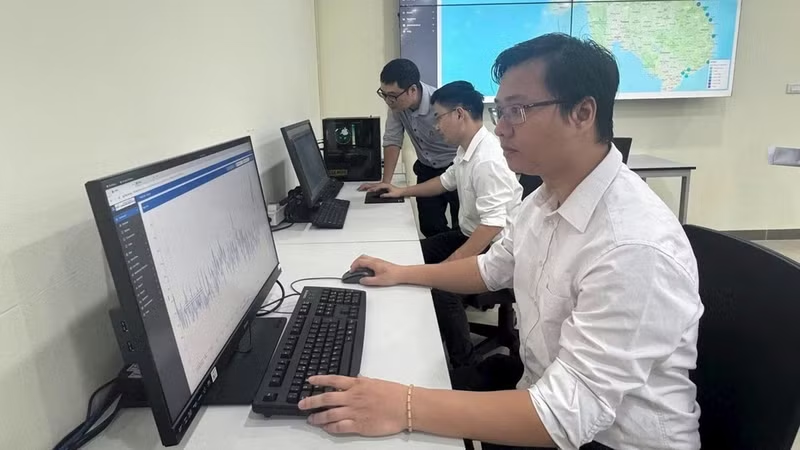
To ensure the system operates effectively and sustainably, investment in infrastructure and equipment must go hand in hand with human resource development.
Expanding the monitoring network
The National Environmental Radiation Monitoring and Early Warning Network has recently been expanded to include an operations centre in Ha Noi, four regional stations in Ha Noi, Da Nang, Lam Dong and Ho Chi Minh City, and 34 monitoring stations located across provinces and cities.
In addition, there are facility-level environmental radiation monitoring and early warning stations, as well as military-operated radiation reconnaissance, surveillance, monitoring and warning systems.
In May, Viet Nam launched an environmental radiation monitoring and early warning network funded by the European Union (EU). The network comprises 41 online radiation monitoring stations, prioritising northern regions and other strategically important locations nationwide. It is currently operated by the Institute for Nuclear Science and Technology under the Viet Nam Atomic Energy Institute.
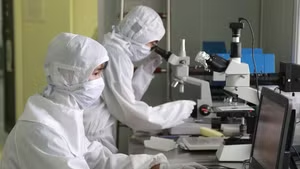
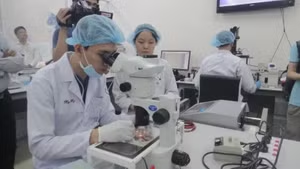
Alongside continuous automated monitoring, technical staff collect samples of soil, water, air and other environmental media for laboratory analysis, providing a comprehensive assessment of environmental radiation levels and trends. The data support early warning, state management and responses to radiation and nuclear incidents.
According to Dr Nguyen Huu Quyet, Director of the Institute for Nuclear Science and Technology, the 34 provincial monitoring stations and the operations centre will be upgraded or newly built during the 2026-2030 period. Once the upgrades are complete, data from all stations will be transmitted online to the operations centre, creating a nationwide centralised monitoring system.
This model will enable regulatory authorities to monitor environmental radiation levels in real time, quickly detect unusual developments and promptly implement inspections, assessments and response measures, thereby strengthening early warning capabilities and ensuring radiation and nuclear safety.
In addition to increasing the number of monitoring stations and modernising equipment, the network will serve as key technical infrastructure supporting Viet Nam’s nuclear power programme. It will help uphold the principle that safety is the highest priority in developing and operating nuclear power, while providing a foundation for transparently disclosing environmental radiation quality information.
When the public has access to accurate, timely and scientifically grounded information on environmental conditions, public confidence and social consensus regarding the nuclear power programme will be strengthened, creating favourable conditions for implementing future nuclear energy development policies.
The establishment of the network also provides a more stable and sustainable basis for funding radiation monitoring activities. In the past, monitoring operations occasionally faced financial constraints, affecting system operation, equipment maintenance and routine sampling and analysis programmes.
As the International Atomic Energy Agency (IAEA) continues to update its standards and guidance on environmental radiation monitoring to strengthen the protection of people and the environment, Viet Nam’s monitoring system will require further investment and upgrading to meet increasingly demanding technical requirements.
According to the leadership of the Institute for Nuclear Science and Technology, many key components of the system, including electronic circuits, signal-processing software and certain sensors, have already been researched and developed domestically.
In particular, scientists are undertaking research projects aimed at mastering the technology for manufacturing radiation detector crystals, the component that determines the sensitivity and detection capability of monitoring equipment.
Mastering these technologies has enhanced domestic capabilities in research, design and equipment manufacturing, reduced reliance on foreign suppliers, and improved the country’s ability to maintain, repair and replace components independently.
This provides an important foundation for gradually developing a domestic nuclear equipment industry and meeting the requirements for expanding and modernising the network in the years ahead.
Addressing the human resources challenge
Alongside the network’s expansion, the shortage of qualified personnel has emerged as one of the greatest challenges. As the system becomes more sophisticated and its monitoring coverage expands, demand continues to grow for staff responsible for operation, maintenance, sampling, analysis and data processing, while the current workforce remains very limited.
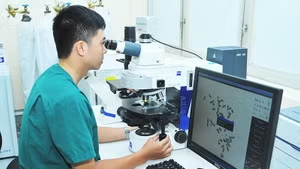
As one of the engineers directly operating the EU-funded environmental radiation monitoring and early warning system, Cao Duc Viet, a researcher at the Institute for Nuclear Science and Technology, said that only 16 staff members are currently responsible for operating the entire system.
In addition to monitoring the operation of the stations, the technical team must regularly travel to field locations to carry out maintenance, repair faults and collect environmental samples for laboratory analysis. As a result, staff members rely heavily on one another to keep the system functioning.
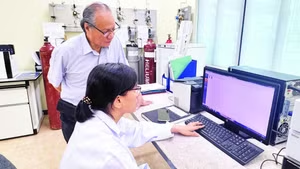
According to Dr Nguyen Huu Quyet, once the National Environmental Radiation Monitoring and Early Warning Network is fully deployed, the operations centre alone will require around 30 to 35 personnel, almost double the current workforce. However, recruitment remains difficult because there are no suitable staffing quotas or specialised mechanisms capable of attracting highly qualified professionals.
From a technical perspective, Dr Nguyen Hao Quang, former Deputy Director of the Viet Nam Atomic Energy Institute, believes that the challenge extends beyond the central coordinating agency to local authorities.
In addition to strengthening staffing at the operations centre and regional stations, authorities should establish regular training programmes for local personnel to ensure consistent system operation nationwide.
Despite the staffing requirements set out in the National Technical Regulation on the Environmental Radiation Monitoring and Early Warning Network, issued by the Ministry of Science and Technology in 2013, local authorities have long been unable to recruit specialised personnel because no dedicated civil service positions have been allocated.
To meet the staffing requirements set out in the National Technical Regulation on the Environmental Radiation Monitoring and Early Warning Network issued by the Ministry of Science and Technology in 2013, local authorities have long been unable to recruit specialised personnel because no dedicated civil service positions have been allocated.
Therefore, an appropriate coordination mechanism between the Ministry of Science and Technology and the Ministry of Home Affairs is needed to allocate staffing for the environmental radiation monitoring system.
At the same time, many experienced specialists are approaching retirement, while training a new generation of experts requires years of knowledge accumulation and practical experience.
Addressing the human resources challenge must therefore begin without delay to ensure the monitoring system operates reliably and continuously, meeting the requirements for radiation and nuclear safety in the new phase.