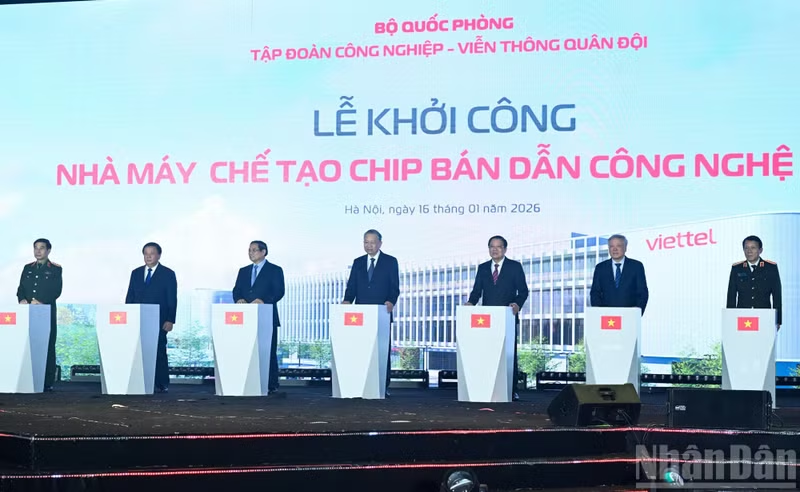
The event, held at the Hoa Lac High-Tech Park in Ha Noi, marks the country’s first step toward building domestic capabilities in semiconductor chip manufacturing, laying the foundation for long-term technology mastery and the development of a semiconductor ecosystem.
The plant, developed by Viettel Group in line with the mission assigned by the Ministry of Defence and based on the government’s resolution, is located on a 27-hectare site within the Hoa Lac High-Tech Park and is expected to serve national industries such as aerospace, telecommunications, Internet of Things (IoT), automotive manufacturing, medical equipment, and automation. The plant’s establishment represents a critical leap in Viet Nam's ambition to master core technologies and join the global semiconductor supply chain.
Speaking at the ceremony, PM Chinh underscored the profound significance of the plant, describing it as not merely an investment project but as a strategic initiative, demonstrating Viet Nam's determination to actively and practically participate in the global semiconductor value chain, and aiming to achieve the goals set forth in the Viet Nam Semiconductor Industry Development Strategy by 2030, with a vision to 2050.
He emphasised that semiconductor chips, though small in size, play a decisive role in national power across various dimensions: economic, industrial, and defence-security capabilities.
The global semiconductor industry, now valued at approximately 2.3 trillion USD, has been not merely an economic sector but has evolved into a matter of geopolitics, national security, and a symbol of technological power for each nation. Those that lack domestic semiconductor production capacity face significant strategic vulnerabilities, limiting their economic development and national security, he noted.
Viet Nam’s participation in the global semiconductor value chain has already seen significant progress. The country has developed a strong ecosystem of semiconductor design companies, with nearly 60 firms, including 13 domestic enterprises. Viet Nam is now the third-largest exporter of chips to the US, a testament to its growing prominence in the semiconductor industry.
The ground-breaking of the plant marks a significant milestone, affirming that Viet Nam is fully capable of gradually mastering high-end technology. This development completes a critical link in the semiconductor value chain - the manufacturing of chips - signifying a shift from participation to mastery, from assembly to innovation, thus contributing to enhancing Viet Nam's capabilities and global standing in the digital age, PM Chinh stressed.
The Government leader outlined a clear vision for the future, stressing the need for comprehensive and coordinated efforts between the government, businesses, and academia to ensure success in this ambitious project. By 2030, Viet Nam aims to have at least 100 semiconductor design companies and one semiconductor chip manufacturing plant, as well as 10 assembly and testing facilities.
The country will focus on developing both the quantity and quality of its semiconductor workforce, ensuring sufficient manpower for all stages, from design and manufacturing to packaging, testing, and research and development. The goal is to train over 50,000 engineers and graduates by 2030 and prepare a high-quality workforce for the period from 2030 to 2050. By 2030, the semiconductor industry aims to achieve annual revenues exceeding 25 billion USD, with added value in Viet Nam ranging from 10-15%. The electronics industry is set to surpass 225 billion USD in annual revenue.

Lieut. Gen. Tao Duc Thang, Chairman and General Director of Viettel, said the group will move swiftly to implement the project following the groundbreaking, with the aim of completing construction, receiving technology transfer and beginning trial production by the end of 2027.
From 2028 to 2030, the project will focus on completing and optimising processes and improving production-line efficiency to meet industry standards, laying the groundwork for research into more advanced chipmaking technologies.