From practical requirements to breakthrough action
According to the World Intellectual Property Organisation’s (WIPO) Global Innovation Index (GII) report 2026, Viet Nam ranked 43rd out of 139 countries and economies, up one place from 2025 and 16 places from 2016. Notably, Viet Nam’s innovation output ranking rose two places to 35th.
However, Viet Nam ranked 54th in terms of innovation inputs, 64th in institutions, and 79th in human resource and research. The gap between innovation inputs and outputs highlights the need to pay greater attention to the quality of conditions supporting research and technology development, as well as the ability to sustain innovation capacity over the long term.
From a business perspective, figures from the Ministry of Science and Technology show that the proportion of businesses undertaking innovation activities stood at 34.6% in 2025, down from 38.8% in 2024.
These figures show that the challenge is not simply to improve Viet Nam’s international ranking but also to expand innovation capacity across the business community and enhance the effectiveness of technology transfer and application. This requires addressing the lack of close links between research, production, and the market, while creating favourable conditions for stakeholders to access appropriate technologies, capital, and partners.
Nguyen Mai Duong, Head of the State Agency for Technology Innovation (SATI) under the Ministry of Science and Technology, said that the three pillars of strategic technologies, innovation, and digital transformation were intrinsically linked and inseparable. Strategic technologies create new capabilities; innovation turns technological knowledge into products, processes, models, and new practical value; while digital transformation provides the infrastructure to connect, scale up, and disseminate these results more rapidly. The current requirement is to make a decisive shift from awareness to action, from ideas to products, from research to application and commercialisation, and from isolated models to results that can be replicated on a wider scale.
Connecting the ecosystem and harnessing the role of digital infrastructure
In the cooperation model involving the state, scientists, and businesses, businesses play a direct role in organising production, accessing markets, and putting technology into practice. Research results can only realise their full value when they meet actual needs and have the potential to be commercialised.
Highlighting this key issue, Nguyen Trung Kien, Vice Chairman of the Board of Directors and General Director of CNCTech Group, said: “Innovation must be substantive, address specific problems, and have the potential for commercialisation. The state can provide support from research through to the development of prototypes, but businesses play the decisive role in mass production and bringing products to market. Their advantages lie not only in manufacturing infrastructure, factories, and prototyping capabilities but also in their supplier networks, distribution systems, and experience in meeting quality standards. These provide the foundation for turning research ideas into competitive commercial products.”
In addition to links between stakeholders, digital infrastructure offers a means of maintaining regular connections beyond the scope of isolated promotional events. The Innovation Support Centre, under the State Agency for Technology and Innovation, Ministry of Science and Technology, has launched the Innovation Support Portal (innovation.gov.vn) and the ISC Innovation Connectivity Platform (isc.arobid.com). The ISC platform is designed to transform trade promotion and business networking activities from isolated events into a permanent digital connection network operating throughout the year.
According to Tran Van Chin, Chairman of Arobid Technology Joint Stock Company, which operates the ISC platform infrastructure, the platform’s breakthrough lies in its use of data and AI to automatically search for and analyse needs and then recommend suitable matches among businesses, technology providers, experts, research institutes, universities, start-ups, and investors.
“AI helps find and match potential cooperation and business opportunities. To seize these opportunities, businesses need digital capability profile that meet the criteria of being ‘accurate, complete, clean, live, and well-presented’, while assigning dedicated staff to monitor, respond, and proactively establish connections in the digital environment. AI identifies opportunities, while people assess them, negotiate, and make the final decisions,” Tran Van Chin emphasised.
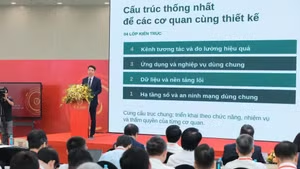
Dang Tung Anh, Deputy Director of the Centre for Digital Government – Technology under the National Digital Transformation Agency, Ministry of Science and Technology, said: “The national digital architecture framework establishes a unified four-layer structure, prioritising the principle of putting data at the centre, adopting an ‘AI First’ approach, and shifting from document-based management to governance and compliance monitoring based on real-world data.”
Clearly, the connection of the innovation ecosystem and the development of digital infrastructure requires synchronous implementation. On the one hand, businesses must be encouraged to participate more deeply in research, development, and technology application. On the other, data and digital platforms must genuinely facilitate information sharing, partner searches, and resource mobilisation.
Viet Nam’s ranking of 43rd out of 139 economies in the GII 2026 is a noteworthy achievement. However, more important measures remain the country’s capacity to master technologies, the level of innovation within businesses and its ability to turn knowledge into economic value. Only when the links from research to the market are effectively connected can innovation spread more widely and make a practical contribution to national development.