
Ha Noi Book Fair connects knowledge and technology
The Ha Noi Book Fair 2026, themed "Books Unlock Knowledge – Technology Leads the Future,” opened on the evening of October 2.
#Technology
The Ha Noi Book Fair 2026, themed "Books Unlock Knowledge – Technology Leads the Future,” opened on the evening of October 2.

Viet Nam is working towards building a technology ecosystem that enables it to harness, master and develop artificial intelligence (AI), cloud computing and sustainable digital infrastructure, thereby fostering innovation.
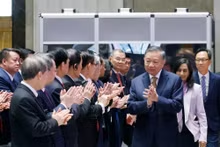
Viet Nam-Canada relations are expanding from trade cooperation to knowledge-intensive fields, including science, technology and innovation. More than two decades ago, Vietnamese businesses had already established a presence and cooperation in Canada, and the shift in relations between the two countries is opening up many new opportunities.

The green transition is truly meaningful only if it enables businesses to use resources more efficiently, reduce costs, and improve product quality.

The University of Science and Technology of Ha Noi (USTH), under the Viet Nam Academy of Science and Technology (VAST), and the French Alternative Energies and Atomic Energy Commission (CEA) exchanged two cooperation agreements in Paris on September 11, in the presence of General Secretary of the Communist Party of Viet Nam Central Committee and President To Lam.
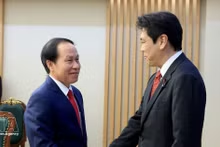
Deputy Prime Minister Le Tien Chau received Japanese Minister of Education, Culture, Sports, Science and Technology Matsumoto Yohei in Ha Noi on September 7, calling for stronger cooperation between the two countries in science and technology, innovation and digital transformation.
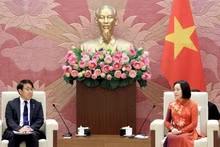
Viet Nam regards Japan as one of its most important and long-term strategic partners and a trusted companion in the new era of development, National Assembly (NA) Vice President Nguyen Thi Thanh said while receiving Saito Hiroaki, a member of the Japanese House of Representatives and Chair of its Committee on Education, Culture, Sports, Science and Technology, together with lawmakers from Japan's Liberal Democratic Party and Centrist Reform Alliance, in Ha Noi on September 3.
Deputy Prime Minister Ho Quoc Dung has signed Decision No.1493/QD-TTg approving the Special National Programme on Science, Technology and Innovation for Strategic Technologies.
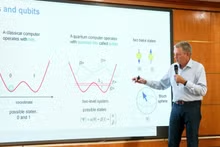
After more than one year of implementing Politburo Resolution No. 57-NQ/TW dated December 22, 2024, on breakthroughs in science, technology, innovation and national digital transformation, quantum technology has been placed at the centre and specified in the list of strategic products and technologies. Therefore, this technology is not merely a matter of scientific research, but a strategic issue for national development.
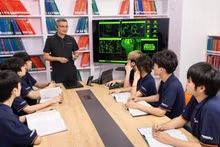
The “three-party” cooperation model, which involves the state, universities, and enterprises, is opening a new means of organising resources for science, technology, and innovation. However, for knowledge to truly move from laboratories to the market, the three actors need to be closely connected within a unified coordination mechanism.
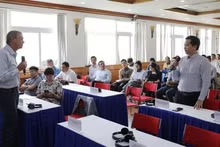
International cooperation in science and technology enables Viet Nam to absorb knowledge, affirm its position, narrow the development gap, master new technologies and enhance national competitiveness.
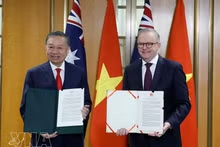
Viet Nam and Australia have issued a Joint Statement on the Enhancement of Science, Technology and Innovation Connectivity between the two countries.

Recognising the strategic importance of science, technology, innovation and digital transformation to the country's development in the new era, Party committees and Party organisations at all levels have thoroughly implemented the Politburo's Resolution No. 57-NQ/TW through a range of innovative approaches. Initial results have helped create an important impetus for rapid and sustainable economic growth.

Artificial intelligence (AI) is becoming increasingly integrated into everyday life, from education and healthcare to media and public administration, serving as a powerful tool to improve productivity and the quality of services. However, alongside its significant benefits, AI also raises important questions about responsibility, transparency, privacy, fairness, and the ethical boundaries surrounding its development and application.
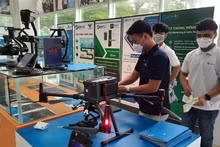
Over the past 18 months of implementation, the Politburo’s Resolution No. 57-NQ/TW, dated December 22, 2024, had catalysed profound shifts in both awareness and action across the entire political system; institutions, mechanisms, and policies have been systematically refined; many bottlenecks and obstacles have been dismantled; and a number of new mechanisms have been established to accelerate the development of science, technology, innovation, and digital transformation.
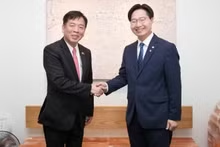
Vietnamese Ambassador to the Republic of Korea (RoK) Vu Ho on June 2 held talks with Koo Huck Chae, First Vice Minister of the Ministry of Science and ICT (MSIT) of the RoK, to discuss measures to strengthen cooperation in science, technology, and innovation between Viet Nam and the RoK.
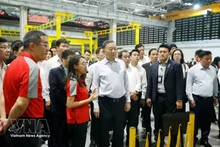
General Secretary of the Communist Party of Viet Nam Central Committee and State President To Lam, accompanied by a high-ranking Vietnamese delegation, on May 30 visited the Singaporean Agency for Science, Technology and Research (A*STAR)’s Model Factory and the SMRT as part of his state visit to Singapore.
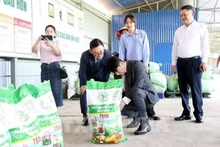
A cooperation programme under the KOICA IBS project was launched in Luu Kiem ward, Hai Phong city, on May 26 with a view to promoting circular agriculture, environmental treatment and sustainable development.
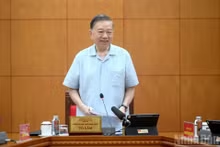
Party General Secretary and State President To Lam chaired a meeting of the Standing Board of the Central Steering Committee for the Development of Science, Technology, Innovation and Digital Transformation, giving opinions on the project “Research, application and development of quantum technology for socio-economic development and ensuring national defence and security” in Ha Noi on the morning of May 21.
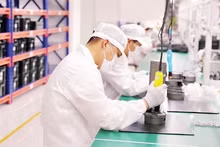
Amid increasingly intense global technological competition, the Party and the State have introduced a series of major policies. Among them, Resolution No. 57-NQ/TW, issued by the Politburo on December 22, 2024, on breakthroughs in science and technology development, innovation, and national digital transformation, identified the development of strategic technologies as a pillar for rapid and sustainable growth.