At present, quantum technology is emerging as one of the revolutionary directions capable of reshaping the entire knowledge economy and key industries. This is a field prioritised by the Party and the State in major strategies on science, technology and innovation. In practice, scientists, research institutes and universities are gradually gaining deeper access to this research field.
Viet Nam National University, Ha Noi has made a strong shift from a fragmented research approach to one based on programmes and interdisciplinary task clusters. It has developed research institutes for strategic industrial technologies, including semiconductor microchips, quantum technology and AI4SD, as well as centres of excellence with priority investment in major resources, forming 16 key research programmes focused on strategic technology fields.
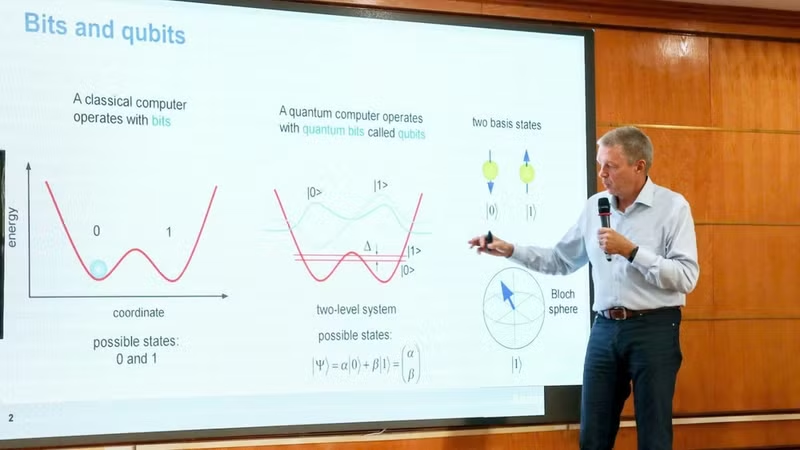
According to Assoc. Prof. Dr Bui The Duy, Director of Viet Nam National University, Ha Noi, in the field of quantum technology, the university is researching the fabrication of superconducting-semiconductor hybrid qubits on 2DEG materials, aiming to gradually form core research capacity in quantum technology in Viet Nam. It is also conducting research on quantum computing and post-quantum cryptography to prepare for the future deployment of quantum technology.
However, this is a new, difficult and rapidly evolving field that is related to many areas and requires deeper and more systematic research to support national development in line with the requirement of strategic autonomy.
Therefore, Viet Nam needs to identify early risks to information security and digital infrastructure, and prepare for the transition to post-quantum cryptography. It also needs to develop basic science and supporting technologies, train specialised interdisciplinary human resources, and improve research infrastructure. A national strategy on quantum technology should be developed; legal regulations and standards should be reviewed and improved; special mechanisms for quantum technology research and development should be issued; and investment should be made in research infrastructure and key laboratories.
It is also necessary to develop high-quality human resources and an innovation ecosystem, while strengthening international cooperation in this technology. In the new period, applied quantum technology should be promoted, harnessing the microscopic principles of the quantum world to create breakthrough technologies.
Analysing experience from developed economies such as the US, China and the European Union, which have poured billions of dollars into quantum ecosystems, Assoc. Prof. Dr Nguyen Dinh Tho from the Institute of Strategy and Policy on Agriculture and Environment said Viet Nam needs to orient quantum technology towards national security, data infrastructure protection, the semiconductor industry, artificial intelligence (AI) and space technology. Therefore, it is necessary to develop a synchronous ecosystem, from building institutions and making focused investment to avoid scattered, to developing elite human resources and creating a selective international cooperation network.
A national quantum centre should be established as the highest-level coordinating agency, directly supervising capital flows and taking responsibility for linking the State, research institutes, universities and the private business sector into a unified whole.
State management agencies need to abandon administrative control thinking and shift towards creating a flexible legal corridor to encourage the private sector and startups to participate more deeply in the quantum R&D process. A sandbox model should be applied immediately to the field of quantum technology to accelerate the process of bringing quantum sensor and encryption research from laboratories into practical products.
Dr Nguyen Hoang Duong, Deputy Head of the Department of Science and Technology under the Viet Nam Academy of Science and Technology, said quantum technology development requires an overall coordination mechanism that prioritises development with a long-term vision. Human resource development should prioritise specialised and interdisciplinary training, attracting international experts and overseas Vietnamese. At the same time, it is necessary to develop research infrastructure, build key laboratories, take advantage of international cooperation opportunities and participate early in global value chains.
When research institutes and higher education institutions shift from basic research to application, this is a necessary step in defining the strategic path for quantum technology development in the coming period.
However, there can be no “burning stages”. Quantum technology requires a long-term vision, sustained investment and a willingness to accept risks, with Viet Nam possibly needing at least 10-20 years of persistence in this field. Policy, financial and human resource bottlenecks must therefore be removed in a timely manner; Vietnamese experts at international quantum centres should be attracted; and a sustainable ecosystem should be built without relying entirely on imports. A strong community should also be developed, with synergy created across policy, management, finance, enterprises and training, to lay the groundwork for quantum technology breakthroughs in Viet Nam.