Technology opens up opportunities for a green economy
The rapid development of digital technologies, big data and artificial intelligence (AI) is helping to optimise resource use, reduce emissions and enhance governance efficiency. Many international studies indicate that AI could help cut around 5–10% of global emissions by 2030 through optimising energy, transport and production systems.
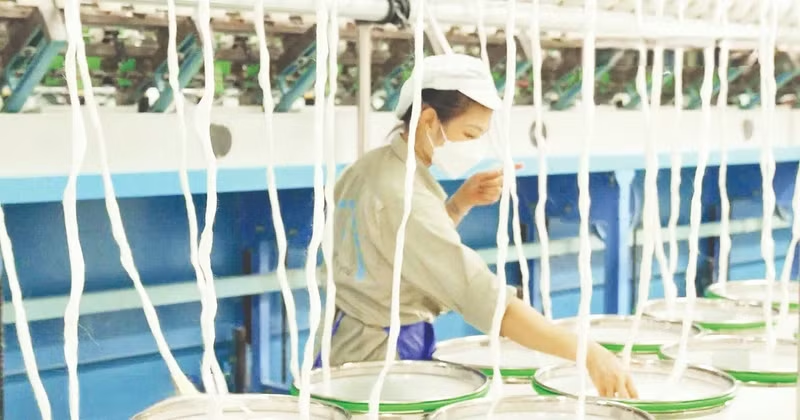
In Viet Nam, a wave of green innovation is gradually taking shape. The start-up ecosystem currently includes more than 4,000 enterprises, of which around 200 - 300 are developing solutions in renewable energy, environmental technology, sustainable agriculture and the circular economy. Several start-up models have demonstrated the potential to transform wasted resources into new economic value, such as the Vietfiber project, which uses pineapple fibre to produce bio-based materials, helping to reduce wastewater and chemicals in production; and Net Zero Pallet, which utilises agricultural by-products to create materials that replace industrial wood.
From the National Green Growth Strategy in 2012 to the Strategy for 2021 - 2030 with a vision to 2050, along with programmes supporting enterprises in sustainable development, numerous policies have been issued to shift the economy towards low-emission pathways. Nevertheless, the green transition is also placing considerable pressure on businesses. In the context of fluctuating energy prices and increasingly stringent environmental standards from export markets, enterprises face a dual pressure: rising input costs while requirements for “greening” production continue to intensify. Therefore, green transition has become a condition for maintaining competitiveness.
In Viet Nam, climate change is estimated to cause losses of about 3.2% of GDP each year. According to the Ministry of Science and Technology, for the green transition to truly become a driver of long-term growth, it is necessary to build a comprehensive green technology ecosystem, from institutions, infrastructure and human resources to data and technology. In this context, science and technology are increasingly becoming an important benchmark for implementing environmental, social and governance (ESG) standards.
From a policy perspective, Dr Tran Van Khai, Vice Chairman of the National Assembly’s Committee for Science, Technology and Environment, stated that the green transition can only succeed when it is closely linked with digital transformation. Technologies such as AI, the Internet of Things (IoT) and big data are helping enterprises measure emissions, ensure transparency in ESG data and improve resource efficiency.
Bottlenecks in technology transfer
Technology is opening up many possibilities for a green economy, yet practical implementation still reveals a considerable gap between technological potential and applicability. One important reason is the lack of connectivity among stakeholders within the innovation ecosystem, from research institutes and universities to businesses and regulatory bodies.
According to Associate Professor, Dr Nguyen The Chinh, Vice President of the Viet Nam Association of Environmental Economics, incentives for green development are not yet fully synchronised, financial resources remain limited, and human resources capable of operating green technologies are still lacking. Notably, coordination among the “three parties” - the State, research institutes and enterprises - remains ineffective, resulting in many research outcomes not being transferred into production. Therefore, experts suggest promoting cooperation models based on the principle of “co-design - co-implementation - co-sharing”, in which enterprises play a central role in the innovation ecosystem.
Another key bottleneck lies in the mechanism for technology transfer. For green technologies to be applied in practice, it is necessary to strengthen linkages among research institutes, universities and enterprises in a demand-driven approach: localities and businesses define problems, institutes and universities develop solutions, and enterprises organise implementation and scaling in the market. This approach helps shorten the gap between research and application, promoting innovation aligned with the needs of the economy.
In addition, many technological initiatives can only develop when there is a suitable testing environment. Models such as WoodID or green credits like P-Coin show that when implemented within policy sandbox mechanisms, technological solutions can be rapidly refined and disseminated in practice.
Alongside institutions and technology, financial resources also play a crucial role in the green transition. In practice, many credit programmes have begun directing capital flows towards sustainable production sectors, such as high-tech agriculture lending, development of OCOP value chains, or high-quality, low-emission rice projects in the Mekong Delta with preferential interest rates for priority sectors.
According to the State Bank of Viet Nam, by the end of 2025, outstanding green credit reached nearly VND 780 trillion, equivalent to around 4.19% of total outstanding loans across the economy. Although the proportion remains modest, the upward trend in green credit indicates that capital flows are gradually shifting towards sustainable production sectors.
However, the demand for resources for the green transition remains substantial. The State Bank is advising on the implementation of a policy to support interest rates of 2% per year for the private sector to carry out green projects under Resolution No. 198/2025/QH15 of the National Assembly. At the end of March, the Government also launched the emulation movement “Innovation, development of science and technology, digital transformation, green transformation” to inspire proactive and creative engagement across society in applying science and technology to management, production and daily life. The implementation plan identifies science and technology, innovation, and “green-digital” transformation as key drivers of growth and as the foundation for improving productivity and competitiveness of the economy.
In this context, Resolution No. 57-NQ/TW of the Politburo continues to affirm that science and technology, innovation and digital transformation are the foundation for developing new productive forces. When the State creates enabling institutions, research institutes and universities develop technologies, and enterprises bring solutions to the market, the innovation ecosystem will gradually be completed, thereby turning the green transition from a policy orientation into a real driver of sustainable growth.