The answer does not lie in the technology itself, but in the farmers. From manual labour to mechanisation and now automation, each step has increased productivity, but largely only changed how work is done. In the past, farmers still relied on experience to make decisions. With AI, things are different. It not only changes how work is done, but also how decisions are made. Factors once considered uncertain, such as weather, pests, or market fluctuations, are gradually becoming data that can be analysed and forecast.
In rice fields, growers can anticipate pest outbreaks. In aquaculture ponds, water quality is continuously monitored. For fruit trees such as mangoes or durians, processes like inducing flowering or nurturing fruit are no longer entirely dependent on intuition. In short, AI does not replace the farmer’s hands, but it is changing how they think and act.
This shift is creating a clear divide. A new generation of “digital farmers” is emerging, those who use smartphones to monitor production, keep electronic records, receive alerts, and adjust cropping schedules based on data.
Meanwhile, others continue to produce in traditional ways, working independently, lacking information, and relying on intermediaries. They are not wrong, but they are operating in a changed context. The gap between these two groups will widen rapidly, not only in terms of income but also in opportunities.
At the same time, the market is undergoing profound changes. Today’s consumers are not only concerned about whether products are safe, but also want to know where they come from, how they are produced, what impact they have on the environment, and what value they bring to health. A mango, a durian, or a batch of shrimp is therefore no longer just a product, but a “verifiable story.”
Consumers are no longer simply buying goods; they are buying transparency and trust. However, these requirements cannot be met through manual methods. Recording and verifying the entire production process for each batch is beyond the capacity of any individual. This is where AI plays an irreplaceable role. It not only improves production, but also helps collect, process, and “tell the story” of production data quickly and systematically.
If data is the language of the modern market, then AI is the tool that enables farming communities to use that language. When farmers perform their role well, the value does not stop at only orchards or harvests, but spreads across the entire agricultural value chain. Well-controlled production helps businesses secure stable raw materials, provides the market with reliable products, and allows the entire chain to operate more efficiently.
However, more importantly, AI is not a tool for isolated individuals. Its true value only appears when there is sufficient data, and such data can only be obtained when production is reorganised.
In other words, AI is truly effective only within a production community — an “organised raw material area.” Here, each farmer is a data point within a shared system. Each farmer needs to become part of a cooperative, a collective economic organisation, or a connected production community. It is within such structures that data is aggregated, technology is deployed, and value is created. At the same time, agricultural AI centres operated collectively should be established to analyse and provide information for the entire region.
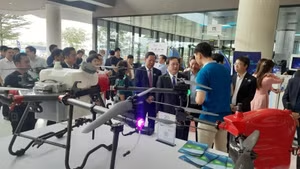
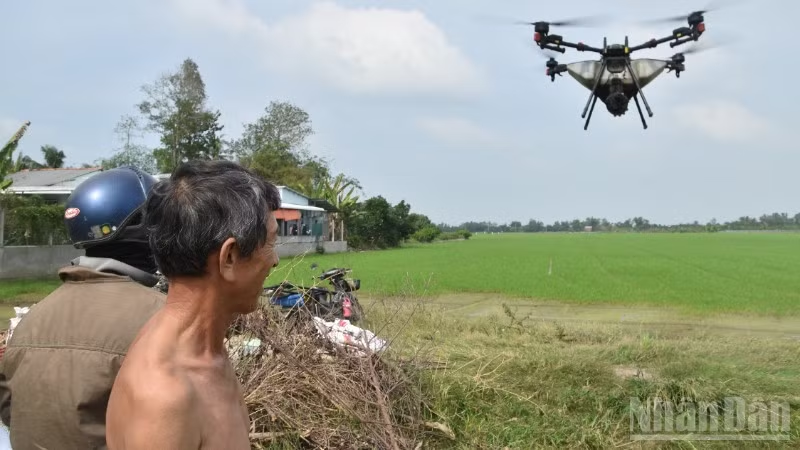
AI goes beyond providing information or supporting decision-making; it is now directly involved in operating production, from automated irrigation and precise fertilisation to drones spraying pesticides and real-time monitoring of aquaculture environments. Many manual tasks are gradually being replaced by intelligent control, shifting farmers from direct labour to supervising and coordinating systems through data. This is redefining their role: no longer simply cultivating fields in the traditional sense, but becoming operators of data-driven production systems within organised communities.
Finally, a major barrier often mentioned is farmers’ ability to access technology. However, with AI, this is changing in the opposite direction. Previously, accessing technology required complex skills and operations. AI, by contrast, is designed to be user-friendly. Farmers do not need to understand complicated computer processes; they only need to ask questions, take photos, or use simple applications on their phones. AI understands natural language, even daily speech, and responds in the most understandable way.
Technology no longer forces people to adapt; it is adapting to people. Therefore, the biggest barrier is no longer skill, but mindset. Once this is overcome, accessing AI is in fact much easier than previous waves of technological transformation.
At some point, farmers will no longer drive tractors in the fields, but will control the data behind the entire production systems. Those who master data will master their crops, the markets, and their own future, and contribute to shaping the future of agriculture.