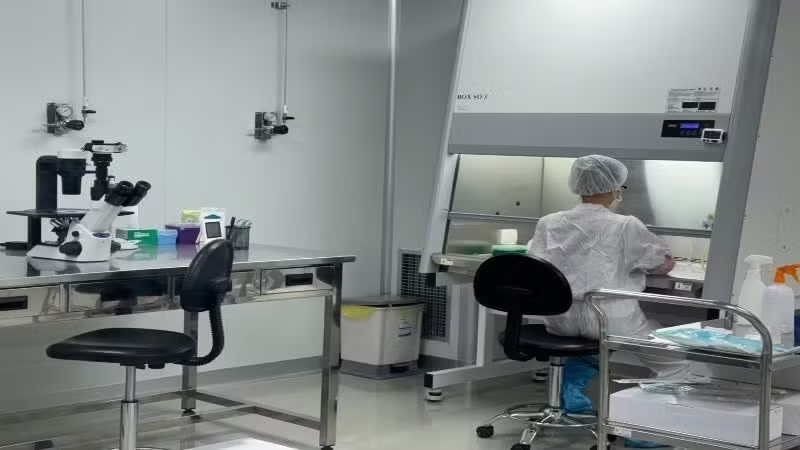
Shifting from short-term project funding to long-term investment
According to the Decision, excellent basic research in the field of natural sciences is identified as the foundation for creating breakthroughs in knowledge and technology, contributing to the formation of capacity to master core technologies, strategic technologies, and enhance national competitiveness in the long term.
The PEBR programme is implemented in a focused, targeted, and in-depth investment direction; prioritising funding for basic research linked to strategic technology development directions and specific strategic technology products; prioritising the development of strong research groups and research directions with the potential to create breakthroughs linked to Viet Nam’s development advantages.
One of the programme’s notable features is the shift from funding individual, short-term research tasks to investing in medium- and long-term (9-10 years) research directions, prioritising task clusters and sequences to ensure continuity, knowledge accumulation, and the development of leading research capabilities.
The programme also encourages new, groundbreaking scientific ideas; accepts scientific risks appropriate to the nature of basic research; implements results-based and impact-based management, ensuring scientific integrity, research ethics, and international academic standards.
According to the Decision, the PEBR Programme is a crucial component of the national strategic research ecosystem, implemented in conjunction with the Excellent Doctoral Programme, the global network of Vietnamese experts, and strategic technology development programmes; strengthening the connection between training high-quality human resources, creating an advanced research environment, and connecting international knowledge.
Creating a knowledge foundation for the development of core and strategic technologies
The overall objective of the programme is to develop excellent basic research in the natural sciences to become a core component of the national science, technology, and innovation system; to enhance research capacity to international standards, to form strong research groups with international reach, and to create an advanced research environment; to contribute to raising Viet Nam’s scientific standing and creating a knowledge foundation for the long-term development of core and strategic technologies.
The programme aims to establish approximately 30 strong research groups in natural sciences by 2030, with at least 3 groups achieving regional leadership; and approximately 50 strong research groups by 2035, with at least 10 groups achieving regional leadership and having a significant international academic impact.
Regarding the quality of scientific publications, by 2030, the proportion of scientific publications in Q1 journals in the Web of Science database and journals in the Nature Index system will increase to approximately 1.5 times; and by 2035, to approximately 2 times the average level of the 2021-2025 period for each respective scientific field.
Regarding the level of scientific impact, by 2030, the goal is to have at least one research direction approaching the top 5% globally in terms of scientific impact according to standardised citation indices by field. By 2035, the programme aims to have at least 3 research directions approaching this group.
By 2030, the programme aims to establish at least 10 new research directions, of which at least 3 have the potential to develop into core technology platforms; by 2035, it aims to establish at least 10 more new research directions, of which at least 5 have the potential to develop into core technology platforms.
According to the set objectives, by 2030, at least 10% of the tasks in the new research directions will have results that qualify for international patent registration or have the potential to transition to strategic technology product development tasks; by 2035, this rate will reach at least 20%.
The programme also aims to support, nurture, and connect at least 500 PhDs, doctoral candidates, postdoctoral researchers, and young scientists within the PEBR research ecosystem by 2030. This includes at least 100 young scientists capable of leading independent international research groups. By 2035, the programme aims to support at least 1,000 scientists, including at least 200 young scientists capable of leading independent research groups.
Regarding international cooperation, by 2030 the programme aims to implement at least 100 international collaborative research projects with substantial participation from foreign research partners; by 2035, at least 300 international collaborative research projects will be implemented. Each strong research group will have at least one strategic international partner.
NAFOSTED will lead the implementation of the programme
According to the Decision, the selection, funding, and evaluation of projects will be conducted on a competitive, open, and transparent basis, according to the criteria of scientific excellence; The programme combines expert evaluation with internationally recognised standardized scientific evaluation indicators such as FWCI, CNCI, and equivalent indicators.
The programme adopts a results- and impact-based management approach; establishes mid-term and end-term evaluation mechanisms to promptly adjust objectives, content, and implementation methods; accepts scientific risks appropriate to the nature of basic research, clearly distinguishing them from administrative and financial violations.
The decision also clarifies the assignment of medium- and long-term scientific goals to strong research groups; gradually implements a package-based funding mechanism linked to autonomy, accountability, and output results; and prioritizes task clusters capable of forming core technology platforms and transitioning to the development of strategic technology products.
According to the Decision, the PEBR Programme will be implemented on the national digital platform for managing science, technology, and innovation to facilitate monitoring, evaluation, and adjustment of the programme, and to enhance transparency and accountability.
The National Foundation for Science and Technology Development (NAFOSTED) is the lead agency responsible for implementing the PEBR Programme. The Foundation is responsible for developing the implementation plan; issuing management regulations; developing a set of indicators to evaluate the programme’s results, output effectiveness, and impact; organising the annual publication of the implementation plan; receiving and reviewing applications; and establishing science and technology councils to evaluate and select research groups and research directions within its authority.
The PEBR Programme will undergo a mid-term evaluation in 2030 to serve as the basis for adjusting objectives, scale, and implementation mechanisms for the next phase.