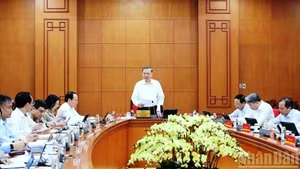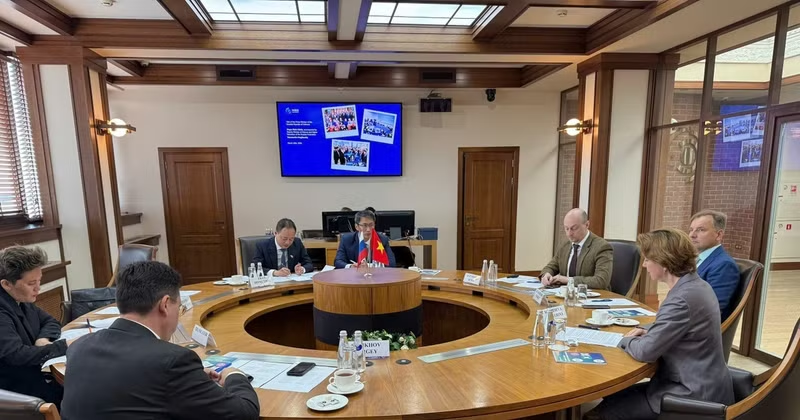
The meeting aimed to promote the development of a cooperation roadmap in strategic technologies, with an immediate focus on quantum technology, helping concretise orientations for bilateral science and technology cooperation in the new period.
The Russian side was represented by Ekaterina Solntseva, Director for Quantum Technologies at Rosatom; Academician Nikolai Kolachevsky, Director of the P.N. Lebedev Physical Institute of the Russian Academy of Sciences; Sergey Salikhov, First Vice-Rector of NUST MISIS; and Denis Avetisyan, Advisor at JV Quantum under Rosatom.
Following its participation in the BRICS Quantum Technologies Forum held in Russia in June 2026, VAST has proactively stepped up exchanges with Rosatom and Russian partners to study a comprehensive model for quantum technology development, covering priority research orientations, infrastructure development, human resources training and a three-party cooperation model linking research institutes, universities and businesses.
The participation of the P.N. Lebedev Physical Institute and NUST MISIS in the meeting provided a bridge for VAST to gain deeper access to Russia’s advanced quantum technology ecosystem.
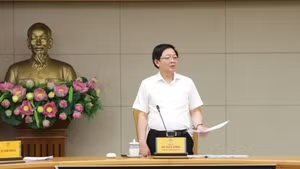
Speaking at the meeting, Prof. Dr. Thai affirmed that quantum technology is an emerging field undergoing rapid breakthroughs and requiring enormous investment resources. Learning from the experience of pioneering countries such as Russia will enable Viet Nam to significantly shorten the time needed to build its workforce and develop endogenous capabilities.
As the agency coordinating Russia’s national quantum programme, Rosatom is an ideal reference partner for VAST to develop a practical roadmap suited to Viet Nam’s capabilities and actual conditions.
Building on the deep traditional friendship between the two countries, VAST has opted for an approach grounded in Russia’s strong scientific and technological foundations. Alongside creating opportunities for Vietnamese scientists, postgraduates and young officials to conduct research directly using Russia’s existing quantum computing infrastructure, VAST also plans to invite leading Russian experts to work at the academy and take charge of components of joint projects, moving towards the establishment of a joint research centre as a technological symbol of the two countries.
In a spirit of broad consensus, VAST and Rosatom agreed on a quantum technology cooperation roadmap comprising four strategic components: sharing experience in developing national strategies; human resources training; sharing and connecting research infrastructure; and gradually accessing and developing comprehensive quantum computing infrastructure covering both software and hardware.
The VAST-Rosatom quantum technology cooperation roadmap represents a concrete step to make the most of the strengths of a pioneering partner, accelerate progress and soon build strategic technology capabilities for Viet Nam in the new era.