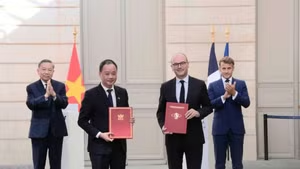
General Secretary of the Communist Party of Viet Nam Central Committee and President To Lam, his wife, and a high-ranking Vietnamese delegation arrived in Paris in the early hours of September 10, beginning his official visit to the French Republic and attendance at the International Space Summit at the invitation of President Emmanuel Macron.
The summit, held on September 9 and 10, brought together leaders from many countries and prominent representatives of the space industry. Its agenda focused on issues ranging from security and the space economy to scientific research, technology development, and governance of the sector.
A day earlier in Moscow, at the Viet Nam–Russia Science and Technology Forum themed “Connecting Strategic Technologies,” General Secretary and President To Lam called for science and technology cooperation between Viet Nam and international partners to go beyond expert exchanges and personnel training, and instead aim to “jointly master technologies, jointly create products, and jointly participate in markets.”
The two consecutive events show that a new space is becoming increasingly evident in Viet Nam’s foreign affairs: science, technology, and innovation are no longer merely areas of specialised cooperation, but are becoming issues closely linked to national competitiveness and standing.
From partnership relations to space for technology cooperation
In October 2024, Viet Nam and France upgraded their relations to a Comprehensive Strategic Partnership, making France the first European Union country to establish this framework of relations with Viet Nam.
In their Joint Statement, the two sides agreed to expand cooperation across various fields, with science, technology, innovation, digital transformation, and human resource training playing increasingly important roles.
In May 2025, the two governments signed a Cooperation Agreement on science, technology, and innovation, upgrading the cooperation framework established in 2007.
By March 2026, the Vietnamese Government had approved a plan to implement the Agreement, setting out mechanisms for coordination, periodic assessment, and implementation among relevant agencies.
General Secretary and President To Lam’s visit to France comes as the two countries have both a political framework at the highest level and a dedicated legal foundation for science and technology cooperation. The International Space Summit in Paris further expands the discussion from bilateral cooperation to new technologies that are directly affecting the security, economy, data, and competitiveness of countries.
In another direction, the State visit to the Russian Federation also placed strategic science and technology in a notable position in bilateral relations. Fields such as artificial intelligence, quantum technology, space, energy, and foundational technologies are opening up new areas for cooperation.
To promote the development of a roadmap for cooperation in strategic technologies, Prof. Dr Tran Hong Thai, President of the Viet Nam Academy of Science and Technology (VAST), held a working session with Russia’s State Atomic Energy Corporation (Rosatom) and leading Russian science and training partners at the National University of Science and Technology MISIS (NUST MISIS).
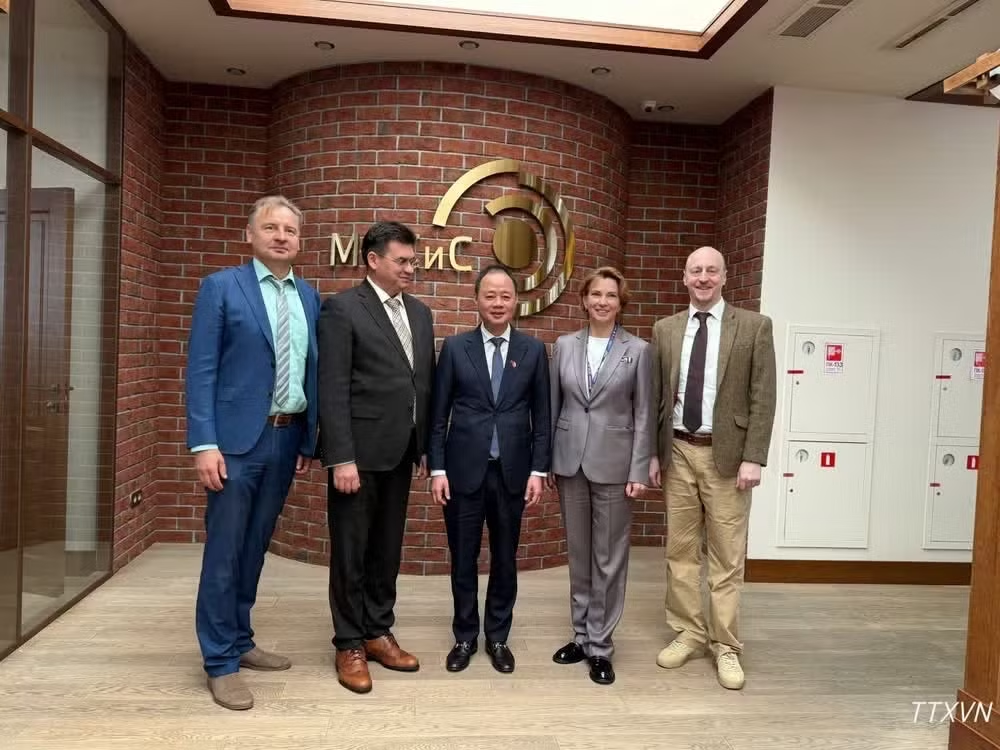
According to Prof. Dr Tran Hong Thai, learning from the experience of countries that have taken the lead, such as Russia, will help Viet Nam significantly shorten the roadmap for building its workforce and developing endogenous capacity. As the agency coordinating Russia’s national quantum programme, Rosatom is an ideal reference partner for VAST to develop a practical roadmap suited to Viet Nam’s capabilities and actual conditions.
During the working session, the two sides agreed on a Quantum Technology Cooperation Roadmap comprising four strategic components: sharing experience in developing national strategies; human resource training; sharing and connecting research infrastructure; and gradually accessing and developing an overall quantum computing infrastructure covering both software and hardware.
The cooperation roadmap between VAST and Rosatom is a concrete step that makes full use of the strengths of a more advanced partner to make breakthroughs and soon build strategic technology capacity for Viet Nam in the new era.
Businesses and research institutes turn cooperation opportunities into technological capacity
An agreement can open the door to laboratories, experts, knowledge, technologies, innovation ecosystems, and international markets. But for these resources to become domestic capacity, there must be entities capable of absorbing, researching, developing, and putting them into practice.
This is also a requirement being set out in Viet Nam’s policies on science, technology, and innovation development. Resolution No. 57-NQ/TW identifies science and technology, innovation, and digital transformation as top-priority breakthroughs, with businesses identified as one of the key actors, resources, and drivers.
At the same time, Viet Nam aims to gradually master strategic technologies and develop products and businesses capable of participating more deeply in global value chains.
Therefore, technology diplomacy cannot be viewed solely through visits, dialogues, or agreements between agencies. Behind these efforts, there must be businesses, research institutes, and universities capable of turning connections into capacity.
In the process of promoting science and technology diplomacy, businesses are among the forces directly translating international cooperation opportunities into domestic technological capacity. An international agreement can provide access to laboratories, experts, markets, or global supply chains.
For these opportunities to become Viet Nam’s capacity, further efforts are needed to absorb knowledge, build research teams, develop intellectual assets, and turn research results into products.
Viet Nam currently has 20 investment projects in France with total registered capital of 38.93 million USD. These activities have helped strengthen the presence of Vietnamese businesses in the European market while creating additional economic bridges between the two countries.
Among Vietnamese technology businesses, FPT Corporation has maintained a presence in France since 2008 and has gradually built relationships with major companies such as Airbus, Quadient, La Poste, Air Liquide, SNCF, and Geopost.
In 2023, FPT’s subsidiary in France was recognised among the top 100 information technology businesses in the French market. In the same year, FPT acquired a controlling stake in AOSIS, a French information technology consultancy with capabilities in data, cloud computing, and solutions for the aviation and transport industries.
These foundations first of all demonstrate that a Vietnamese business has accumulated a presence, experience, and network in a developed technology market. But the value of an international network lies in more than the number of customers or markets.
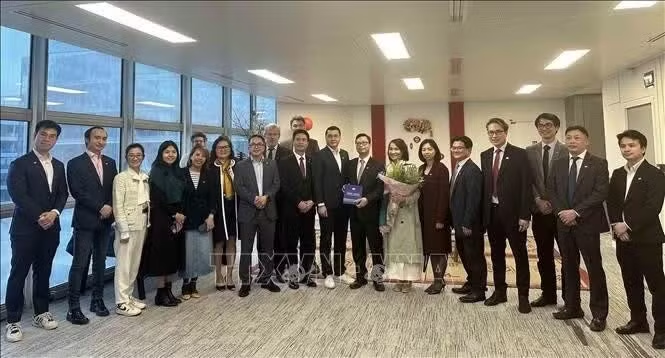
In March 2026, at a working session with FPT’s leadership in France, Vietnamese Ambassador to France Trinh Duc Hai praised FPT Corporation’s expansion in the French market, affirming national pride and the value of Vietnamese intellect.
From 2026, FPT has oriented itself towards shifting from being primarily an information technology services provider to becoming a technology innovation company, increasing investment in research and gradually mastering strategic technologies.
Under its strategy from 2026, the corporation has identified areas including artificial intelligence (AI), Quantum AI and cybersecurity, unmanned aerial vehicles (UAVs), railway technology, cybersecurity, and data, while continuing to invest in semiconductors.
In some fields, the investment process has already begun to produce concrete results. In artificial intelligence, FPT is developing computing infrastructure, research teams, models, and intellectual assets through both domestic investment and cooperation with international organisations. In semiconductors, the company has designed power chip lines and brought commercial chips to the Japanese market, while expanding into testing and packaging.
In newer fields such as UAVs, railway technology, and cybersecurity, FPT is building dedicated units, research teams, and partner networks. Of particular note is the changing role of the business: from receiving and deploying technologies to becoming more deeply involved in research, design, product development, and higher-value-added stages.
Accessing global science and technology to build domestic capacity
From this perspective, international cooperation is no longer simply a matter of businesses gaining an additional market or partner. More importantly, it is about how deeply businesses can move along the value chain: from receiving and deploying technologies to conducting research, designing, and developing products, and gradually building capabilities that can continue to grow through domestic expertise.
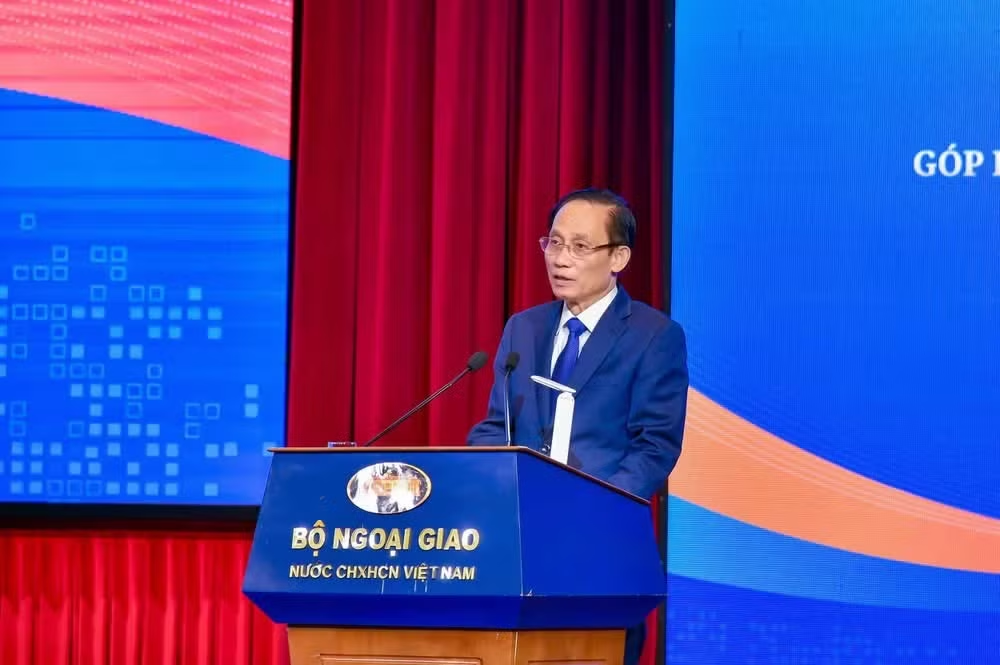
Minister of Foreign Affairs Le Hoai Trung speaks at the session on science and technology diplomacy contributing to building national development capacity. (Photo: Thanh Long)
As part of the 33rd Diplomatic Conference held in Ha Noi in August, the Ministry of Foreign Affairs organised a session on science and technology diplomacy contributing to building national development capacity.
At the session, Minister of Foreign Affairs Le Hoai Trung emphasised that science and technology diplomacy and innovation are becoming an important pillar of development-oriented diplomacy, playing a role in opening the way, connecting stakeholders, and creating favourable international conditions to enhance science, technology, and innovation capacity, promote mastery of strategic technologies, ensure technological security, and raise the national standing in the new technological order.
General Secretary and President To Lam’s State visit to Russia and official visit to France come at a notable point in Viet Nam’s foreign relations. As science, technology, and innovation are becoming increasingly important elements of cooperation with international partners, Viet Nam has greater opportunities to access resources that a country cannot create on its own within a short period: global knowledge, expert networks, new technologies, innovation ecosystems, and international markets.
These resources can become an advantage only when Viet Nam has the capacity to absorb and transform them into domestic strength. Diplomacy can open the door to global knowledge and technology networks. But the ability to walk through that door, absorb what is available, and turn international connections into its own capabilities will ultimately determine the long-term value of cooperation.