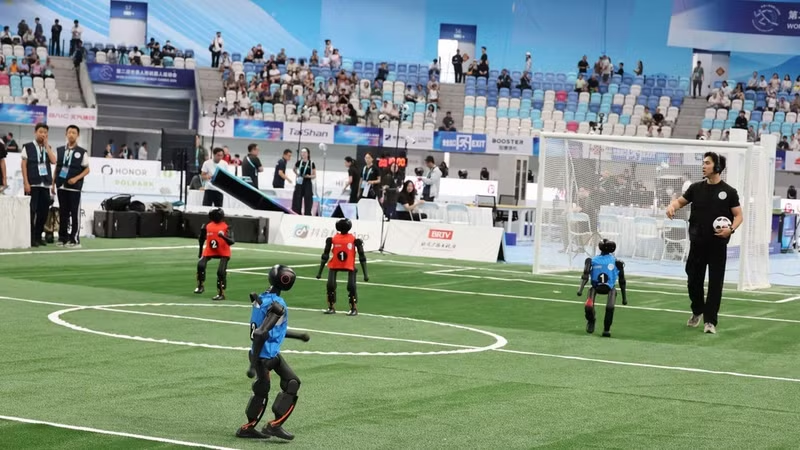
This year’s event attracted 666 teams from 16 countries across six continents, with 2,056 robots competing across 51 categories and 1,301 matches. The total number of participating teams increased by 138% compared with the same period last year, while the number of robots quadrupled. International teams included robot teams from the US, Germany and Japan. Notably, Brazil brought together five teams that had previously won the RoboCup World Robot Football Championship to form a national team for the event.
Jiang Guangzhi, Head of the Beijing Municipal Bureau of Economy and Information Technology and Deputy Executive Director of the Organising Committee of the World Humanoid Robot Games, said newly added high-intensity competitive events such as long jump, weightlifting, tug of war and table tennis are all rigorous tests of robots’ structures and core components.
This year’s competition expanded its scope to real-world environments, including industry, hotels, homes and logistics. In addition, special contests were set up to test dexterity, such as assembly and loading, house cleaning, firefighting and book sorting. All were carefully designed for “tiring, dirty, dangerous and difficult” situations. Dexterity contests such as weighing flour, picking up beans with tweezers and opening bottles tested fine fingertip dexterity, requiring good vision, firm gripping ability and precise execution.
Jiang said that once robots master these “last-mile” skills, they will “receive orders as soon as they win medals and enter construction sites as soon as they leave the arena”. In addition, some competition rules formed through these events will gradually become practical technical standards, thereby achieving the substantive goal of “setting standards through competitions and promoting production through standards”.
According to the organisers, in the qualifying round of the 100m running event on August 22, a robot from “Team Tianzhuo” crossed the finish line first in 9.39 seconds, surpassing the men’s 100m world record of 9.58 seconds held by Jamaican star Usain Bolt.
Earlier, at the Beijing Yizhuang Half Marathon and Humanoid Robot Half Marathon in April 2026, a humanoid robot won with an actual time of 50 minutes and 26 seconds, beating the men’s half-marathon world record of 57 minutes and 20 seconds set by Ugandan athlete Kiprimo at the Lisbon Half Marathon in March 2026.
The report “Development of the Humanoid Robot Industry in 2026” show that in the first half of 2026, China’s shipments of humanoid robots exceeded 40,000 units, raising its global market share to 97%.