On September 2, 1945, in the Declaration of Independence that proclaimed the birth of the Democratic Republic of Viet Nam, President Ho Chi Minh affirmed a timeless truth: “Vietnam has the right to be a free and independent country and in fact it is so already.”
More than eight decades later, that sacred independence has become a firm foundation for the nation to embark on a new journey: from safeguarding sovereignty and territorial integrity to building outstanding development capacity; from efforts to escape poverty to the aspiration to become a developed, high-income, and strong nation by 2045.
Having endured wars, embargoes, and poverty, the renovation process over nearly four decades has created a historic turning point: taking the size of the economy beyond 500 billion USD, expanding the country’s extensive multilateral diplomatic network, and participating more deeply in global value chains. However, the greatest significance of the renovation lies not only in GDP growth figures or import-export turnover.
Behind these figures is a fundamental change in the prospects of the Vietnamese people: from worrying about food and clothing to demand of a better quality of life, a liberal education, and a fair and civilised society. The initial phase of renovation has taken Viet Nam a long way; the vital problem today is how to help the country rise higher and stand firmer in the face of global upheavals.
From unlocking productive forces to unleashing creative capacity
In 1986, renovation unleashed productive forces that had been constrained by the bureaucratic, state-subsidised mechanism. However, the 21st century enters, traditional advantages such as low-cost labour, the exploitation of raw resources, and land incentives to attract foreign capital are gradually reaching their limits. The advantages of the past do not automatically become the strengths of the future.
The second phase of renovation must therefore be a revolution in the quality of growth. If the previous phase was about “unlocking productive forces”, the current phase must “unlock creative and intellectual capacity”. New growth drivers can no longer rely on intensive use of resources, but must come from science and technology, digital data, artificial intelligence (AI), the semiconductor industry, and the green transition.
A country cannot remain at the bottom of global value chains, confined to processing and assembly. FDI attraction must undergo a substantive shift: competing through superior institutions, highly skilled human resources, modern logistics infrastructure, and an innovation ecosystem, rather than relying on low costs.
Development-oriented institutions as a core competitive advantage
If science and technology are the driving force for breakthroughs, institutions are the tracks and launch pad that allow this driving force to operate smoothly. Businesses cannot make breakthroughs if they are held back by cumbersome administrative procedures, overlapping regulations, a fear of making mistakes, and shifting responsibility within the implementation system.
Scientists, too, cannot commercialise inventions if the path from the laboratory to the market is surrounded by administrative barriers. Institutional reform is not simply about streamlining the organisational apparatus; its ultimate goal is to unleash all social resources, reduce compliance costs, and encourage innovative entrepreneurship.
A development-oriented and effective state does not replace the market or society, but it establishes a safe and transparent framework in which the potential of people and businesses can flourish. The success of institutional reform must be measured through very specific questions: Can businesses reduce their costs? Are policy decisions made more quickly, accurately and transparently? Are people genuinely receiving better public services?
Domestic businesses: Pillars of an autonomous economy
A country cannot have an independent and self-reliant economy without a strong national business community.
The development of the private economic sector cannot depend solely on short-term preferential policies. It requires a transparent and stable business environment and protection of property rights so that entrepreneurs can confidently make long-term investments in research and development (R&D).
The strategic goal is to build Vietnamese corporations and businesses with management capabilities that meet international standards, mastery of core technologies, strong brands, and the ability to compete on an equal footing internationally. Economic self-reliance begins with mastering technology and domestic supply chains.
Flexibility in diplomacy
In a multipolar, complex and interdependent world, the challenge of foreign affairs is not about choosing sides but about steadfastly protecting national interests on the basis of international law.
Experience from countries neighbouring major powers shows that a medium- or small-sized country cannot change its geographical position, but it can significantly expand its strategic space by proactively pursuing multilateralisation and diversifying its trade, technology, and supply-chain partners.
Maintaining stable and balanced relations with major powers, including the US and China, while deepening cooperation with ASEAN, Japan, the Republic of Korea, Europe, India, and others, is the optimal way to minimise the risks of dependence.
This is the profound philosophy behind Viet Nam’s “bamboo diplomacy”: firm roots, a strong trunk and flexible branches. It means being flexible and adaptable in tactics while remaining steadfast in the principles of independence, sovereignty, and territorial integrity. And the deepest roots enabling the bamboo to withstand every geopolitical storm are economic internal strength and the unity of the entire people.
The people’s will and border defence begin in schools
Ultimately, the strength of a nation does not lie in the glamour of high-rise buildings or emotionless statistics but in the quality of life and development opportunities of every individual.
A nation is its people. A poor child in a remote area gaining access to quality education; a household escaping poverty sustainably; a young person equipped with digital skills to enter the wider world — all are pieces that make up national capacity.
From this perspective, modern schools built in border and island areas have significance far beyond that of ordinary public infrastructure. They are projects reflecting the people’s support and the country’s sovereignty. A child from an ethnic minority community who receives a full education and has knowledge, skills, and confidence in the future is a “living landmark” protecting the nation’s frontier.
The border is most firmly protected by the prosperity of local communities and their development. Investing in the education of younger generations is a fundamental investment that yields the greatest long-term dividends for the enduring vitality of the nation.
Ecological security and resilience
Alongside building up human resources, a country that wishes to stand firm over the long term must also ensure ecological security in the face of unpredictable natural changes. Climate change, rising sea levels, droughts, landslides, and saltwater intrusion are no longer distant threats but are occurring every day, threatening to erase economic achievements accumulated over decades.
A mindset of sustainable development requires a fundamental shift: from exhausting natural resources to pursuing a circular approach and conserving nature; from the mindset of “fighting nature” to the philosophy of “living in harmony with nature”, adapting intelligently and proactively learning to live with risks. Green economic development and the transition to clean energy are not merely international commitments but survival imperatives to ensure water security, food security, and safe living spaces for future generations.
Vision 2045: Action today shapes the future
Twenty years towards the historic milestone of 2045 is not a long period. The aspiration to achieve a "dragon-like" transformation cannot stop at statements or resolutions; it must be realised through concrete action and discipline in implementation every day and every hour.
The greatest challenge today is not that we lack clear objectives, but that we must accelerate the transformation of those objectives into results. A double-digit growth target leaves no room for slow decision-making. The aspiration to move up the high-tech ladder cannot go hand in hand with an education system that is slow to reform.
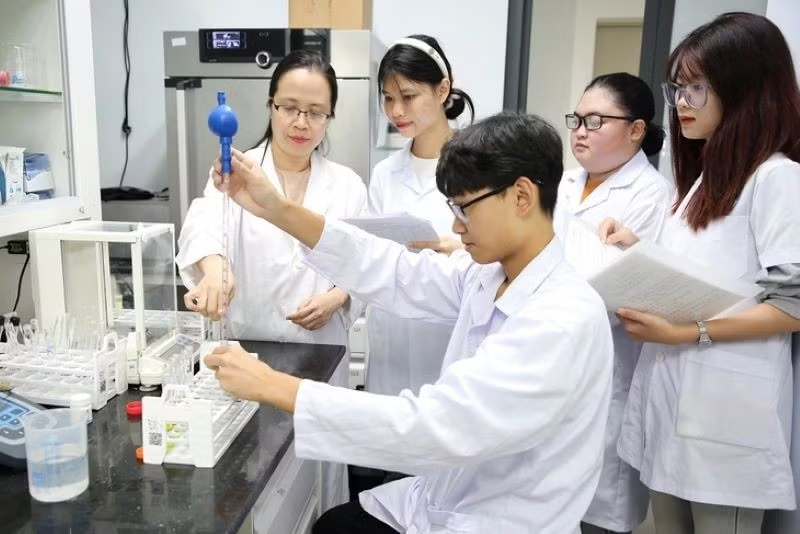
Every policy that removes a bottleneck, every business that overcomes difficulties and reaches out to the wider world, every laboratory that produces a practically valuable product, and every school in the highlands that keeps its lights on for learning are concrete building blocks for creating the glory of 2045.
Conclusion
In the autumn of 1945, the Vietnamese people rose up to win independence and freedom. Today, as we stand on the threshold of a new era, the historic mission entrusted to us is to transform that independence into real national strength and build a prosperous, civilised, and happy country.
Amid the unpredictable changes of the times, we cannot choose the direction of the winds, but we can determine the depth of our roots and the strength of our sails. With an open and development-oriented institutional framework, a self-reliant economy, endogenous strength from the great national unity, and Vietnamese intellect, we have every capacity to move towards the future on our own feet. This is the inevitable path: from independence to self-reliance, from self-reliance to strength.