Digital transformation is paving the way — shifting from monitoring and responding to incidents towards proactively identifying risks, optimising resources, and enhancing system adaptability.
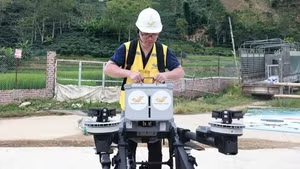
At An Duong Water Plant in Hai Phong, digital transformation is now woven into daily operations, from monitoring water quality and equipment to operating the system, controlling pressure, and managing energy use.
Covering nearly 9 hectares, the plant is currently being expanded to a capacity of 200,000 cubic metres per day, prioritising automation and modernisation solutions to improve operational accuracy, reliability, and efficiency.
Plant management noted that automation has eased operator workloads, improved system monitoring, and cut energy consumption and maintenance costs by about 10%.
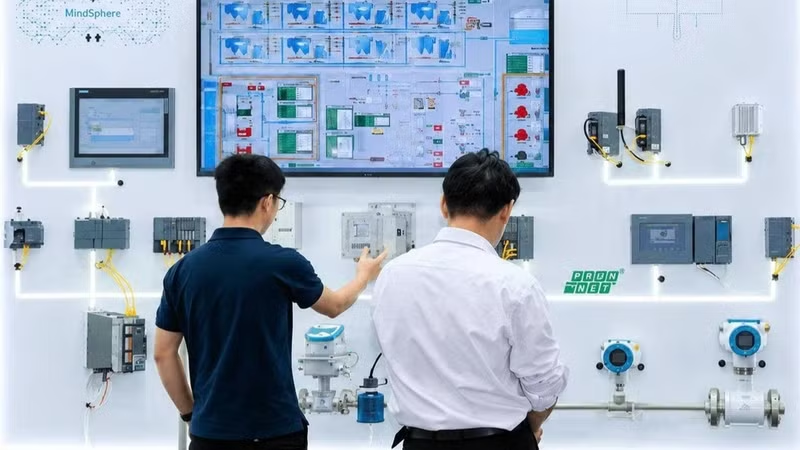
Through its SCADA (Supervisory Control and Data Acquisition) system, the plant can monitor and collect data, and detect abnormalities in the water supply for swift intervention.
In addition, its online pressure map and GIS (Geographic Information System) have been upgraded to streamline network management.
Data from the system is also shared with customers, enabling them to monitor water pressure in their residential areas.
Behind these changes is an operational approach that anchored in data. Information on water sources, equipment, pressure, and energy is collected continuously, empowering operators to seamlessly fine-tune the plant’s operations.
Ngo Minh Huy, Head of the Solutions Department at Minh Khang Mechatronics JSC, which has implemented automation solutions for An Duong Water Plant and more than 30 water plants nationwide, said the core objective was to digitise processes, reduce reliance on manual operations, and optimise production.
He noted that many processes previously relied largely on manpower and operators’ experience. With digital equipment and solutions put into operation, machines can now perform many tasks autonomously, thereby reducing the pressure on operators and improving production stability.
At automated plants, the number of operators per shift can plummet from around 10–20 to just 2–5, depending on the plant’s size and level of automation. Real-time data collection is also key to tackling energy and maintenance challenges.
However, at the sector-wide level, the current challenge is how to connect and share data, and turning it into a driver for executive decision-making.
According to Deputy Minister of Construction Bui Xuan Dung, amid these changes, the water sector needs to gradually shift from reactive incident response to risk management, and from standalone investment to the development of integrated and interconnected systems.
Digital transformation needs to be directly linked to asset management, forecasting water demand, controlling water losses, optimising energy use, monitoring water quality, and providing early warnings of incidents.
Sharing this view, Nguyen Ngoc Diep, Chairman of the Viet Nam Water Supply and Sewerage Association, said the essence of digital transformation did not lie in investing in more software or equipment, but in using data to manage operations more effectively, make earlier forecasts, reduce water losses, save energy, control water quality, and improve public services.
For data to truly become a management tool, a prerequisite is to standardise and establish interoperability between systems.
Deputy Minister Bui Xuan Dung stressed that, alongside the application of technology, particular attention must be paid to connectivity, data sharing, information security, and cybersecurity.
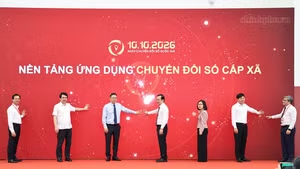
In 2026, the Ministry of Construction issued the Data Architecture Framework, the Data Governance and Management Framework, and the Common Data Dictionary for the construction sector, Version 1.0, creating a foundation for gradually standardising, connecting, sharing, and exploiting data.
At the same time, the Ministry of Construction is studying and finalising policies and legislation on water supply and drainage.
Data-driven management must also be linked to the adaptability of infrastructure. This requirement needs to be integrated throughout the process, from planning, investment preparation, design, and construction to management and operation.
In water supply, particular attention should be paid to water-source security, redundancy, and the ability to connect different systems. At the same time, mechanisms for mobilising social resources should continue to be improved, while the role of the private sector, public-private partnerships (PPPs), and green finance should be promoted.
When data is collected, standardised, and connected, the water sector will have a stronger basis for shifting from responding to incidents to proactively identifying risks, from managing individual stages to taking a holistic view of the entire system, and from there using resources more efficiently.
As water resources and urban infrastructure come under growing pressure, this is not simply a matter of bringing technology into factories. Rather, it represents a shift in management practices and an enhancement of the adaptability of the water sector as a whole.